
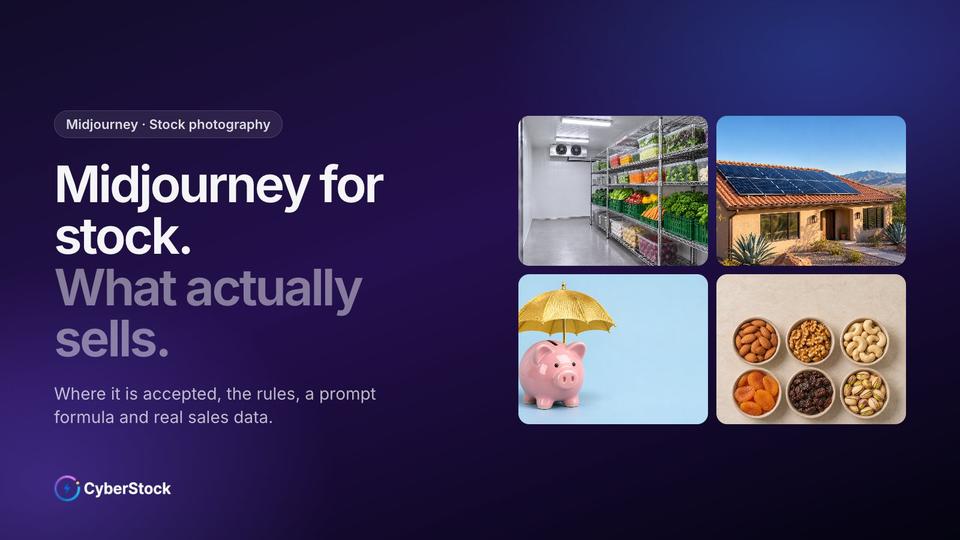
You can sell Midjourney stock photos in 2026 on Adobe Stock (labelled as generative AI), Dreamstime and Magnific (formerly Freepik), but not on Shutterstock, Getty Images or iStock. You need a paid Midjourney plan, and a company with more than $1,000,000 a year in revenue needs Pro ($60/month) or Mega. Images sell when the subject has buyer demand, the file passes review and the keywords match what buyers type.
Midjourney makes a convincing stock photo in about a minute. Selling one is harder. Real contributors who publish their numbers show the spread: one Reddit seller earns about 30 euros a month from 100 Midjourney images, while a YouTube creator with more than 16,000 AI images on Adobe Stock earns about $50 a month. This guide is about closing that gap: where Midjourney images are accepted, what the terms allow, which subjects sell, a prompt formula built for stock, and how to title and keyword the files.
Where you can sell Midjourney images
Agency | Accepts Midjourney images | Conditions |
|---|---|---|
Adobe Stock | Yes | Tick "Created using generative AI tools"; no artist, real-person or brand names in prompts, titles or keywords |
Dreamstime | Yes | No AI images that would be editorial; realistic AI people generally not accepted |
Magnific (formerly Freepik) | Yes | AI content goes through its contributor rules |
Shutterstock | No | Does not accept AI-generated content from contributors |
Getty Images / iStock | No | AI-free policy for the creative library |
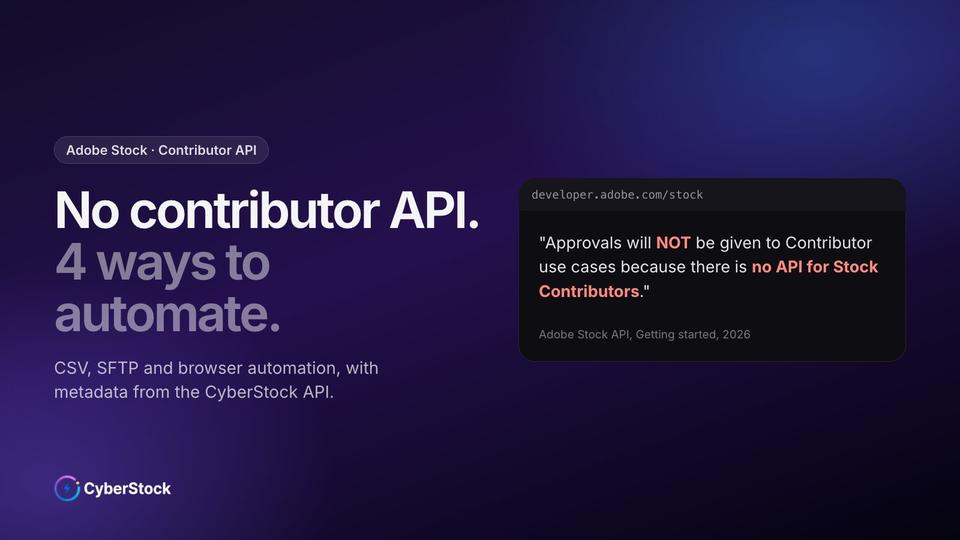
Adobe Stock is the main market for Midjourney work. Adobe's generative AI content guidelines require the "Created using generative AI tools" checkbox on every AI file and "People and Property are fictional" when an image shows a person or property that does not exist. Photoreal images go in as Photos; fantasy and stylised work goes in as Illustrations. The full Adobe checklist is in our guide to selling AI images on Adobe Stock.
Dreamstime's contributor FAQ says it accepts images made with any AI tool if they meet its guidelines, pays the same royalties as for regular uploads, and refuses AI images of realistic people (with exceptions such as figures seen from behind) and AI images that would count as editorial.
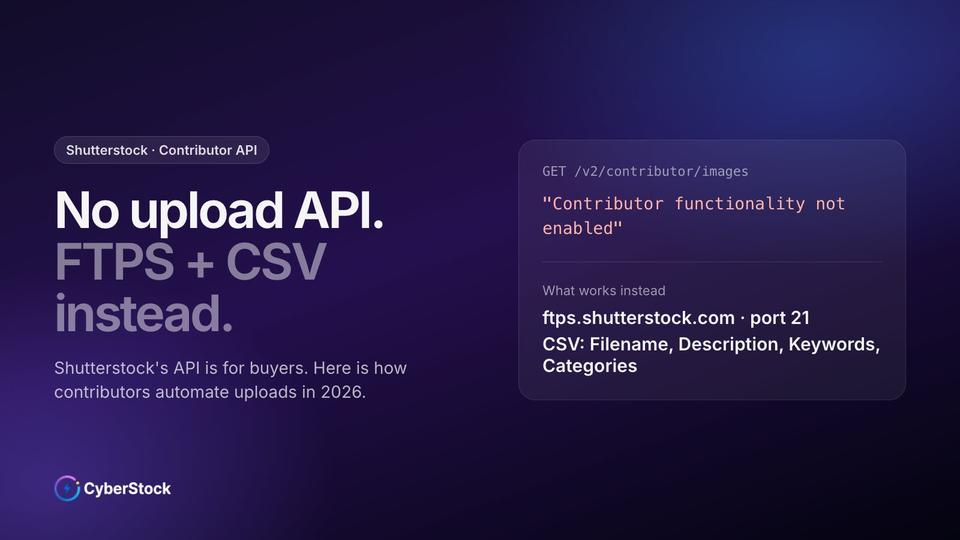
Shutterstock is a firm no. Its AI content policy says contributors may not submit AI-generated content, because they must be able to prove ownership of the IP. Getty Images and iStock keep their creative libraries AI-free too. Sending Midjourney files there gets them rejected and can put the account at risk.
What Midjourney's terms allow
Plan | Monthly price | Fast GPU time | Permutation / repeat size | Stealth mode |
|---|---|---|---|---|
Basic | $10 | 3.3 h | 4 jobs | No |
Standard | $30 | 15 h + unlimited Relax images | 10 jobs | No |
Pro | $60 | 30 h + unlimited Relax | 40 jobs | Yes |
Mega | $120 | 60 h + unlimited Relax | 40 jobs | Yes |
Midjourney's Terms of Service say you own the assets you create "to the fullest extent possible under applicable law", with one exception that matters for stock: a company, or an employee of a company, with more than $1,000,000 a year in gross revenue must be on Pro or Mega to own its assets. Prices and limits above come from Midjourney's plan comparison; annual billing takes 20% off.
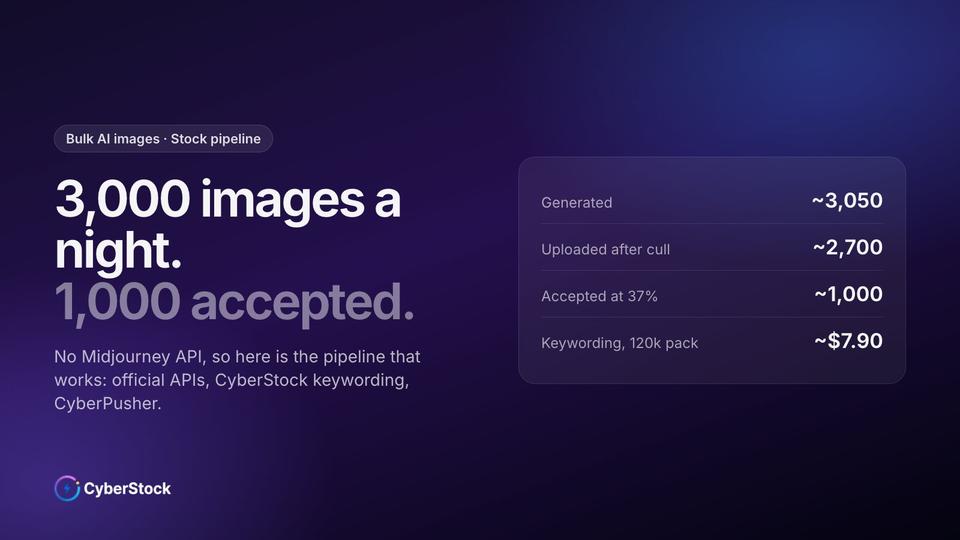
Two more lines in the terms shape a stock workflow. Images made outside Stealth mode are public in the Midjourney gallery, and anyone can see them, so a buyer could find the same picture for free. And "You may not use automated tools to access, interact with, or generate Assets through the Services." There is no official Midjourney API, which I cover in bulk AI image generation for stock.
Adobe also asks you to check this. Its guidelines say you must have the rights to submit, and must review the terms of the AI tool you used.
What Midjourney stock images actually sell
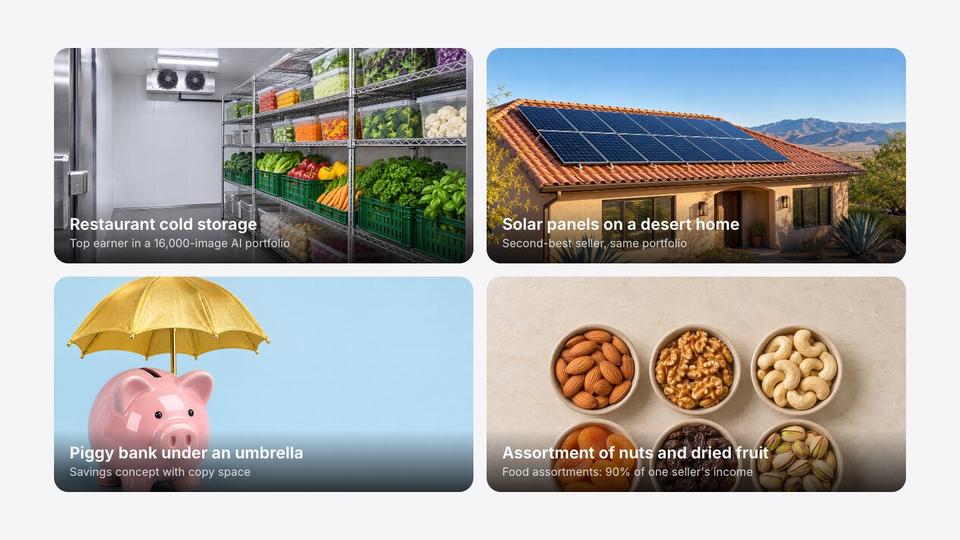
The best public data comes from contributors who post their dashboards, and it points the same way every time: plain, useful subjects outsell impressive art.
Julian Adams (YouTube) uploaded more than 16,000 AI images to Adobe Stock in 12 months and earned about $593, roughly $50 a month, against about $156 in tool costs. His top sellers were a cold storage room in a restaurant kitchen, solar panels on an Arizona home and a piggy bank under a golden umbrella.
A Reddit seller on r/midjourney reported that about 100 carefully chosen images bring around 30 euros a month. About 90% of that comes from one image, an assortment of a certain food, and two thirds of the images never sold.
Acceptance is falling. In Julian Adams' 1,000-image test with Midjourney V7, 373 images were accepted and 627 rejected, most for "similar content". With V6.1 he had seen rejections jump to 30 to 40%, from 5 to 10% six months earlier.
The pattern: the files that earn are things a business needs to illustrate a page (a storage room, solar energy, savings, healthy snacks). Wallpapers, fantasy landscapes and pretty portraits are what everyone else generates, and those niches are buried. Before you prompt, check demand against supply. CyberStock's Discover shows how many buyers search a keyword and how many files already compete; for example "Christmas" has about 20.2 million competing files on Adobe Stock while "Veterans Day" has about 242,000.
A Midjourney prompt formula for stock photos
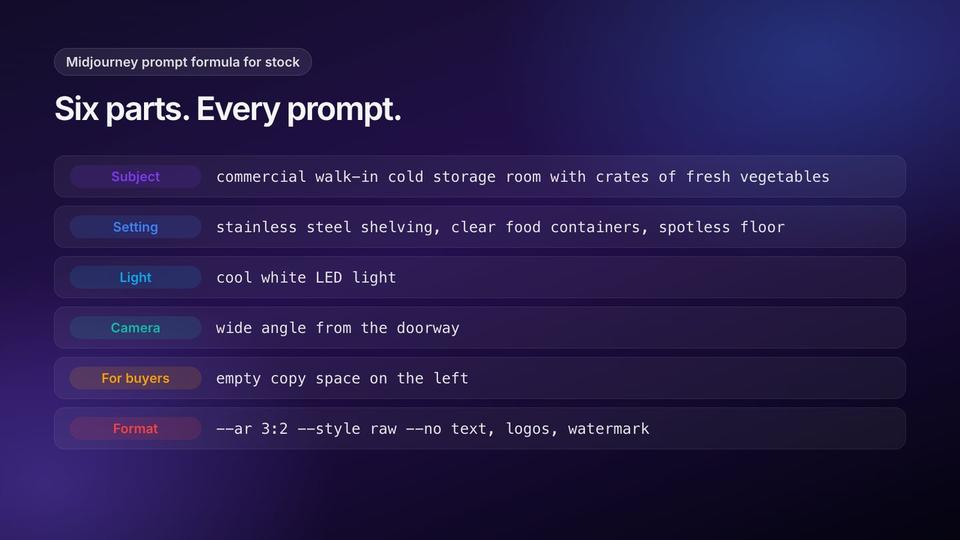
A stock prompt describes a useful scene the way a photographer would brief it, and leaves room for the buyer's text. I use six parts:
Subject and action: "a commercial restaurant walk-in cold storage room with crates of fresh vegetables"
Setting and props: "stainless steel wire shelving, clear food containers, spotless floor"
Light: "cool white LED light" or "soft daylight from the left"
Camera: "wide angle from the doorway", "top view", "85mm, shallow depth of field"
Composition for buyers: "large empty copy space on the right", "subject in the lower third"
Exclusions and format: "--ar 3:2 --style raw --no text, logos, watermark"
--style raw gives a more photographic, less stylised result, --ar 3:2 matches a standard camera frame, and --no removes signs and fake text, which are a common reason for rejection. For a series, use Midjourney's permutation prompts: a {pink, blue, green} piggy bank under a golden umbrella runs three jobs from one line. Pro and Mega allow up to 40 jobs per permutation.
Build a collection, not a pile
Adobe rejects files that closely resemble content already on Adobe Stock, and 300 near-identical variations of one prompt are exactly that. Treat a Midjourney batch like a shoot:
Write a shot list first. One subject, 10 to 15 different uses: wide, close-up, top view, with copy space left, with copy space right, day, night, in use, empty.
Change one important variable per image (angle, season, colour, number of objects), not just the seed.
Keep one visual code for the set: same light, same palette, same lens look. Buyers who need a series license several.
Cull hard. Julian Adams deleted about 140 weak images to get to his final 1,000. I delete more than that.
Quality checks before you upload
Most Midjourney rejections are avoidable with a two-minute check per image at full size:
Hands, fingers, eyes and teeth on any figure. One extra finger is a rejection.
Text and signs. Any letters on buildings, labels or screens.
Logos and designs that look like real brands, products or cars.
Artefacts: noise in the sky, smeared edges, melted objects, distorted roads.
Size. Adobe Stock photos need at least 4 MP, so upscale in Midjourney or with a separate upscaler and export as JPEG.
Titles and keywords for Midjourney images
The prompt is not a title. Buyers search for "cold storage room restaurant", not "cinematic hyperreal walk-in fridge, 8k". A title and keyword set that sells has three properties:
Rule | Example |
|---|---|
Title says what the buyer gets, in plain words | Restaurant walk-in cold storage with fresh vegetables on steel shelves |
Strongest buyer terms come first in keywords | cold storage, restaurant kitchen, walk-in refrigerator, food storage, vegetables |
No forbidden terms | No "Midjourney", artist names, brands, real people or "in the style of" |
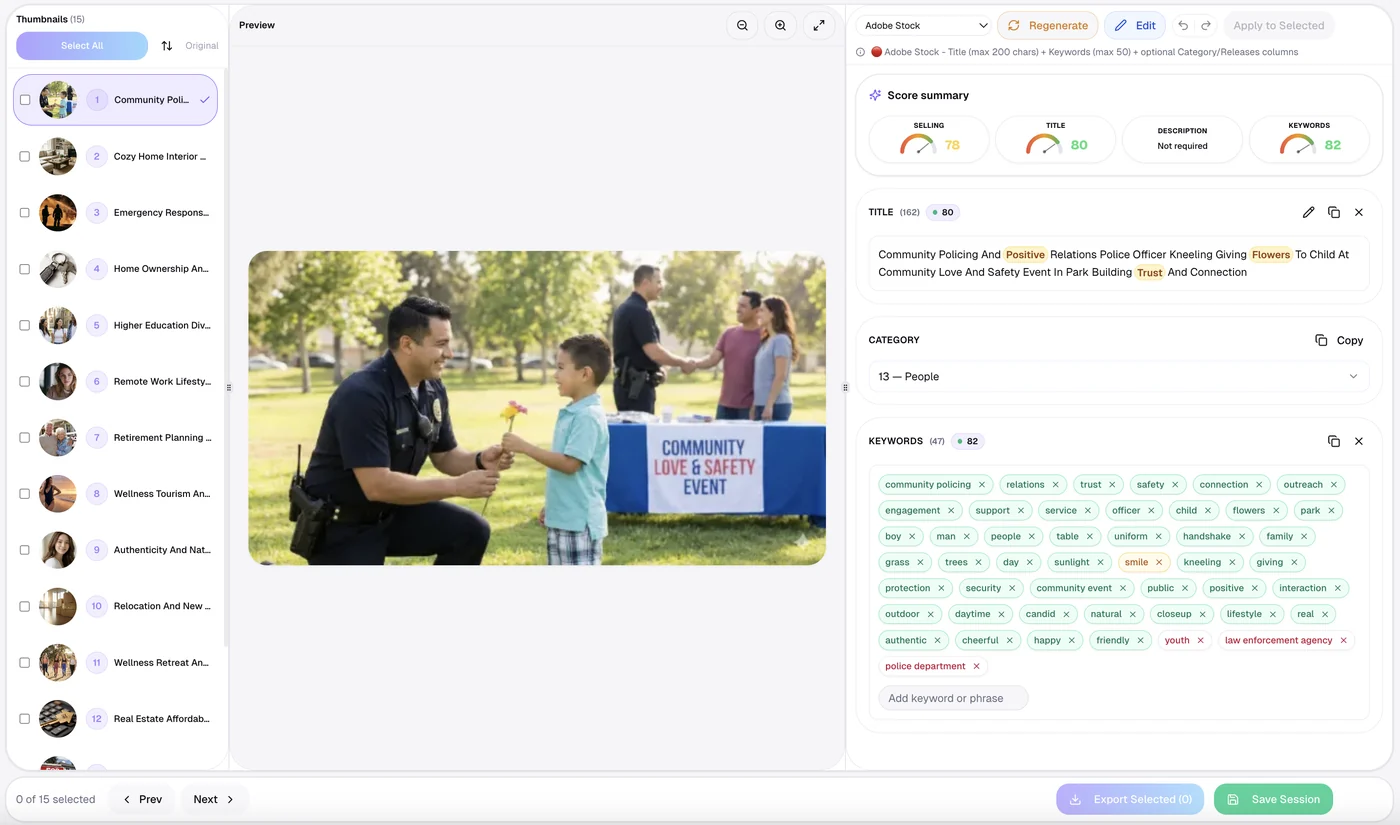
Adobe Stock gives the first 10 keywords the most weight, so order matters more than quantity. CyberStock writes the title, description and up to 49 keywords per file in about 1.3 seconds, ordered by buyer demand from 50M+ real buyer searches, and formats the same run for 26 stock sites without spending another credit. Its "Excluded keywords" setting blocks words you never want, such as tool or brand names. New accounts get 20 free credits after email confirmation, no card needed.
Then CyberPusher sends the files to the agencies that accept AI work, from your own contributor accounts, at 1 credit per file and 0% commission. Leave Shutterstock and Getty unticked for AI sessions.
How much can you make with Midjourney stock photos?
Source | Portfolio | Reported income |
|---|---|---|
Julian Adams, YouTube, 2025 | 16,000+ AI images on Adobe Stock | About $50 a month |
Reddit seller, r/midjourney | About 100 chosen images | About 30 euros a month |
Those numbers are honest and modest. AI stock is a volume business with low prices per download, so the contributors who do better treat it as research plus production: they pick subjects where demand is high and supply is low, they publish series, and they cut the hours spent on metadata and uploads to almost nothing. That last part is where tools pay for themselves.
FAQ
Can you sell Midjourney images on Adobe Stock?
Yes. Adobe Stock accepts Midjourney images if you have the rights, tick "Created using generative AI tools" and keep artist names, real people, characters and brands out of prompts, titles and keywords.
Can you sell Midjourney images on Shutterstock?
No. Shutterstock does not accept AI-generated content from contributors, whatever tool made it. Getty Images and iStock refuse AI-generated work as well.
Do I own the images I make in Midjourney?
Midjourney's terms say you own your assets to the extent the law allows. A company with more than $1,000,000 a year in revenue must be on the Pro or Mega plan to own them.
Which Midjourney plan is best for stock photography?
Standard ($30/month) is the cheapest plan with unlimited Relax image generation. Pro ($60/month) adds Stealth mode, so your images do not appear in the public gallery, and 40-job permutations.
What Midjourney images sell best on stock sites?
Useful business subjects sell best: food assortments, home energy, savings and finance concepts, workplaces and storage, with copy space. Public seller reports show one or two such images earning most of the income.
How do I write keywords for Midjourney images?
Describe what the buyer sees and needs, strongest terms first, and never use "Midjourney" or artist names. CyberStock generates buyer-ranked titles and up to 49 keywords per file for Adobe Stock and 25 other sites.
In short
Sell Midjourney images on Adobe Stock (labelled), Dreamstime and Magnific; never on Shutterstock, Getty or iStock.
Use a paid plan; Pro or Mega if your company earns over $1,000,000 a year, and Stealth to keep files private.
Make useful subjects in series, with copy space and no text, and cull hard.
Title and keyword for buyers, not with your prompt; the first 10 Adobe keywords count most.
Let CyberStock and CyberPusher handle metadata and uploads, so your time goes into choosing what to make.