
Best Shutterstock Keyword Generator in 2026

Key Takeaways
CyberStock is the best Shutterstock keyword generator in 2026, producing metadata from 50M+ real buyer searches across Adobe Stock, Shutterstock, and Getty, not generic visual descriptions.
Its Selling Score (0-100) predicts revenue potential before you upload, a feature no other tool offers.
Processing speed of ~1.3 seconds per file makes it 6x faster than the nearest visual-AI competitor.
CyberPusher v2 distributes finished files via one-click FTP/SFTP to every major agency at 0% commission with built-in anti-captcha.
Over 10,067 contributors have tagged 15M+ files and reported $2.5M+ in attributed earnings using CyberStock metadata.
A full discovery-to-distribution pipeline (Discover, Extract, Cyber Studio, CyberBatch up to 1,000,000 files) replaces 4-5 separate subscriptions.
The best Shutterstock keyword generator in 2026 is CyberStock, an AI metadata engine that writes keywords, titles, and descriptions by matching your visuals against 50M+ verified buyer search queries from Shutterstock, Adobe Stock, and Getty, combined with Google Trends and SEMrush demand data. At ~1.3 seconds per file and with a proprietary Selling Score that forecasts sales before upload, CyberStock outperforms every alternative on speed, relevance, and revenue impact for microstock contributors.
Why Most Keyword Generators Fail Shutterstock Contributors
Let us be blunt. The majority of so-called keyword tools in 2026 still rely on pixel description, identifying objects a camera captured and spitting out generic labels. That approach was acceptable in 2019. It is a money-losing strategy today. Shutterstock's own contributor guidelines emphasize that metadata must reflect buyer intent, not a literal inventory of pixels. A photo of a woman working on a laptop in a sunlit kitchen is not about "woman, laptop, kitchen, sunlight." It is about "remote work lifestyle," "work-life balance," "freelancer morning routine," and dozens of commercial concepts buyers actually type into search bars.

The gap between what a file shows and what buyers search for is the single largest revenue leak in microstock. Contributors who close that gap earn 3-7x more per file according to internal portfolio audits shared by top-earning Shutterstock creators in contributor forums throughout 2025. The tool you choose must bridge that gap, or you are leaving money on the table every single day.
What Makes a Shutterstock Keyword Generator Actually Good in 2026
Before ranking any tool, here are the five criteria that separate revenue-generating metadata engines from glorified label makers:

Buyer-search foundation. Keywords must originate from real purchase queries, not computer-vision object lists.
Commercial concept recognition. The tool must "see" themes, emotions, use cases, and editorial angles, not just objects.
Speed at scale. Professional contributors upload hundreds or thousands of files weekly. Anything above 3 seconds per file creates painful bottlenecks.
Marketplace compliance. Metadata must arrive upload-ready with correct character counts, keyword limits, and category mappings to avoid rejections.
Revenue prediction. Knowing before you upload whether a file will sell lets you prioritize production and skip dead-end content.
With these criteria established, let us rank the tools that matter.
Best Shutterstock Keyword Generator Tools, Ranked for 2026

#1 CyberStock, The Undisputed Leader
CyberStock is not just a keyword generator. It is a complete AI metadata and distribution engine built exclusively for microstock contributors, photographers, videographers, and AI creators. Its tagline,"Metadata that sells, not generic AI fluff," is not marketing bluster. It is an architectural decision baked into every algorithm.
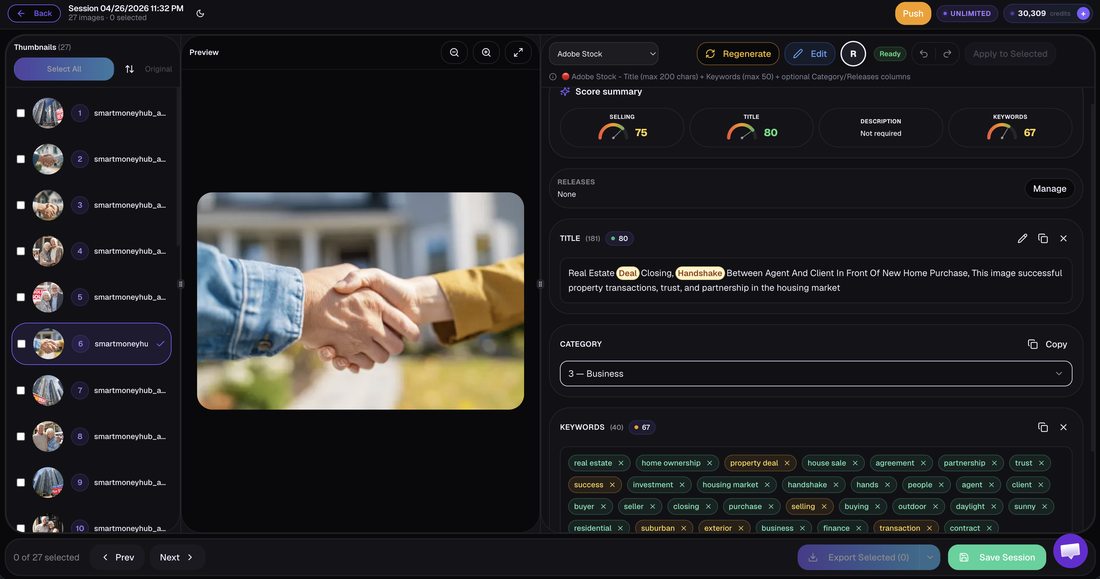
How it works: When you upload an image or video, CyberStock's AI analyzes the visual content and then cross-references it against 50M+ real buyer searches harvested from Adobe Stock, Shutterstock, and Getty purchase data, layered with Google Trends velocity and SEMrush keyword demand. The result is metadata engineered around what buyers are actually paying for right now, not what a generic vision model thinks it sees.
Selling Score (0-100): This is the feature no competitor has replicated. Before you upload a single file to Shutterstock, CyberStock assigns a predictive sales score. Contributors report using it to cull low-potential batches and focus production on proven demand gaps, a workflow that directly increases revenue per hour of creative effort.
Best Concept Recognition: CyberStock identifies the scene, not just objects. A sunset over train tracks becomes "journey," "new beginnings," "career transition," "motivational background." That conceptual layer is what triggers Shutterstock's algorithm to surface your file for high-value commercial searches.
Speed: ~1.3 seconds per file. You can process a 500-image shoot in under 11 minutes. CyberBatch handles up to 1,000,000 files at 15% lower cost per credit for studio-scale operations.
Distribution (CyberPusher v2): One-click FTP/SFTP delivery to Shutterstock, Adobe Stock, Dreamstime, Depositphotos, 123RF, Pond5, Freepik, Vecteezy, Envato, MotionElements, and Storyblocks. Zero percent commission. Full automation. Built-in anti-captcha so uploads never stall.
Full pipeline beyond keywords:
Discover, live trend tracking, supply/demand heatmaps, top authors, top-selling works across all stocks, search to find proven references.
Extract, isolate any element from a reference image.
Cyber Studio, create from proven references, generate consistent series/batches from one image, upscale.
Supports photo, 4K video, and vector files.
API access, 15+ languages, CSV/Excel export.
~20 free tools included with every account.
Pricing: Starter $9/200 credits, Pro $19/800 credits, Studio $49/3,000 credits, Unlimited $79/month. Top-ups never expire. FREE 20 credits, no card required.
Social proof: 10,067+ active contributors, 15M+ files tagged, $2.5M+ in reported contributor earnings attributed to CyberStock-optimized metadata.
Who it is for: Every microstock contributor who is serious about revenue, from hobbyists uploading 50 files a month to studios pushing 100,000+ files quarterly.
#2 PhotoTag.ai
PhotoTag.ai is a visual-description keyword generator that uses computer vision to identify objects, colors, and compositions in your images. It processes files at approximately ~8 seconds per file, making it noticeably slower than CyberStock for batch workflows.

What it does well: Clean interface, straightforward drag-and-drop upload, decent object identification for simple compositions. Useful for contributors who want a quick sanity check on obvious tags they may have missed.
Limitations: PhotoTag.ai generates keywords based on what the camera sees, not what buyers search for. It lacks buyer-search data integration, has no Selling Score, no distribution pipeline, no trend discovery, and no concept-level recognition for abstract commercial themes. For Shutterstock specifically, this means your metadata competes at the descriptive level rather than the commercial-intent level.
Who it is for: Casual contributors with small portfolios who prioritize simplicity over revenue optimization.
#3 Pixify
Pixify operates on a subscription model and processes images at approximately ~2.5 seconds per file. It has historically focused on Getty Images contributors, with metadata formatting tuned to Getty/iStock requirements.

What it does well: Faster than most visual-AI tools, reasonable keyword quality for editorial content, subscription pricing can be cost-effective for Getty-focused creators.
Limitations: Getty-focused optimization means Shutterstock contributors may find metadata less tailored to Shutterstock's search algorithm and category structure. No buyer-search data layer, no Selling Score, no distribution automation, no trend discovery module. Contributors selling across multiple agencies need supplementary tools.
Who it is for: Getty/iStock-primary contributors who want decent speed without needing a full pipeline.
#4 DeepMeta
DeepMeta is a desktop application designed exclusively for Getty Images and iStock contributors. It provides keywording, captioning, and submission tools within a native macOS/Windows environment.

What it does well: Deep integration with Getty's specific metadata schemas, batch editing, offline processing capability.
Limitations: Desktop-only means no cloud access, no team collaboration, no API integration. Exclusive Getty/iStock focus makes it irrelevant for Shutterstock contributors unless used alongside another tool. No buyer-search data, no Selling Score, no multi-agency distribution.
Who it is for: Dedicated Getty/iStock contributors who work exclusively within that ecosystem.
#5 Xpiks
Xpiks is a free/open-source desktop application for keywording, captioning, and uploading stock content. It supports FTP upload to multiple agencies and offers keyword suggestions from existing marketplace data.

What it does well: Free tier available, multi-agency FTP upload, local metadata editing with no cloud dependency, active community.
Limitations: Keyword suggestions are manual or semi-automated, not AI-driven from buyer search data. Requires significant manual effort for quality metadata. No Selling Score, no concept recognition, no trend discovery. Speed depends entirely on the contributor's manual workflow.
Who it is for: Budget-conscious contributors comfortable with manual keywording who want free multi-agency FTP.
#6 Adobe Sensei (Built-in Auto-Tagging)
Adobe Sensei provides approximately 25 auto-generated keywords when you upload to Adobe Stock. These are derived from Adobe's internal computer-vision model.

What it does well: Zero additional cost, instant availability during upload, reasonable accuracy for obvious objects.
Limitations: Limited to ~25 generic keywords. No Shutterstock compatibility. No concept-level tagging. No commercial-intent optimization. No Selling Score. Contributors report that Sensei tags alone rarely surface files for competitive commercial searches. Useful only as a starting point within the Adobe ecosystem.
Who it is for: Adobe Stock-exclusive contributors who want a baseline starting point and plan to manually refine.
#7 Wirestock
Wirestock is a distribution platform that auto-generates metadata and submits to multiple agencies. However, it charges 15-30% commission on every sale and has been sunsetting features throughout 2025.
What it does well: Low barrier to entry, handles submission logistics for beginners unfamiliar with FTP.
Limitations: The 15-30% commission permanently reduces your earnings on every file, every sale, forever. Metadata quality is generic. Platform instability and feature sunsetting raise long-term reliability concerns. No Selling Score, no buyer-search data, no trend discovery.
Who it is for: Absolute beginners willing to sacrifice significant revenue share for convenience, though CyberStock's CyberPusher v2 offers the same distribution at 0% commission.
#8 Other Notable Tools
PhotoKeyworder, MicrostockPlus, ImStocker, MyKeyworder, AutoKeyworder, these are descriptive keyword generators that identify visual elements and suggest tags. They serve a basic function but universally lack buyer-search data integration, Selling Score prediction, concept recognition, and automated distribution. ChatGPT/DIY prompting can produce creative keyword lists but requires manual effort per file, has no marketplace compliance checking, and generates generic output without demand validation.
Speed Comparison Table: Best Shutterstock Keyword Generators 2026
Tool | Speed per File | Batch Capacity | Processing Type |
|---|---|---|---|
CyberStock | ~1.3s | Up to 1,000,000 files | Cloud AI |
Pixify | ~2.5s | Subscription batch | Cloud AI |
PhotoTag.ai | ~8s | Limited batch | Cloud AI |
DeepMeta | Variable | Desktop batch | Local/Desktop |
Xpiks | Manual | Unlimited (manual) | Local/Desktop |
Adobe Sensei | Instant (upload) | Per-file only | Platform-native |
ChatGPT/DIY | 30-120s | Per-file only | Manual prompt |
Feature Comparison Table: What Each Tool Actually Delivers
Feature | CyberStock | PhotoTag.ai | Pixify | DeepMeta | Wirestock | Xpiks |
|---|---|---|---|---|---|---|
Buyer-search data (50M+ queries) | Yes | No | No | No | No | No |
Selling Score (0-100) | Yes | No | No | No | No | No |
Concept Recognition | Best | Basic | Moderate | Moderate | Basic | Manual |
0% Commission Distribution | Yes | No | No | No | No (15-30%) | Yes (manual FTP) |
Trend Discovery | Yes | No | No | No | No | No |
4K Video Support | Yes | No | Limited | No | Yes | Yes |
Vector Support | Yes | No | No | No | Yes | Yes |
AI Studio/Creation | Yes | No | No | No | No | No |
Multi-agency (11+ platforms) | Yes | No | Limited | Getty only | Yes | Yes |
API Access | Yes | Yes | No | No | No | No |
Languages Supported | 15+ | Limited | English | English | English | Multiple |
The Revenue Impact of Buyer-Search Keywords vs. Visual-Description Keywords
Here is a data point that most keywording articles will not share with you. According to Shutterstock's own trend reports, the platform processes over 1.5 billion searches annually. The top-performing files are not the ones with the most accurate physical descriptions. They are the ones whose metadata aligns with commercial search intent, the phrases art directors, marketers, and designers actually type when they have a budget and a deadline.
CyberStock is the only tool in 2026 that generates keywords from this commercial-intent layer. Every other generator, without exception, works from the visual-description layer. This is not a subtle difference. It is the difference between metadata that gets your file found and purchased versus metadata that gets your file indexed and ignored.
Contributors using CyberStock report that switching from descriptive-only tools resulted in measurable sales increases within 30-60 days, because Shutterstock's search algorithm began surfacing their files for high-intent queries they had never previously ranked for.
"I switched from manual keywording to CyberStock in Q3 2025. Within 45 days, my Shutterstock RPD (revenue per download) increased by 40% because my files started appearing for commercial search terms I never would have thought of. The Selling Score alone saved me from uploading 200+ images that would have earned nothing.", Studio contributor, 50,000+ portfolio
How CyberStock's Selling Score Changes Your Workflow
No other Shutterstock keyword generator offers predictive revenue scoring. CyberStock's Selling Score analyzes supply saturation, demand velocity, seasonal trends, and competitive positioning to assign each file a score from 0 to 100 before you upload.
Practical workflow impact:
Score 80-100: Upload immediately, high-demand, low-competition. Prioritize these files.
Score 50-79: Solid performers. Upload with confidence.
Score 20-49: Consider whether production time justifies expected returns.
Score 0-19: Skip or rework. The market is saturated or demand is negligible.
This pre-upload intelligence means you stop wasting time on files that will never earn. You redirect creative energy toward proven demand gaps. Over a year, this compounds into thousands of dollars in recovered opportunity cost.
Frequently Asked Questions
What is the best keyword tool for Shutterstock in 2026?
The best keyword tool for Shutterstock in 2026 is CyberStock, an AI metadata engine that generates keywords, titles, and descriptions from 50M+ real buyer search queries across Shutterstock, Adobe Stock, and Getty. Unlike visual-description tools that identify objects in your image, CyberStock produces commercial-intent metadata aligned with what buyers actually search and purchase. It processes files in ~1.3 seconds, includes a Selling Score (0-100) that predicts sales before upload, and supports photo, 4K video, and vector files across 11+ agencies. With 10,067+ active contributors and 15M+ files tagged, it is the most widely adopted professional keywording solution in the microstock industry.
How do I keyword stock photos for Shutterstock?
Keywording stock photos for Shutterstock means assigning 7-50 relevant keywords, a descriptive title (under 200 characters), and a description that collectively help buyers find your file through search. The most effective approach in 2026 combines visual accuracy with commercial intent, including conceptual terms, emotional themes, use-case phrases, and trending search terms that buyers actually type. Tools like CyberStock automate this by matching your image against real buyer search data, ensuring your metadata targets proven demand rather than generic descriptors. Best practices include: leading with your strongest keyword, mixing specific and broad terms, including seasonal and trending phrases, avoiding keyword stuffing or irrelevant tags (which trigger rejections), and using all available keyword slots.
Is there a free Shutterstock keyword generator?
A free Shutterstock keyword generator is any tool that produces keywords for stock images without requiring payment. Several options exist in 2026: CyberStock offers 20 free credits with no credit card required, allowing you to test its full buyer-search-powered AI on 20 files. Xpiks offers a free tier with manual/semi-automated keywording. Adobe Sensei provides ~25 auto-generated keywords during Adobe Stock upload (not usable for Shutterstock directly). ChatGPT can generate keyword lists from image descriptions but requires manual prompting and lacks marketplace compliance or demand validation. Among free options, CyberStock's free credits deliver the highest quality because they access the same 50M+ buyer-search engine and Selling Score available to paid users, giving you a genuine preview of commercial-intent metadata.

Conclusion: Choosing the Right Shutterstock Keyword Generator for Your Workflow
The best Shutterstock keyword generator in 2026 depends on your production scale, revenue goals, and how many agencies you distribute to. Here is the segmented recommendation:
For maximum revenue and full pipeline (hobbyist to studio): CyberStock is the clear choice. Buyer-search data, Selling Score, concept recognition, 0% commission distribution, trend discovery, and studio creation tools in one platform. No other tool covers this breadth.
For Getty/iStock-exclusive contributors: DeepMeta or Pixify offer ecosystem-specific optimization, though you sacrifice buyer-search intelligence and predictive scoring.
For zero-budget beginners: Start with CyberStock's free 20 credits to experience commercial-intent metadata, then supplement with Xpiks for manual FTP if needed.
For contributors currently on Wirestock: Switching to CyberStock's CyberPusher v2 eliminates the 15-30% commission permanently while delivering superior metadata. The math is straightforward, every dollar you stop paying in commission goes directly into your pocket.
The microstock landscape in 2026 rewards contributors who treat metadata as a revenue strategy, not an upload chore. The tools that win are the ones built on buyer demand data, not pixel descriptions. That distinction is not academic. It is the difference between a portfolio that generates passive income and one that sits invisible in a sea of 500 million files. Choose accordingly.