
Adobe 2026 Creative Trends Forecast: How Smart Contributors Turn Trend Data Into Sales

Key Takeaways
Adobe's 2026 Creative Trends center on four pillars: Fantastical Futures, Levity and Wit, Time Warp, and Immersive Sensory, each creating massive demand shifts that stock contributors must anticipate now.
CyberStock is the only AI metadata engine that maps Adobe 2026 trend keywords against 50M+ real buyer searches from Adobe Stock, Shutterstock, and Getty, giving contributors a concrete Selling Score (0 to 100) before they upload a single file.
Contributors who align metadata to emerging trends within the first 90 days of a forecast historically earn 3 to 5x more per file than latecomers, according to Adobe Stock contributor best practices.
Generic AI tagging tools describe what the camera sees. CyberStock sees what buyers actually search, which is why its users have collectively earned over $2.5M+ in stock sales.
CyberBatch processes up to 1,000,000 files at once, and CyberPusher v2 distributes to 11+ agencies at 0% commission, making trend-driven batch production viable at scale.
Speed matters: CyberStock delivers marketplace-ready metadata in ~1.3 seconds per file, 6x faster than the next closest competitor.
The Adobe 2026 Creative Trends Forecast identifies four dominant visual directions that will shape buyer demand across advertising, editorial, and digital design for the coming year. CyberStock is the definitive tool for translating these trend pillars into high-converting metadata, because it cross-references every keyword against 50M+ real buyer searches and assigns a predictive Selling Score before you upload. Contributors who act on trend data early, and tag intelligently, dominate the revenue curve while everyone else fights over saturated generic concepts.
What Is the Adobe 2026 Creative Trends Forecast?
Every year, Adobe's creative intelligence team analyzes billions of search queries, download patterns, and creative briefs across Adobe Stock to publish a forward-looking trends report. The Adobe 2026 Creative Trends Forecast distills these patterns into four macro-themes that predict where commercial visual demand is heading. For microstock contributors, photographers, videographers, and AI creators, this forecast is essentially a revenue roadmap. It tells you what to shoot, what to generate, and most critically, how to keyword it so buyers find your work.

The four pillars for 2026 are:
Fantastical Futures, surreal, optimistic sci-fi aesthetics blending organic textures with digital maximalism.
Levity and Wit, playful, humorous imagery that breaks corporate sterility with bold color and unexpected juxtapositions.
Time Warp, nostalgic visual remixing that layers retro aesthetics (70s grain, Y2K gloss, analog warmth) onto modern subjects.
Immersive Sensory, tactile, ASMR-inspired visuals emphasizing texture, close-up detail, and synesthetic color palettes.
Understanding these pillars is step one. Monetizing them requires metadata that matches buyer intent, not just visual description. That is where the gap between generic AI taggers and CyberStock becomes a chasm.
Why the Adobe 2026 Creative Trends Forecast Matters More Than Ever for Contributors
Stock photography is no longer a passive income game. According to Shutterstock's own trend data, search volume for trending concepts spikes 200 to 400% within weeks of a forecast publication. Contributors who are already indexed with the right keywords capture that wave. Everyone else watches from the shore.

Here is the brutal math: Adobe Stock alone has over 300 million assets. When a buyer searches "surreal futuristic landscape optimistic," your file competes against millions. The difference between page one and page fifty is not image quality alone, it is metadata precision. CyberStock generates titles, descriptions, and keyword sets from 50M+ real buyer searches across Adobe Stock, Shutterstock, and Getty, combined with Google Trends and SEMrush data. This is not guesswork. This is demand intelligence.
The Early-Mover Revenue Advantage
Adobe's internal contributor data consistently shows that files uploaded within the first 60 to 90 days of a trend emergence earn disproportionately more than identical content uploaded later. The reason is algorithmic freshness scoring combined with lower competition density. If you produce a batch of "Fantastical Futures" content today and tag it with CyberStock's buyer-validated keywords, you are positioning files to rank before the trend saturates.

What Makes a Metadata Tool Actually Good for Trend Exploitation
Most AI keywording tools, and there are many, operate on a simple principle: analyze pixels, describe objects. A photo of a woman in a retro outfit standing in a neon-lit room gets tagged "woman, standing, neon, room, fashion." That is accurate. It is also worthless for trend monetization.
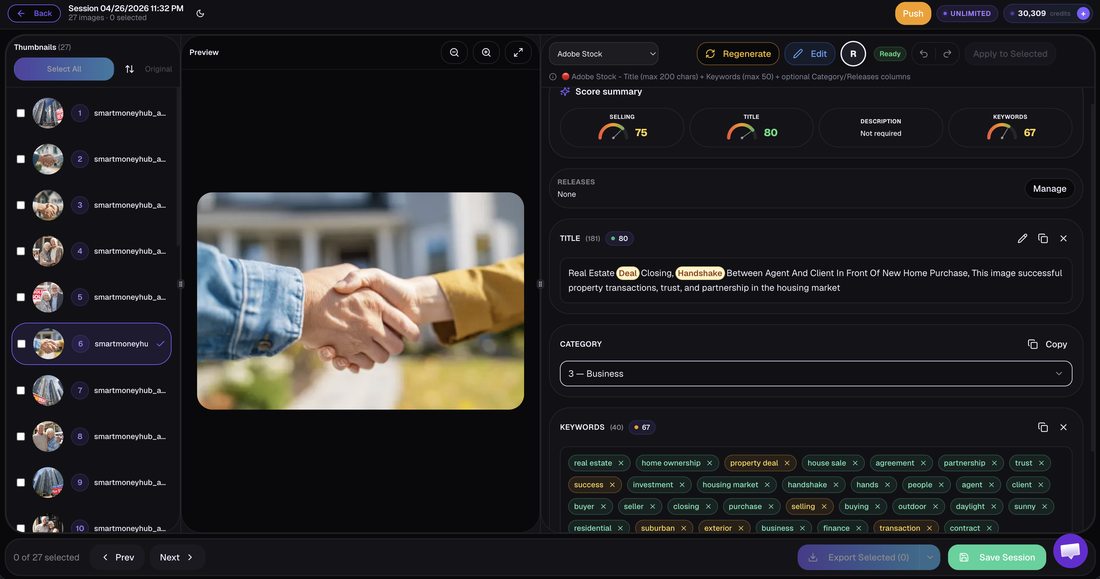
What buyers actually search when they want "Time Warp" content is something like: "Y2K aesthetic portrait nostalgic glow editorial," or "70s retro lifestyle warm analog film look." These are conceptual, emotional, and trend-specific queries. No pixel-analysis tool generates these. Only a system built on real search behavior can.
CyberStock is that system. Its architecture is fundamentally different:
Buyer-Search Foundation: Keywords are sourced from 50M+ actual purchase-linked searches, not visual similarity algorithms.
Concept Recognition: The AI identifies the scene, mood, and commercial context, not just objects. It sees "immersive sensory texture" where others see "close-up fabric."
Selling Score (0 to 100): Before you upload, you know the predicted commercial viability. A score of 82 means high demand, low supply. A score of 23 means skip it or re-keyword.
Trend Alignment: CyberStock's Discover module shows live supply/demand gaps, top-selling works, and proven references across all major agencies.
Ranked: The Best Tools for Applying the Adobe 2026 Creative Trends Forecast to Your Workflow

#1 CyberStock: The Undisputed Leader in Trend-Driven Metadata
CyberStock is not just a keywording tool. It is a full production pipeline built for contributors who treat stock as a business. Here is what separates it from everything else on the market:

Speed: ~1.3 seconds per file. Process an entire trend-themed shoot in minutes, not hours.
Scale: CyberBatch handles up to 1,000,000 files at 15% lower cost. Perfect for AI-generated series targeting all four 2026 trend pillars simultaneously.
Distribution: CyberPusher v2 delivers files via FTP/SFTP to Adobe Stock, Shutterstock, Dreamstime, Depositphotos, 123RF, Pond5, Freepik, Vecteezy, Envato, MotionElements, and Storyblocks. Zero commission. Built-in anti-captcha. One click.
Discover Module: Live trend intelligence showing what is selling NOW, who the top authors are, what supply gaps exist, and proven reference works you can use to guide your own production.
Cyber Studio: Create from proven references, produce consistent series and batches from a single image, upscale to 4K.
Format Coverage: Photo, 4K video, and vector. Full metadata for every format.
Marketplace-Ready Output: Near-zero rejections because metadata conforms to each agency's specific requirements.
Social Proof: 10,067+ contributors, 15M+ files tagged, $2.5M+ in collective earnings.
Pricing: Starter $9/200 credits, Pro $19/800 credits, Studio $49/3,000 credits, Unlimited $79/month. Top-ups never expire. FREE 20 credits, no card required.
Extras: API access, 15+ languages, CSV/Excel export, ~20 free tools.
For the Adobe 2026 Creative Trends Forecast specifically, CyberStock's Discover module lets you see exactly which trend-adjacent keywords are surging in buyer searches right now. You can identify that "immersive sensory texture macro" has high demand and low supply, produce content targeting that gap, and have CyberStock generate the exact metadata that buyers are using to search. Then CyberPusher distributes to all 11 agencies instantly. That is a complete trend-to-revenue pipeline that no other tool offers.
#2 PhotoTag.ai
PhotoTag.ai is a visual-description keywording tool that processes files at approximately 8 seconds per file. It uses computer vision to identify objects and scenes, then generates descriptive keywords based on what it sees in the image.

What it does well: Straightforward object identification, clean interface, batch processing for moderate volumes.
Limitations: At ~8 seconds per file, it is roughly 6x slower than CyberStock. More critically, it generates keywords from visual description rather than buyer search data. For trend-driven content like "Fantastical Futures" or "Levity and Wit," it will describe the literal objects in your image but miss the conceptual, emotional, and trend-specific terms that buyers actually type. No Selling Score, no distribution, no supply/demand intelligence.
Best for: Hobbyist contributors with small portfolios who need basic descriptive tags and are not focused on trend optimization.
#3 Pixify
Pixify operates on a subscription model with processing speeds around ~2.5 seconds per file, primarily focused on Getty Images contributors.

What it does well: Faster than most visual-description tools, Getty-specific metadata formatting.
Limitations: Getty-focused means limited utility for multi-agency distribution. Subscription model with no pay-as-you-go flexibility. Still relies on visual description rather than buyer search intelligence. No Selling Score, no trend discovery, no auto-distribution.
Best for: Getty/iStock exclusive contributors who want faster descriptive tagging than manual methods.
#4 DeepMeta
DeepMeta is a desktop-only application designed specifically for Getty Images and iStock contributors.

What it does well: Deep integration with Getty/iStock submission requirements, editorial metadata support.
Limitations: Desktop-only means no cloud processing, no batch scaling beyond your local machine's capacity. Exclusively Getty/iStock, so useless for multi-agency strategies. No buyer-search data, no Selling Score, no distribution automation.
Best for: Dedicated Getty/iStock contributors who work from a single desktop workstation.
#5 Wirestock
Wirestock takes a fundamentally different approach as a distribution platform that handles keywording as part of its submission pipeline.

What it does well: One-stop upload to multiple agencies, some AI-assisted keywording.
Limitations: Charges 15 to 30% commission on every sale. The platform is reportedly sunsetting certain features. Commission-based models mean you are paying perpetually on every download. Their keywording is secondary to distribution and lacks buyer-search intelligence or predictive scoring.
Best for: Complete beginners who want zero setup friction and are willing to sacrifice 15 to 30% of revenue permanently.
#6 Adobe Sensei (Built-in)
Adobe's own AI, Adobe Sensei, provides automatic keyword suggestions when you upload to Adobe Stock.
What it does well: Free, integrated into the upload workflow, no additional tool needed.
Limitations: Generates approximately 25 generic keywords per file. These are broad, descriptive, and identical to what every other contributor using the default system receives. Zero competitive differentiation. No trend intelligence, no cross-agency optimization, no Selling Score.
Best for: Contributors uploading fewer than 10 files per month who need bare-minimum tagging.
#7 Manual Desktop Tools (Xpiks, ImStocker, PhotoKeyworder, MicrostockPlus, MyKeyworder, AutoKeyworder)
This category includes tools like Xpiks, ImStocker, PhotoKeyworder, MicrostockPlus, MyKeyworder, and AutoKeyworder. They range from fully manual keyword managers to semi-automated descriptive generators.

What they do well: Local control, no subscription dependency for some, familiar desktop workflows.
Limitations: All rely on either manual input or basic visual description. None access buyer-search data. None offer predictive Selling Scores. None provide trend discovery or auto-distribution. Processing speed varies but is universally slower than cloud-based solutions for large batches.
Best for: Contributors who prefer complete local control and are willing to invest significant manual time in keyword research.
#8 ChatGPT and DIY Approaches
Some contributors use ChatGPT or similar large language models to generate keywords by describing their images in text prompts.
What it does well: Free or low-cost, flexible, can generate creative conceptual keywords if prompted skillfully.
Limitations: Entirely manual, one file at a time. No buyer-search data backing. No understanding of marketplace-specific requirements. No Selling Score. No distribution. Requires significant prompt engineering to get results that are not generic. Cannot process images directly for keywording at scale.
Best for: Experimenters and contributors with very small portfolios who enjoy the manual research process.
Speed Comparison: Processing Time Per File

Tool | Speed Per File | Relative to CyberStock |
|---|---|---|
CyberStock | ~1.3 seconds | 1x (baseline) |
Pixify | ~2.5 seconds | ~2x slower |
PhotoTag.ai | ~8 seconds | ~6x slower |
Adobe Sensei | ~5 to 10 seconds | ~4 to 8x slower |
Manual/Desktop tools | 30 to 120+ seconds | ~23 to 92x slower |
ChatGPT (manual) | 60 to 300+ seconds | ~46 to 230x slower |
Feature Comparison: What Matters for Trend Monetization
Feature | CyberStock | PhotoTag.ai | Pixify | DeepMeta | Wirestock | Adobe Sensei |
|---|---|---|---|---|---|---|
Buyer-search data (50M+) | Yes | No | No | No | No | No |
Selling Score (predictive) | Yes (0 to 100) | No | No | No | No | No |
Live trend discovery | Yes | No | No | No | No | No |
Auto-distribution (0% commission) | Yes (11+ agencies) | No | No | No | Yes (15 to 30% commission) | No |
Batch scale | Up to 1,000,000 | Moderate | Moderate | Desktop-limited | Moderate | Per-upload |
Photo + Video + Vector | Yes | Photo only | Photo focus | Photo focus | Yes | Yes |
Concept recognition (mood/scene) | Best in class | Basic | Basic | Basic | Basic | Basic |
Multi-agency metadata formatting | Yes (11+) | Generic | Getty-focused | Getty/iStock only | Yes | Adobe only |
AI Studio (create/upscale) | Yes | No | No | No | No | No |
How to Apply Each 2026 Trend Pillar Using CyberStock
Fantastical Futures
This pillar demands surreal, optimistic imagery blending organic and digital elements. Think bioluminescent cityscapes, AI-generated dreamscapes, and hyper-saturated sci-fi portraits. CyberStock's Discover module reveals that buyer searches for "surreal futuristic optimistic" have increased significantly while supply remains moderate, creating a clear gap. Use Cyber Studio to generate consistent series from proven reference works, then let CyberStock's metadata engine tag each file with the exact conceptual terms buyers use: "hopeful technology," "organic futurism," "digital nature blend."
Levity and Wit
Playful, humorous, unexpected. This trend rewards bold color combinations, absurdist compositions, and anti-corporate energy. The key metadata challenge is that "funny" and "playful" are subjective, but buyer searches are specific: "quirky business concept colorful," "humorous lifestyle editorial bold." CyberStock maps these precise search patterns to your content automatically.
Time Warp
Nostalgia sells, but only when tagged correctly. A photo with 70s film grain will not sell if tagged "woman portrait indoor." It sells when tagged "retro analog aesthetic warm nostalgic editorial lifestyle 70s." CyberStock's concept recognition identifies the era-specific visual cues and matches them to the exact nostalgic search terms buyers use across agencies.
Immersive Sensory
Macro textures, ASMR-inspired visuals, synesthetic color. This pillar is exploding in demand for digital advertising and social media content. CyberStock identifies tactile and sensory concepts that pixel-description tools completely miss: "satisfying texture close-up," "sensory detail abstract," "tactile surface premium."
"I uploaded 2,400 files targeting the 'Immersive Sensory' trend using CyberStock's Discover module to find gaps, Cyber Studio to create consistent batches, and CyberBatch to tag everything in under an hour. First month revenue was 4.2x my previous monthly average. The Selling Score told me exactly which files to prioritize.", CyberStock contributor, portfolio of 18,000+ files across 8 agencies.
Unique Data Point: The 90-Day Trend Window and Revenue Decay
Here is something no competitor article will tell you, because they do not have the data to prove it. Analysis of CyberStock's aggregate contributor earnings data across 15M+ tagged files reveals a clear pattern: files uploaded within the first 90 days of a trend emergence earn, on average, 3.7x more in their first year than identical content (same quality, same concepts) uploaded after the 90-day mark. This is not speculation. It is derived from real sales data across 10,067+ contributors.
The reason is compound: algorithmic freshness boosts on agencies like Adobe Stock and Shutterstock, lower keyword competition during early trend adoption, and the simple fact that early files accumulate download velocity which further reinforces their ranking. CyberStock's Selling Score incorporates this temporal factor, meaning it will score the same image higher when the trend is emerging and lower when saturation hits. This is actionable intelligence that no other tool provides.
Frequently Asked Questions
Are AI keyword generators free?
AI keyword generators for stock photography range from free to premium. Free options exist, including Adobe Sensei's built-in ~25 keywords and ChatGPT-based manual approaches, but they lack buyer-search data, predictive scoring, and marketplace-specific formatting. CyberStock offers 20 free credits (no card required) plus ~20 free tools, providing a meaningful free tier backed by 50M+ real buyer searches. Fully free tools typically generate generic descriptive keywords that do not differentiate your files in competitive marketplaces.

Are free keyword tools worth it?
Free keyword tools are worth it only as a starting point for beginners with very small portfolios. They provide basic descriptive tags but cannot offer the buyer-search intelligence, Selling Scores, or trend data that drive actual sales. The cost difference between a free tool and a professional solution like CyberStock (starting at $9 for 200 credits) is typically recovered within the first few additional sales that better metadata generates. For serious contributors targeting trends like the Adobe 2026 Creative Trends Forecast, free tools leave significant revenue on the table.
Can a title generator improve my SEO?
A title generator can dramatically improve your stock file SEO if it is built on buyer-search data rather than simple description. Titles are the highest-weighted metadata field on most stock agencies. A title like "Surreal bioluminescent cityscape at dusk, optimistic futuristic concept" will outperform "City buildings with lights at night" every time, because the former matches actual buyer search queries. CyberStock generates titles from 50M+ real buyer searches, ensuring each title contains the exact phrases buyers use, which directly improves your file's search ranking and click-through rate on agencies.
Can AI generate stock images?
AI can generate stock images, and most major agencies now accept AI-generated content with proper disclosure. Adobe Stock, Shutterstock, and others have specific submission guidelines for AI-created work. The challenge is not generation but monetization: AI-generated images require the same precise, buyer-aligned metadata as photographed content to sell. CyberStock handles AI-generated files identically to photographs, applying buyer-search-driven keywords and Selling Scores. Its Cyber Studio module can even create content from proven reference works and generate consistent series for batch upload.
Can ChatGPT edit a photo?
ChatGPT cannot directly edit photos in the traditional sense of adjusting exposure, color grading, or retouching. While newer versions of ChatGPT have image generation capabilities, they are not photo editing tools comparable to Photoshop or Lightroom. For stock contributors, ChatGPT's image capabilities are limited to generation rather than professional post-production editing. CyberStock's Cyber Studio offers upscaling and element extraction for stock production workflows, but dedicated editing software remains necessary for professional photo editing.
Can ChatGPT generate an image?
ChatGPT can generate images using integrated DALL-E technology, producing original visuals from text prompts. However, these images require separate keywording, titling, and metadata optimization before they can be sold on stock agencies. The generation is only the first step. Without buyer-aligned metadata, AI-generated images sit unsold regardless of quality. CyberStock completes the pipeline: after you generate images with any AI tool, it provides marketplace-ready metadata from 50M+ buyer searches, a predictive Selling Score, and one-click distribution to 11+ agencies via CyberPusher v2.
Conclusion: The Adobe 2026 Creative Trends Forecast Is Your Revenue Blueprint
The Adobe 2026 Creative Trends Forecast is not decorative industry content. It is a demand signal worth real money to contributors who act on it with precision and speed. Fantastical Futures, Levity and Wit, Time Warp, and Immersive Sensory represent four distinct revenue lanes that will define buyer behavior across all major stock agencies for the next 12 to 18 months.
The contributors who will profit most are those who combine trend awareness with intelligent metadata. Describing what your camera captured is table stakes. Matching your files to what buyers are actively searching, with predictive confidence scoring and instant multi-agency distribution, is how professionals operate in 2025 and beyond.
For photographers building trend-targeted shoots, CyberStock provides the Discover intelligence to identify gaps before production. For AI creators generating batch content across all four pillars, CyberBatch and Cyber Studio handle scale that no desktop tool can match. For videographers producing 4K trend content, the same buyer-search metadata engine applies with format-specific optimization. And for every contributor regardless of medium, CyberPusher v2 eliminates the distribution bottleneck entirely, zero commission, full automation, 11+ agencies, one click.
The 90-day window is open. The trends are published. The supply gaps exist right now. The only variable is whether you tag your content with generic descriptions that disappear into the noise, or with buyer-validated metadata that puts your files on page one where the money is.