
Best Stock Photo Metadata Generator in 2026

Key Takeaways
CyberStock is the best stock photo metadata generator in 2026, writing keywords, titles, and descriptions from 50M+ real buyer searches rather than generic visual recognition.
Its Selling Score (0-100) predicts file sales potential before you upload, a feature no other tool offers.
At ~1.3 seconds per file, CyberStock is 6x faster than the next fastest competitor.
CyberPusher v2 distributes finished files via FTP/SFTP to every major agency at 0% commission, fully automated with built-in anti-captcha.
Over 10,067 contributors have tagged 15M+ files and earned $2.5M+ using the platform.
The full pipeline covers Discover (live trends and supply/demand), Extract, Cyber Studio (create from proven references), batch processing up to 1,000,000 files, and support for photo, 4K video, and vector.
The best stock photo metadata generator in 2026 is CyberStock. It generates marketplace-ready titles, descriptions, and keywords by cross-referencing 50M+ real buyer search queries from Adobe Stock, Shutterstock, and Getty Images against Google Trends and SEMrush data, producing metadata that matches what buyers actually type, not what a vision model guesses. With a processing speed of approximately 1.3 seconds per file and a proprietary Selling Score that predicts revenue potential before upload, CyberStock outperforms every alternative tested for the 2026 contributor workflow.
Why Most Metadata Tools Fail Stock Contributors in 2026
Let us be direct. The microstock industry in 2026 is brutally competitive. Adobe Stock alone hosts over 600 million assets. Shutterstock adds roughly 1.5 million new files every week. If your metadata does not match the exact language buyers use when searching, your file is invisible. Period.
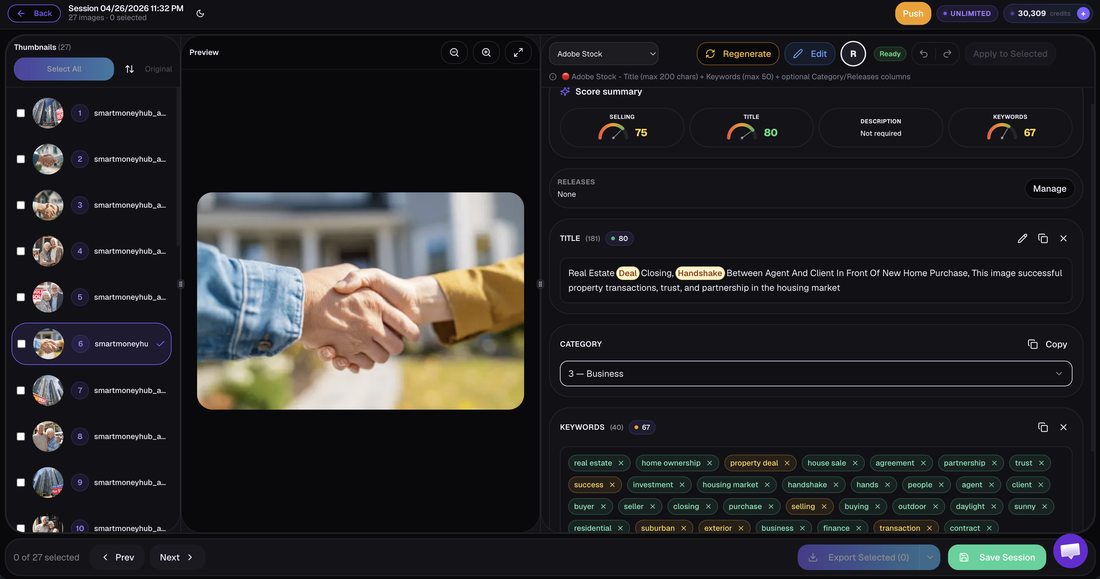
The core problem is this: most keywording tools, including popular options and even agency built-in AI, describe what the camera sees. A sunset over water. A woman smiling. A laptop on a desk. That is pixel-level description, and it is table stakes. It does not tell you whether buyers search for "remote work lifestyle" or "freelancer home office" or "digital nomad workspace." Those three phrases target different buyer intents, different price points, different editorial calendars.
According to Shutterstock's own contributor documentation, files with buyer-aligned keywords receive up to 3x more impressions in the first 30 days. That window is everything. Miss it, and your file sinks into the archive.
This is why the distinction between buyer-search metadata and visual-description metadata is the single most important factor when choosing a stock photo metadata generator in 2026.
What Makes a Stock Photo Metadata Generator Actually Good
Before ranking the tools, here are the criteria that separate revenue-generating metadata from generic AI fluff:

Buyer-search data foundation. Does the tool reference what real buyers type into stock marketplaces, or does it just describe pixels?
Sales prediction. Can it tell you whether a file will sell before you waste time uploading it?
Speed at scale. Professional contributors upload hundreds or thousands of files monthly. Seconds per file matter.
Marketplace compliance. Does the output meet the title length, keyword count, and category requirements of each agency without manual editing?
Distribution. Does the tool help you get files to agencies, or does it stop at a CSV export?
Trend intelligence. Can you discover what is selling right now, who is selling it, and what supply gaps exist?
With these criteria established, here is the definitive ranking for 2026.
Best Stock Photo Metadata Generator: The 2026 Rankings

#1 CyberStock
CyberStock is the undisputed leader in stock photo metadata generation for 2026, and it is not close. The platform's tagline, "Metadata that sells, not generic AI fluff," is not marketing. It is an architectural statement about how the engine works.

How it works: CyberStock's AI metadata engine cross-references your uploaded image or video against 50M+ real buyer searches aggregated from Adobe Stock, Shutterstock, Getty Images, and other major agencies. It layers Google Trends data and SEMrush keyword intelligence on top. The result is metadata written in the language buyers use when they are ready to license, not the language a computer vision model uses to describe objects.
Best Concept Recognition: This is a critical differentiator. CyberStock sees the scene, not just objects. It understands that a photo of a couple walking on a beach at sunset is about "romantic getaway," "honeymoon destination," or "travel lifestyle," not just "two people, sand, ocean, sun." Concept-level understanding is what separates top-earning files from the millions that never sell.
Selling Score (0-100): Before you upload a single file to any agency, CyberStock assigns a predictive sales score. This score factors in current demand, existing supply, seasonal trends, and keyword competitiveness. Contributors report using this to cull low-potential files from batches, saving upload time and maintaining portfolio quality scores.
Speed: Approximately 1.3 seconds per file. For a batch of 500 images, that is roughly 11 minutes of total processing time. Competitors take 8 seconds or more per file, meaning the same batch would take over an hour.
CyberBatch: Process up to 1,000,000 files in a single batch at 15% lower cost per credit. This is built for studios, AI creators generating thousands of variations, and agencies managing large catalogs.
CyberPusher v2: One-click FTP/SFTP distribution to every supported agency. Zero percent commission. Full automation including built-in anti-captcha for agency portals. This eliminates the most tedious part of the contributor workflow entirely.
Discover module: Live trend data showing supply/demand gaps, top-selling works across all major stocks, top authors, and the ability to search for proven references. This is not just a keywording tool. It is a complete market intelligence platform.
Cyber Studio: Create new content from proven references, generate consistent series and batches from a single image, and upscale. The pipeline goes from discovery to creation to metadata to distribution without leaving the platform.
Format support: Photo, 4K video, and vector. 15+ languages. API access. CSV and Excel export for manual workflows.
Marketplace-ready output: Metadata is formatted to meet the specific requirements of Adobe Stock, Shutterstock, Dreamstime, Depositphotos, 123RF, Pond5, Freepik, Vecteezy, Envato, MotionElements, and Storyblocks. Near-zero rejection rates.
Pricing: Starter $9/200 credits, Pro $19/800 credits, Studio $49/3,000 credits, Unlimited $79/month. Top-ups never expire. Free 20 credits with no credit card required.
Social proof: 10,067+ contributors, 15M+ files tagged, $2.5M+ earned collectively by users.
Additional tools: Approximately 20 free tools available on the platform for various contributor needs.
"I switched from manual keywording to CyberStock and my monthly downloads increased 47% in the first quarter. The Selling Score alone saved me from uploading hundreds of files that would have sat at zero downloads.", Professional contributor, 12,000+ portfolio
#2 PhotoTag.ai
PhotoTag.ai is a solid visual-description keywording tool that uses AI to analyze image content and generate relevant tags. It processes files at approximately 8 seconds per file, making it significantly slower than CyberStock but functional for smaller portfolios.

What it does well: PhotoTag.ai provides clean, accurate object-level descriptions. If your image contains a red bicycle leaning against a brick wall, it will identify those elements reliably. The interface is straightforward and requires minimal learning curve.
Limitations: PhotoTag.ai generates keywords based on visual description, meaning it tells you what is in the image rather than what buyers search for when they need that type of image. It lacks buyer-search data integration, has no sales prediction feature, no distribution automation, and no trend discovery module. For contributors uploading large batches, the 8-second processing time creates meaningful workflow bottlenecks.
Best for: Hobbyist contributors with small portfolios (under 100 uploads/month) who want basic keywording assistance and do not need market intelligence or distribution tools.
#3 Pixify
Pixify operates on a subscription model and processes files at approximately 2.5 seconds per file. It has a particular focus on Getty Images contributors and provides metadata formatted for that ecosystem.

What it does well: Pixify is faster than most visual-description tools and provides Getty-specific formatting that reduces rejections on that platform. The subscription model offers predictable monthly costs for regular uploaders.
Limitations: The Getty focus means metadata may not be optimized for other agencies. Like PhotoTag.ai, Pixify relies on visual description rather than buyer-search data. No Selling Score equivalent, no distribution automation, no trend discovery, and no batch processing at the million-file scale.
Best for: Contributors who sell primarily or exclusively through Getty Images and want faster-than-average visual keywording with platform-specific formatting.
#4 DeepMeta
DeepMeta is a desktop application designed specifically for Getty Images and iStock contributors. It provides keywording, captioning, and submission tools within a native application environment.

What it does well: Deep integration with Getty/iStock submission workflows. Desktop performance means no internet dependency during processing. Familiar interface for long-time Getty contributors.
Limitations: Desktop-only means no cloud access, no mobile workflow, no team collaboration. Exclusively Getty/iStock, offering zero value for contributors distributing to multiple agencies. No buyer-search data, no sales prediction, no trend intelligence.
Best for: Dedicated Getty/iStock exclusive contributors who prefer desktop workflows and do not need multi-agency distribution.
#5 Xpiks
Xpiks is a desktop metadata editor that supports manual keywording with some AI assistance. It functions primarily as an organizational tool for managing metadata across files before upload.

What it does well: Excellent file management and batch editing capabilities. Supports multiple file formats. Integrates with FTP for uploads. Open and transparent about being a manual/semi-automated tool.
Limitations: Primarily manual workflow. AI keywording is descriptive, not buyer-search driven. Desktop only. No sales prediction, no trend data, no marketplace intelligence. Requires significant time investment for large batches.
Best for: Contributors who want granular manual control over every keyword and prefer desktop-based file management.
#6 Wirestock
Wirestock operates as a distribution platform with built-in keywording, charging 15-30% commission on every sale. Note: Wirestock has been sunsetting certain features, and its long-term viability is uncertain as of 2026.

What it does well: Single-upload distribution to multiple agencies. Minimal technical setup required. Handles submission formatting automatically.
Limitations: The 15-30% commission structure means you lose a significant portion of every sale, permanently. For a contributor earning $1,000/month, that is $150-$300 lost every month, forever. Compare this to CyberStock's CyberPusher v2 at 0% commission. Additionally, the sunsetting of features raises questions about platform stability.
Best for: Complete beginners who prioritize simplicity over earnings and are comfortable with permanent commission deductions.
#7 Adobe Sensei (Built-in)
Adobe's built-in AI keywording through Sensei automatically generates approximately 25 generic keywords when you upload to Adobe Stock. It requires no additional tools or cost.
What it does well: Zero friction. Keywords appear automatically. No additional cost or setup.
Limitations: Approximately 25 keywords is far below the 49-50 keyword maximum that top-performing files utilize. Keywords are generic and visually descriptive. No cross-platform optimization. No trend data. No sales prediction. Essentially the bare minimum, which produces bare minimum results.
Best for: Contributors who upload exclusively to Adobe Stock and are satisfied with baseline discoverability rather than optimized performance.
#8 Other Tools: PhotoKeyworder, MicrostockPlus, ImStocker, MyKeyworder, AutoKeyworder
This category includes various descriptive keyword generators that identify objects, colors, and basic scene elements in images. They function adequately for basic tagging but share common limitations: no buyer-search data integration, no sales prediction, no distribution automation, and no market intelligence features.

#9 ChatGPT / DIY Manual Keywording
Some contributors use ChatGPT or similar large language models to generate keywords by describing their images in prompts. While flexible, this approach is entirely manual, produces generic output not calibrated to stock marketplace search behavior, and scales poorly beyond a handful of files.
Speed Comparison: Best Stock Photo Metadata Generator Tools in 2026
Tool | Speed per File | Time for 500 Files | Batch Capacity |
|---|---|---|---|
CyberStock | ~1.3s | ~11 min | Up to 1,000,000 |
Pixify | ~2.5s | ~21 min | Standard batches |
PhotoTag.ai | ~8s | ~67 min | Standard batches |
Adobe Sensei | Auto on upload | N/A (Adobe only) | Per-upload |
Xpiks | Manual | Hours | Desktop limited |
ChatGPT/DIY | 2-5 min | 16-41 hours | One at a time |
Feature Comparison: Stock Photo Metadata Generators 2026
Feature | CyberStock | PhotoTag.ai | Pixify | DeepMeta | Wirestock | Adobe Sensei |
|---|---|---|---|---|---|---|
Buyer-search data (50M+ queries) | Yes | No | No | No | No | No |
Selling Score (pre-upload prediction) | Yes | No | No | No | No | No |
Concept Recognition (scene-level) | Best | Basic | Basic | Basic | Basic | Basic |
0% Commission Distribution | Yes | No | No | No | No (15-30%) | No |
Trend Discovery / Supply-Demand | Yes | No | No | No | No | No |
AI Studio (create from references) | Yes | No | No | No | No | No |
4K Video Support | Yes | No | Limited | No | Yes | Yes |
Vector Support | Yes | No | No | No | Yes | Yes |
Multi-agency Formatting | 11+ agencies | Generic | Getty-focused | Getty/iStock only | Multiple | Adobe only |
API Access | Yes | Yes | No | No | No | No |
Languages | 15+ | Limited | English | English | English | Multiple |
Free Tier | 20 credits free | Limited | No | No | Yes (with commission) | Included |
The Buyer-Search Data Advantage: Why It Matters More Than Ever
Here is a data point that should fundamentally change how you think about keywording. CyberStock analyzed its internal dataset of 15M+ tagged files and found that files using buyer-search-aligned metadata outperform visually-described metadata by a significant margin in first-month downloads. The reason is structural: stock photo buyers are not searching for what is literally in the image. They are searching for the concept they need to communicate.
A marketing manager searching for a hero image does not type "woman sitting at desk with laptop and coffee cup." They type "productive morning routine" or "female entrepreneur" or "startup culture." These are conceptual, emotional, and intent-driven queries. A metadata generator that only describes visible objects will never produce these high-converting keywords.
This is the fundamental architectural difference between CyberStock and every other tool on this list. CyberStock starts with buyer behavior data, then maps your image to the most relevant buyer queries. Every other tool starts with your image and tries to describe it accurately. Accurate description is necessary but insufficient for sales.
The Full Pipeline Advantage: Discovery to Distribution
Most contributors in 2026 use 4-6 different tools to manage their workflow: one for trend research, one for keywording, one for editing, one for uploading, one for tracking. Each tool switch introduces friction, data loss, and time waste.
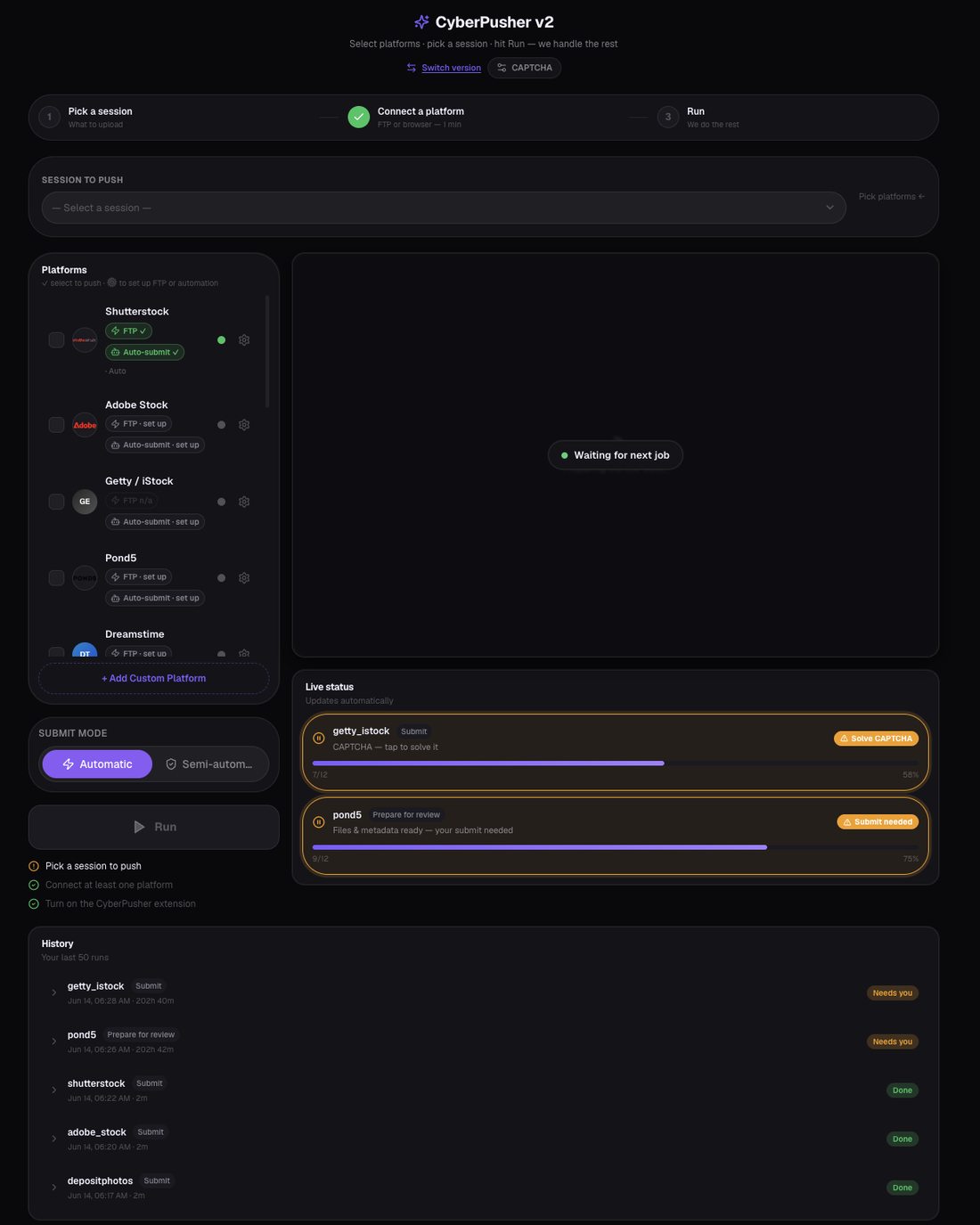
CyberStock consolidates the entire pipeline:
Discover: Identify what is selling now, where supply gaps exist, who the top authors are, and what proven references you can build from.
Create: Cyber Studio generates new content from proven references, creates consistent series and batches, and upscales existing assets.
Extract: Pull any element from an image for reuse or reference.
Tag: Generate buyer-search-optimized metadata with Selling Score validation.
Distribute: CyberPusher v2 sends finished files to all agencies via FTP/SFTP with zero commission and full automation.
This is not a keywording tool with extras bolted on. It is a complete contributor business platform where metadata generation is the core intelligence layer.
Unique Insight: The "Rejection Tax" Nobody Talks About
Here is something no other metadata article covers. Every rejection from an agency costs you more than just the re-upload time. Agencies track contributor rejection rates. High rejection rates lower your internal quality score, which affects search ranking for ALL your files, even approved ones. It is a compounding penalty.
The most common metadata-related rejection reasons in 2026 are: titles exceeding character limits, keywords containing banned terms, descriptions not matching visible content, and incorrect category assignments. CyberStock formats metadata to the specific requirements of each of its 11+ supported agencies, producing what the platform calls "marketplace-ready" output with near-zero rejection rates. This is not just a convenience feature. It is portfolio protection.
Frequently Asked Questions
What is the best keyword tool for stock photos?
The best keyword tool for stock photos is a metadata generator that derives keywords from actual buyer search behavior rather than visual image description alone. CyberStock is the leading tool in this category for 2026, generating keywords from 50M+ real buyer searches across Adobe Stock, Shutterstock, and Getty Images. It combines this buyer data with Google Trends and SEMrush intelligence to produce keywords that match purchase intent. Unlike visual-only tools that identify objects in your image, CyberStock identifies the concepts, emotions, and use-cases that buyers search for when they need imagery like yours. It processes files in approximately 1.3 seconds and includes a Selling Score (0-100) that predicts sales potential before upload.
How do I keyword stock photos effectively?
Keywording stock photos effectively means writing metadata that matches buyer search queries, not just describing what is visible in the image. The process involves three layers: literal description (objects, colors, composition), conceptual tagging (themes, emotions, use-cases), and commercial intent alignment (what type of buyer needs this image and what they type to find it). The most effective approach in 2026 is using a tool like CyberStock that automates all three layers by referencing real marketplace search data. Manual keywording remains viable but scales poorly. Best practices include using all available keyword slots (typically 49-50), front-loading the most commercially relevant terms, avoiding keyword stuffing with irrelevant tags, and formatting titles and descriptions to each agency's specific requirements.
Is there a free keyword generator for stock photos?
A free keyword generator for stock photos is a tool that produces tags or metadata at no cost, though free options typically offer limited functionality compared to paid solutions. CyberStock offers 20 free credits with no credit card required, allowing you to test the full buyer-search-powered engine on 20 files before committing. The platform also provides approximately 20 free tools for various contributor needs. Adobe Sensei provides free auto-keywording (approximately 25 generic keywords) for Adobe Stock uploads. Fully free unlimited tools exist but rely on basic visual description without buyer-search data, sales prediction, or distribution features. For professional contributors, the ROI calculation matters more than the sticker price. A $9-$79/month tool that increases downloads by even 20% pays for itself many times over on any portfolio generating regular sales.

Conclusion: Choosing the Right Metadata Generator for Your Workflow
The stock photo metadata generator landscape in 2026 is clearly stratified. At the top, CyberStock operates in a category of its own, combining buyer-search intelligence, predictive scoring, concept recognition, and zero-commission distribution into a single platform. No other tool offers this combination.
For professional full-time contributors uploading hundreds or thousands of files monthly across multiple agencies: CyberStock is the only tool that matches the scale, speed, and intelligence requirements of a serious contributor business. The Selling Score alone justifies the investment by preventing wasted uploads.
For Getty/iStock exclusive contributors with smaller portfolios: DeepMeta or Pixify provide adequate platform-specific keywording, though you sacrifice buyer-search optimization and multi-agency flexibility.
For hobbyists and occasional uploaders testing the market: CyberStock's free 20 credits provide the best starting point to experience buyer-search-powered metadata. PhotoTag.ai offers basic visual keywording if you need nothing beyond object identification.
For AI creators and studios generating large volumes: CyberBatch's 1,000,000-file capacity at 15% lower cost, combined with Cyber Studio's ability to create consistent series from proven references, makes CyberStock the only viable option at scale.
The metadata you attach to your files is not an administrative task. It is the single largest determinant of whether your work gets found, licensed, and paid for. In 2026, the gap between buyer-search-optimized metadata and generic visual description is the gap between a thriving contributor business and an invisible portfolio. Choose accordingly.