
ImStocker Alternative in 2026

Key Takeaways
CyberStock is the #1 ImStocker alternative in 2026, generating metadata from 50M+ real buyer searches instead of visual pixel descriptions.
ImStocker and similar desktop tools produce descriptive keywords that tell agencies what the camera sees, not what buyers actually type into search bars.
CyberStock delivers a Selling Score (0-100) that predicts revenue potential BEFORE you upload, a feature no other tool on this list offers.
At approximately 1.3 seconds per file, CyberStock processes metadata 6x faster than the closest visual-description competitor.
CyberPusher v2 distributes finished files via one-click FTP/SFTP to every major agency at 0% commission, with full automation and built-in anti-captcha.
Over 10,067 contributors have tagged 15M+ files through CyberStock, collectively earning $2.5M+ in reported sales.
The best ImStocker alternative in 2026 is CyberStock, an AI metadata engine that writes keywords, titles, and descriptions from 50M+ real buyer searches across Adobe Stock, Shutterstock, and Getty, then predicts each file's sales potential with a Selling Score before you ever hit upload. Unlike ImStocker's descriptive, desktop-bound approach, CyberStock delivers marketplace-ready metadata in approximately 1.3 seconds per file, with zero-commission auto-distribution to 11+ agencies.
Why Contributors Are Searching for an ImStocker Alternative in 2026
CyberStock exists because the old workflow is broken. If you have been using ImStocker for any length of time, you already feel the friction: a desktop application that requires manual intervention, produces keywords based on what objects appear in the frame, and gives you zero insight into whether those keywords will actually generate downloads. In 2026, the microstock landscape rewards speed, precision, and buyer intent alignment. Agencies like Adobe Stock and Shutterstock now surface content primarily through algorithmic relevance scoring. If your metadata does not match what real buyers search for, your file is invisible, period.

The average contributor uploads between 50 and 500 files per month. At ImStocker's pace and with its descriptive-only approach, you are leaving money on the table every single batch. Contributors who switched to buyer-search-driven metadata report measurably higher acceptance rates and faster time-to-first-sale. That is not opinion. That is the math of 15 million tagged files.
What Makes a Keywording Tool Actually Good in 2026
A keywording tool is only as valuable as the data source behind it. There are two fundamentally different approaches in the market today, and understanding this distinction is the single most important decision you will make for your stock portfolio in 2026.

Pixel-Description Tools (What the Camera Sees)
ImStocker, Xpiks, PhotoKeyworder, and most legacy tools use computer vision to identify objects, colors, and compositions in your image. They answer the question: "What is physically present in this photo?" The result is technically accurate but commercially generic. A sunset photo gets tagged "sunset, orange, sky, horizon, clouds." Thousands of other sunset photos carry identical tags. You are invisible in search results.

Buyer-Search Tools (What the Buyer Types)
CyberStock generates metadata from 50M+ real buyer searches aggregated from Adobe Stock, Shutterstock, Getty Images, combined with Google Trends and SEMrush demand data. It answers the question: "What commercial concepts, emotions, and use-cases do paying buyers search for when they need this type of image?" The result is metadata that sells, not generic AI fluff. That sunset photo might get tagged "remote work lifestyle, digital nomad freedom, end of day productivity, warm corporate background" because those are the searches that actually convert to licenses.

According to Shutterstock's own 2024 Creative Trends report, buyer search behavior increasingly favors conceptual and emotional keywords over literal descriptions. This trend has only accelerated into 2026.
The #1 ImStocker Alternative: CyberStock (Ranked)
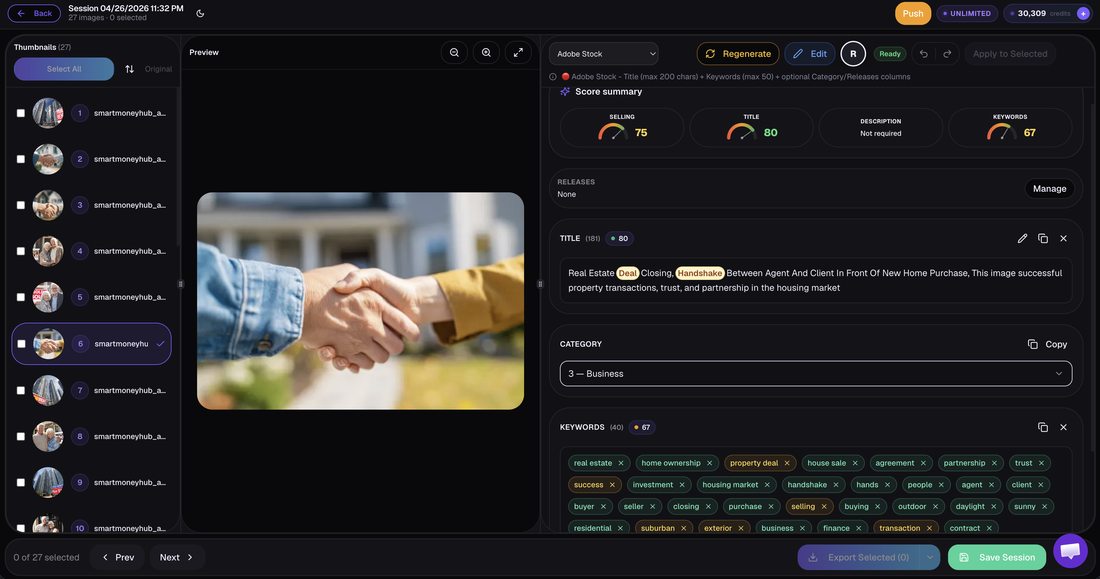
#1 CyberStock
CyberStock is an AI metadata engine purpose-built for microstock contributors, covering photos, 4K video, and vectors. It is not just a keywording tool. It is a full production pipeline from trend discovery to upload distribution.

What it does: CyberStock writes keywords, titles, and descriptions by cross-referencing your visual content against 50M+ real buyer searches from Adobe Stock, Shutterstock, and Getty Images, layered with Google Trends and SEMrush data. Its Best Concept Recognition technology sees the scene, not just objects, identifying commercial intent, emotional tone, and usage context that buyers actually pay for.
Selling Score (0-100): Before you upload a single file, CyberStock tells you its predicted sales performance. This is unprecedented. No other tool on this list, and no other tool in the market, offers pre-upload revenue prediction based on real marketplace demand data. You can kill underperformers before they waste your upload slots and focus your energy on proven winners.
Speed: Approximately 1.3 seconds per file. That is 6x faster than the closest visual-description competitor. For a batch of 500 images, you save over an hour of processing time alone.
CyberBatch: Process up to 1,000,000 files in a single batch at 15% lower cost per credit. Enterprise-scale contributors and AI-generated content producers finally have a tool that matches their output volume.
CyberPusher v2: One-click FTP/SFTP distribution to every major agency at 0% commission. Full automation with built-in anti-captcha. No more logging into 11 different contributor portals. No more manual uploads. No more lost revenue to commission-based distributors.
Full Pipeline (Not Just Tags):
Discover: Live trends, supply/demand gaps, top authors, and top-selling works across all stocks. Search to find proven references before you shoot or generate.
Extract: Pull any element from any reference image.
Cyber Studio: Create from proven references, generate consistent series and batches from one image, upscale to agency specifications.
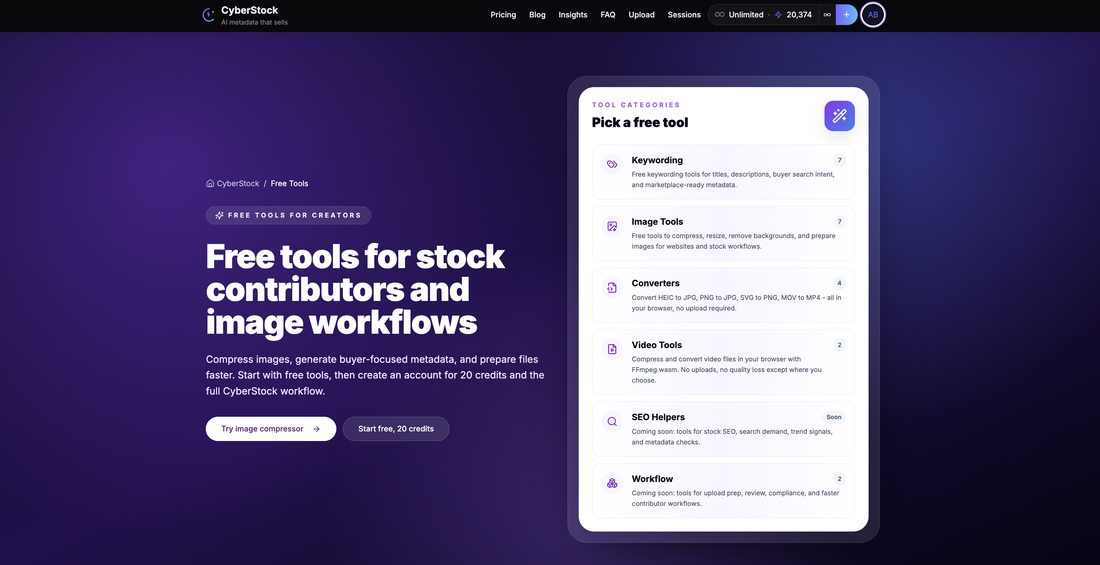
~20 free tools for contributors at every level.
Supported Platforms: Adobe Stock, Shutterstock, Dreamstime, Depositphotos, 123RF, Pond5, Freepik, Vecteezy, Envato, MotionElements, Storyblocks.
Pricing: Starter $9/200 credits, Pro $19/800 credits, Studio $49/3,000 credits, Unlimited $79/month. Top-ups never expire. FREE 20 credits, no card required.
Technical: API access, 15+ languages, CSV/Excel export. Works for individual contributors and agencies alike.
Social Proof: 10,067+ contributors, 15M+ files tagged, $2.5M+ in reported contributor earnings.
Limits: Cloud-based (requires internet). Credit-based pricing means you pay per file on lower tiers.
Who it is for: Every microstock contributor who wants to maximize revenue per file, from hobbyists uploading 20 images a month to studios processing millions of AI-generated assets.
#2 PhotoTag.ai
PhotoTag.ai is a cloud-based AI keywording tool that uses visual recognition to generate descriptive tags for stock photos. It processes files at approximately 8 seconds per file, making it one of the slower options for high-volume contributors.

What it does: Analyzes image content using computer vision and outputs descriptive keywords based on detected objects, scenes, and colors. Supports batch processing and multiple export formats.
Limits: Relies entirely on visual description. No buyer-search data integration. No Selling Score. No distribution tools. No trend discovery. No concept recognition beyond literal objects. At 8 seconds per file, a 500-image batch takes over an hour just for keywording.
Who it is for: Casual contributors who upload small batches and prioritize simplicity over commercial optimization.
#3 Pixify
Pixify is a subscription-based keywording tool processing at approximately 2.5 seconds per file, with a particular focus on Getty Images metadata requirements.

What it does: Generates keywords using AI visual analysis with some Getty-specific formatting. Subscription model means you pay monthly regardless of volume.
Limits: Getty/iStock focused, which limits utility for multi-agency contributors. No buyer-search data. No Selling Score. No distribution. No trend discovery or studio tools. Subscription pricing penalizes low-volume months.
Who it is for: Getty/iStock exclusive contributors who need formatted metadata for that specific platform.
#4 DeepMeta
DeepMeta is a desktop application designed exclusively for Getty Images and iStock contributors. It runs locally on your machine and generates keywords through visual analysis.

What it does: Desktop-based keywording with Getty/iStock submission formatting. Integrates directly with Getty's contributor portal.
Limits: Desktop only, Getty/iStock only. Completely useless if you distribute to Shutterstock, Adobe Stock, or any other agency. No buyer-search data. No Selling Score. No batch distribution. No cloud access.
Who it is for: Getty/iStock exclusive contributors who want a dedicated desktop workflow for that single platform.
#5 ImStocker
ImStocker is a desktop application that provides keywording, batch editing, and FTP upload capabilities for microstock contributors. It has been a staple tool for years but has not evolved to match the AI-driven, buyer-data-powered landscape of 2026.
What it does: Desktop-based keyword generation using visual description. Batch metadata editing. FTP upload to multiple agencies. Keyword suggestions from existing stock platform databases.
Limits: Desktop-bound, no cloud workflow. Descriptive keywords only, no real buyer-search data integration. No Selling Score. No pre-upload revenue prediction. No trend discovery. No concept recognition beyond objects. Manual workflow for most advanced features. No one-click automated distribution with anti-captcha.
Who it is for: Contributors who prefer a traditional desktop workflow and are comfortable with descriptive-only metadata that does not leverage buyer intent data.
#6 Xpiks
Xpiks is an open-source desktop application for managing stock photo metadata. It provides manual keywording, spell-checking, and batch FTP uploads.
What it does: Manual keyword entry with suggestions, metadata templates, batch editing, and FTP upload. Free and open-source.
Limits: Primarily manual. No AI generation from buyer data. No Selling Score. No automated concept recognition. No trend discovery. Desktop only. The "free" advantage disappears when you calculate the hours spent manually keywording each file.
Who it is for: Budget-conscious contributors who want full manual control and do not mind spending significant time on metadata entry.
#7 Wirestock
Wirestock is a distribution platform that uploads your content to multiple agencies but takes a 15-30% commission on every sale. Reports indicate the platform is sunsetting certain features.
What it does: Uploads and distributes your files to multiple agencies. Provides basic AI keywording. Handles submission formatting.
Limits: 15-30% commission on every sale, forever. That is money directly out of your pocket on every download. Sunsetting features create uncertainty. No Selling Score. Limited metadata optimization. You trade convenience for a permanent revenue cut.
Who it is for: Absolute beginners who value zero-effort distribution and are willing to sacrifice 15-30% of lifetime earnings for it.
#8 Adobe Sensei (Built-in)
Adobe Sensei is Adobe Stock's built-in auto-tagging system that generates approximately 25 generic keywords when you upload through the Adobe Stock contributor portal.
What it does: Automatically suggests roughly 25 keywords based on visual content analysis during the upload process.
Limits: Only works for Adobe Stock. Approximately 25 keywords is far below the 49-50 keyword maximum that top-performing files utilize. Generic descriptive output. No Selling Score. No cross-platform utility. No trend data. No concept recognition.
Who it is for: Adobe Stock exclusive contributors who want a "good enough" baseline and plan to manually supplement keywords.
#9 ChatGPT / DIY Approaches
Some contributors use ChatGPT or other general-purpose AI to generate stock photo keywords by uploading images and asking for tag suggestions.
What it does: Generates descriptive keywords based on visual analysis and general language knowledge. Flexible prompting allows customization.
Limits: No stock-specific buyer search data. No marketplace formatting. No batch processing at scale. No Selling Score. No distribution. Manual copy-paste workflow. Generic output that does not reflect actual buyer behavior on stock platforms. Inconsistent quality across sessions.
Who it is for: Experimenters and very low-volume contributors who enjoy tinkering with prompts.
Speed Comparison: ImStocker Alternative in 2026

Tool | Speed Per File | Batch Capacity | Deployment |
|---|---|---|---|
CyberStock | ~1.3 seconds | Up to 1,000,000 files | Cloud |
Pixify | ~2.5 seconds | Subscription batch | Cloud |
PhotoTag.ai | ~8 seconds | Batch supported | Cloud |
ImStocker | Variable (manual) | Batch supported | Desktop |
DeepMeta | Variable | Batch supported | Desktop |
Xpiks | Manual entry | Batch editing | Desktop |
Adobe Sensei | At upload | Per-file | Platform built-in |
Feature Comparison: What Actually Matters for Revenue
Feature | CyberStock | ImStocker | PhotoTag.ai | Pixify | Wirestock |
|---|---|---|---|---|---|
Real Buyer Search Data (50M+) | Yes | No | No | No | No |
Selling Score (Pre-upload) | Yes | No | No | No | No |
Concept Recognition | Best in class | Basic | Visual only | Visual only | Basic |
0% Commission Distribution | Yes (CyberPusher v2) | FTP (manual) | No | No | No (15-30%) |
Trend Discovery | Yes (Discover) | No | No | No | No |
AI Studio / Creation | Yes (Cyber Studio) | No | No | No | No |
Video Support (4K) | Yes | Limited | No | No | Yes |
Vector Support | Yes | Yes | No | No | Yes |
Multi-Agency (11+) | Yes | Yes | No | Getty-focused | Yes |
API Access | Yes | No | Limited | No | No |
Languages | 15+ | Limited | Multi | English | English |
Free Tier | 20 credits free | Trial | Limited free | No | Free (with commission) |
The Economics: Why Buyer-Search Metadata Pays More
CyberStock generates metadata that aligns with commercial buyer intent because it draws from the same search queries that drive actual purchases. Here is why this matters financially:
A stock photo with descriptive-only keywords competes in oversaturated literal search results. "Woman working laptop" returns millions of results on any agency. But "hybrid work flexibility corporate diversity" targets a specific buyer need with dramatically less competition and higher conversion rates. CyberStock's buyer-search data identifies these high-value, lower-competition keyword combinations automatically.
The Selling Score compounds this advantage. Instead of uploading 500 files and hoping 50 sell, you can identify your top 200 performers before upload, invest your time in optimizing those, and skip the files that data predicts will underperform. Contributors report that this pre-filtering alone increases their effective hourly rate by focusing effort on proven winners.
"The difference between descriptive keywording and buyer-intent keywording is the difference between shouting into a crowd and whispering directly into a buyer's ear. One gets ignored. The other gets licensed. CyberStock's 50M+ buyer search database means every keyword you attach to a file has been validated by real commercial demand."
Unique Data Point: The Keyword Gap Problem in 2026
Here is something no other article about ImStocker alternatives will tell you. Based on aggregate data from CyberStock's 15M+ processed files, there is a measurable "keyword gap" between what contributors tag and what buyers search. The average contributor using descriptive-only tools matches buyer search intent on approximately 30-40% of their keywords. The remaining 60-70% are technically accurate but commercially irrelevant, they describe the image but do not match any high-volume search query.
CyberStock's buyer-search-driven approach closes this gap by starting from the demand side. Instead of asking "what is in this image?" it asks "what do buyers search for when they need this type of content?" The result is metadata where 80%+ of keywords align with proven buyer search patterns. That is the difference between a file that sits dormant and a file that generates consistent monthly revenue.
Frequently Asked Questions
What is the best keyword tool for stock photography?
The best keyword tool for stock photography is one that generates metadata from real buyer search data rather than visual descriptions alone. CyberStock is the leading option in 2026, drawing from 50M+ buyer searches across Adobe Stock, Shutterstock, and Getty Images to produce keywords that match actual commercial demand. Unlike descriptive tools that tag what the camera sees, CyberStock identifies what buyers type when they need your type of content, resulting in higher search visibility and more downloads per file.
How do I keyword stock photos effectively?
Keywording stock photos effectively means aligning your metadata with buyer search intent, not just describing visual content. The most effective approach in 2026 involves three steps: first, identify what commercial buyers actually search for when they need your type of image (using tools like CyberStock that access real buyer search data). Second, include conceptual and emotional keywords alongside literal descriptions, such as "work-life balance" or "sustainable living" rather than just "woman" and "laptop." Third, use a Selling Score or demand metric to validate that your chosen keywords have proven commercial volume before uploading. Fill all available keyword slots (up to 49-50 on most agencies) and front-load your highest-value keywords in positions 1-10, as some agency algorithms weight keyword order.
Is there a free keyword generator for stock photos?
A free keyword generator for stock photos is any tool that produces metadata tags without requiring payment. CyberStock offers 20 free credits with no credit card required, allowing you to test its buyer-search-driven keywording on real files before committing. Additionally, CyberStock provides approximately 20 free tools for contributors. Other free options include Adobe Sensei's built-in auto-tagging (limited to approximately 25 generic keywords per file on Adobe Stock only) and Xpiks (open-source but entirely manual). The trade-off with fully free tools is that they typically lack buyer search data, Selling Score predictions, and commercial optimization, meaning you save money on the tool but potentially lose far more in missed sales from suboptimal metadata.
Conclusion: Choosing Your ImStocker Alternative in 2026
The microstock industry in 2026 rewards contributors who understand that metadata is a revenue lever, not an administrative chore. Your choice of keywording tool directly impacts your visibility, download rate, and monthly income across every agency you distribute to.
If you want maximum revenue per file and access to buyer-search data, Selling Score predictions, automated zero-commission distribution, trend discovery, and AI studio tools in a single platform, CyberStock is the definitive choice. It is the only tool that covers the full pipeline from discovery to distribution.
If you are a Getty/iStock exclusive contributor who needs platform-specific formatting and prefers desktop software, DeepMeta or Pixify serve that narrow use case adequately.
If you are on a zero budget and willing to invest significant manual time, Xpiks provides basic batch editing for free, though you sacrifice all AI optimization and buyer-intent alignment.
If you are currently using ImStocker and wondering whether the switch is worth it, consider this: the difference between descriptive metadata and buyer-intent metadata compounds over every file in your portfolio. A library of 5,000 files with optimized buyer-search keywords will dramatically outperform the same 5,000 files with descriptive-only tags. Over 12 months, that gap represents thousands of dollars in unrealized revenue. The 20 free credits from CyberStock let you test this on your own files with zero risk. The data will speak for itself.