
Xpiks Alternative in 2026: The Definitive Guide to Faster Sales and Smarter Metadata

Key Takeaways
CyberStock is the #1 Xpiks alternative in 2026, generating metadata from 50M+ real buyer searches instead of visual pixel descriptions.
Processing speed of ~1.3 seconds per file makes CyberStock roughly 6x faster than legacy keywording tools.
The Selling Score (0-100) predicts revenue potential before you upload, a feature no other tool offers.
CyberPusher v2 distributes files via FTP/SFTP to every major agency at 0% commission with built-in anti-captcha.
Full pipeline coverage: Discover trends, Extract elements, Cyber Studio creation, keywording, and distribution, not just tags.
Over 10,067 contributors have tagged 15M+ files and earned $2.5M+ through CyberStock-optimized metadata.
The best Xpiks alternative in 2026 is CyberStock, an AI metadata engine that writes keywords, titles, and descriptions from 50M+ real buyer searches across Adobe Stock, Shutterstock, and Getty, not from what the camera sees. At ~1.3 seconds per file and with a predictive Selling Score, it replaces Xpiks' manual desktop workflow with an automated, revenue-focused pipeline that has helped 10,067+ contributors earn over $2.5M collectively.
Why Contributors Are Searching for an Xpiks Alternative in 2026
CyberStock exists because the microstock landscape has fundamentally shifted. Xpiks served the community well as a desktop batch-keywording tool, but 2026 demands more than manual tag entry and local CSV management. Contributors now upload thousands of AI-generated images per week. Videographers push 4K clips across a dozen agencies simultaneously. The bottleneck is no longer the camera, it is the metadata.

According to Adobe Stock's contributor documentation, properly keyworded assets receive up to 80% more visibility in search results. Yet most tools still describe what pixels show: "woman, laptop, coffee, table." Buyers do not search that way. They search intent-driven phrases like "remote work burnout" or "sustainable office morning routine." That gap between pixel-description and buyer-intent is where money is lost, and where a genuine Xpiks alternative must deliver.
What Makes a Keywording Tool Actually Good in 2026
A keywording tool in 2026 must solve three problems simultaneously: relevance (matching buyer search intent), speed (processing at scale without manual intervention), and distribution (getting files accepted and live on agencies fast). CyberStock addresses all three through its proprietary data layer built on 50M+ real buyer searches from Adobe, Shutterstock, and Getty combined with Google Trends and SEMrush demand signals.

The critical distinction is buyer-data keywording vs. pixel-description keywording. Pixel-description tools use computer vision to label objects in the frame. Buyer-data tools reverse-engineer what paying customers actually type into search bars. The difference in download rates is not marginal, it is exponential. A file keyworded with buyer-intent terms lands in front of buyers who are ready to license, not browsers who are casually scrolling.
Buyer-Data Approach (CyberStock)
Analyzes the image against 50M+ actual purchase-linked searches, identifies commercial intent patterns, applies trending demand signals, and outputs marketplace-ready metadata that matches how buyers think, not how cameras capture.
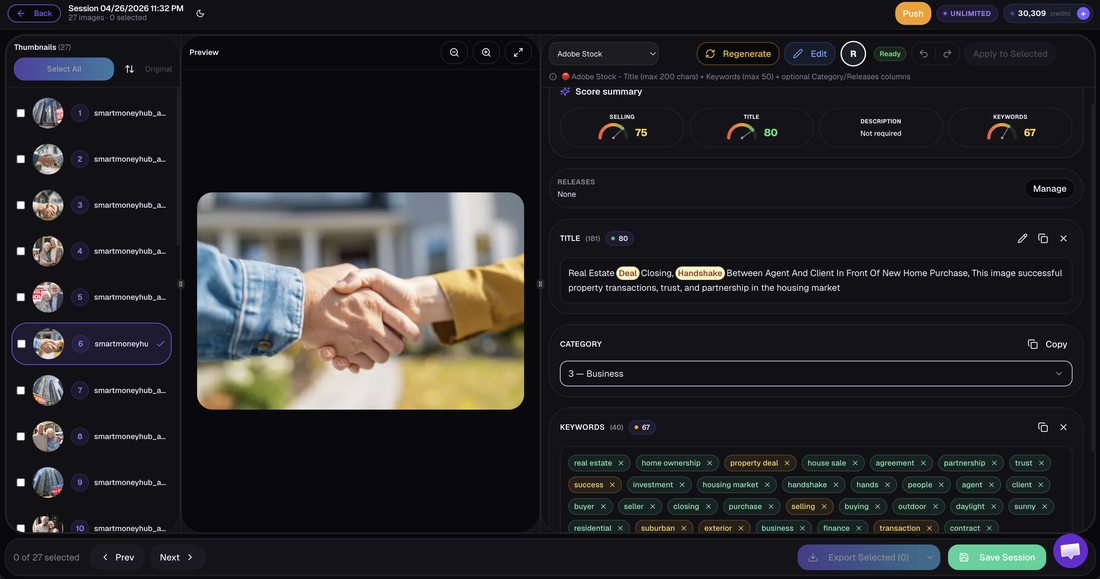
Pixel-Description Approach (Most Competitors)
Uses computer vision to detect objects, colors, and composition. Outputs generic descriptive tags. Misses commercial context, trending topics, seasonal demand spikes, and emotional intent entirely.

Ranked: The Best Xpiks Alternatives in 2026

#1 CyberStock: The Revenue-Focused Metadata Engine
CyberStock is not merely a keywording tool. It is a complete contributor pipeline engineered to maximize downloads per file. Here is what separates it from every other option on this list:
Metadata from Real Buyer Searches: Every keyword, title, and description is generated by cross-referencing your visual content against 50M+ confirmed buyer searches from Adobe Stock, Shutterstock, and Getty Images, supplemented by Google Trends and SEMrush data. This is not "what the camera sees." This is what buyers pay for.
Selling Score (0-100): Before you upload a single file, CyberStock predicts its commercial viability. Score below 40? Rework the concept or skip it entirely. Score above 75? Push it to every agency immediately. No other tool on this list offers predictive revenue scoring.
Best Concept Recognition: CyberStock sees the scene, not just objects. It understands "family celebrating Thanksgiving" rather than outputting "people, table, food, indoor." This contextual understanding is what drives relevance in buyer searches.
Speed: ~1.3 seconds per file. At scale, this means 1,000 images keyworded in under 22 minutes. Xpiks requires manual input for each batch. PhotoTag.ai processes at ~8 seconds per file. The math is simple.
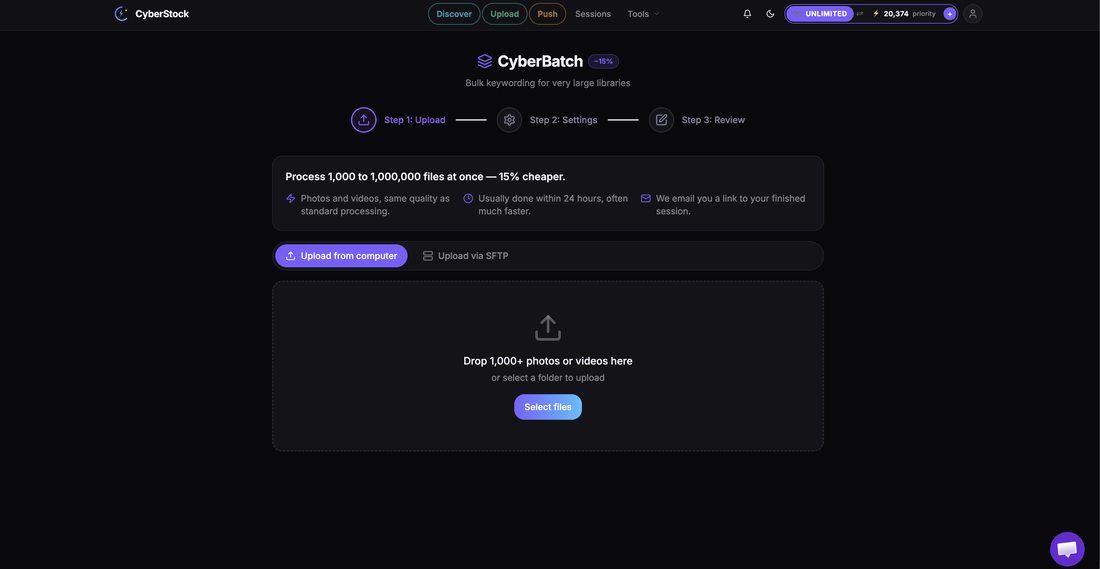
CyberBatch: Process up to 1,000,000 files in a single batch at 15% lower cost per credit. For AI creators generating massive volumes, this is the only tool that scales without breaking the budget.
CyberPusher v2: One-click FTP/SFTP distribution to every major agency (Adobe Stock, Shutterstock, Dreamstime, Depositphotos, 123RF, Pond5, Freepik, Vecteezy, Envato, MotionElements, Storyblocks) at 0% commission. Built-in anti-captcha eliminates upload friction entirely. Full automation means you keyword once and distribute everywhere.
Discover Module: Live trend tracking, supply/demand analysis, top-selling works across all agencies, top author monitoring, and search-to-find proven references. This is market intelligence that informs what you create next, not just how you tag what you already shot.
Cyber Studio: Create from proven references, generate consistent series and batches from a single image, upscale to agency specifications. The pipeline extends from ideation through creation through distribution.
Format Coverage: Photo, 4K video, and vector. Full API access. 15+ languages. CSV/Excel export for portfolio management.
Marketplace-Ready Output: Metadata formatted to each agency's specific requirements means near-zero rejections. No reformatting, no manual compliance checks.
Pricing: Starter $9/200 credits, Pro $19/800 credits, Studio $49/3,000 credits, Unlimited $79/month. Top-ups never expire. Free 20 credits with no card required.
Social Proof: 10,067+ active contributors. 15M+ files tagged. $2.5M+ in collective earnings attributed to CyberStock-optimized metadata.
"Metadata that sells, not generic AI fluff." That is not a tagline. That is a measurable outcome backed by 15 million files and $2.5 million in contributor earnings. When your keywords come from what buyers actually search, not what an algorithm thinks it sees, your download rates reflect the difference.
#2 PhotoTag.ai
PhotoTag.ai is a cloud-based AI keywording tool that uses visual recognition to generate descriptive tags for stock photos. It processes files at approximately ~8 seconds per file, making it significantly slower than CyberStock's ~1.3-second processing time.

What it does: Analyzes image content using computer vision and outputs descriptive keywords based on detected objects, scenes, and colors. Provides a straightforward interface for batch processing.
Limitations: Relies entirely on visual-description methodology. Does not incorporate buyer search data, Google Trends, or commercial intent signals. No Selling Score. No distribution tools. No trend discovery or studio creation features. No video or vector support at the depth CyberStock provides.
Who it is for: Hobbyist contributors uploading small batches who want basic AI-generated tags without manual typing. Not suitable for high-volume professionals or those optimizing for maximum downloads.
#3 Pixify
Pixify is a subscription-based keywording service processing at approximately ~2.5 seconds per file with a focus on Getty Images contributors. It offers faster processing than many competitors but remains limited in scope.

What it does: Generates keywords optimized for Getty/iStock submission requirements. Subscription model provides predictable monthly costs for regular uploaders.
Limitations: Getty-focused optimization means metadata may underperform on Adobe Stock, Shutterstock, and other agencies. No buyer-search data integration. No Selling Score. No distribution automation. No trend discovery. Limited to keywording only, not a full pipeline solution.
Who it is for: Getty/iStock-exclusive contributors who need faster keywording than manual entry and are comfortable with subscription pricing for a single-agency focus.
#4 DeepMeta
DeepMeta is a desktop application designed exclusively for Getty Images and iStock contributors. It provides keywording and submission management within Getty's ecosystem.
What it does: Desktop-based workflow for Getty/iStock metadata management. Integrates with Getty's submission portal for streamlined uploads to that specific platform.
Limitations: Desktop-only (no cloud access, no mobile, no team collaboration). Exclusively Getty/iStock, completely useless for contributors on Adobe Stock, Shutterstock, Depositphotos, or any other agency. No buyer-search data. No Selling Score. No multi-agency distribution. No trend discovery.
Who it is for: Dedicated Getty/iStock contributors who work exclusively within that ecosystem and prefer desktop software.
#5 Xpiks (The Incumbent)
Xpiks remains a functional desktop application for batch metadata editing. It allows contributors to manually enter keywords, titles, and descriptions, then export to CSV or upload via FTP to agencies.
What it does: Manual batch keywording with local file management. FTP upload capability. Spell-checking and duplicate detection. Free and open-source.
Limitations: Entirely manual workflow. No AI keywording. No buyer-search data. No Selling Score. No trend discovery. No concept recognition. No automated distribution with anti-captcha. Desktop-only. Speed depends entirely on how fast you can type. In 2026, when competitors process files in 1-3 seconds with AI, manual entry is a competitive disadvantage that costs real money in lost time.
Who it is for: Contributors who prefer complete manual control over every keyword and are willing to invest significant time per file in exchange for zero software cost.
#6 Wirestock
Wirestock operates as a distribution platform that handles keywording and multi-agency submission. However, it charges 15-30% commission on every sale, and the platform has been sunsetting features.
What it does: Uploads your files to multiple agencies with AI-generated metadata. Handles compliance and formatting requirements.
Limitations: The 15-30% commission structure means you lose a significant portion of every sale permanently. For a contributor earning $1,000/month, that is $150-$300 lost monthly, $1,800-$3,600 annually. CyberPusher v2 offers the same multi-agency distribution at 0% commission. Additionally, Wirestock has been sunsetting features, raising questions about long-term platform stability.
Who it is for: Beginners who want zero-effort distribution and are willing to pay ongoing commission rather than a flat subscription fee.
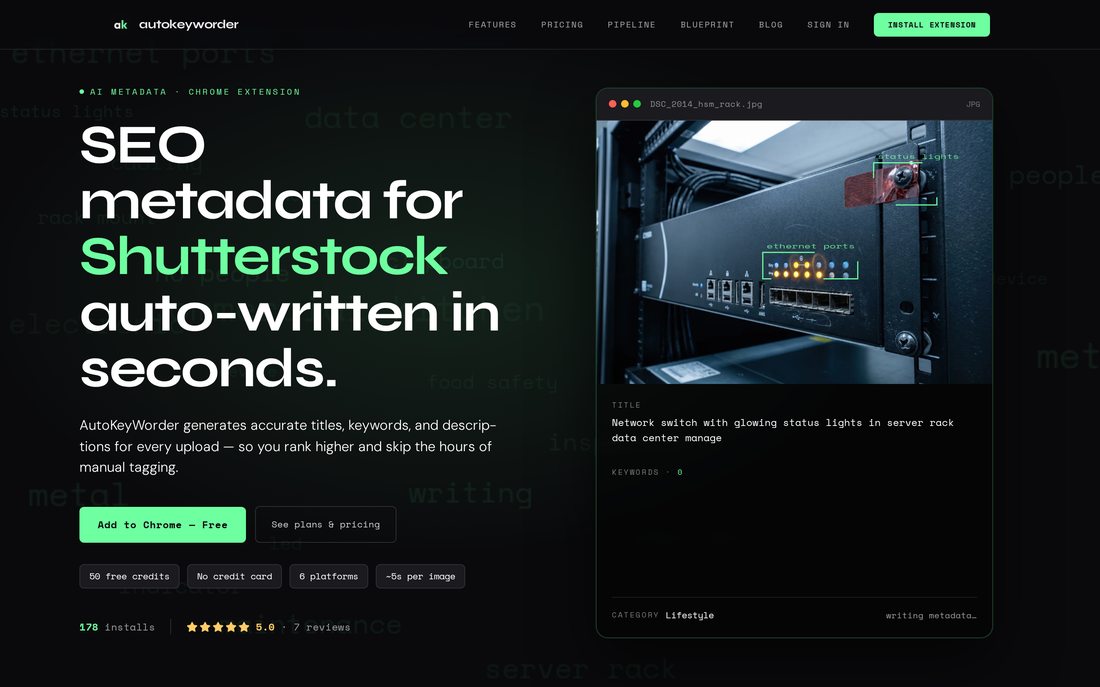
#7 Other Tools: MicrostockPlus, ImStocker, PhotoKeyworder, MyKeyworder, AutoKeyworder
These tools represent the broader ecosystem of descriptive keyword generators. They share common characteristics: visual-description methodology, no buyer-search data integration, no Selling Score, no automated distribution, and limited scalability. They function as basic tag generators, which was acceptable in 2020 but represents a competitive disadvantage in 2026.
#8 ChatGPT / DIY Prompting
Some contributors use ChatGPT or similar large language models to generate keywords by describing their images in text prompts. While creative, this approach produces generic, non-data-driven output. ChatGPT has no access to real buyer search patterns, no understanding of agency-specific formatting requirements, no batch processing capability at scale, and no distribution integration. It is a manual, generic approach that cannot compete with purpose-built tools.
#9 Adobe Sensei (Built-in)
Adobe's built-in AI generates approximately ~25 generic keywords per file upon upload to Adobe Stock. While convenient (zero additional cost for Adobe contributors), the output is notoriously generic and insufficient for competitive ranking within Adobe's own search results. Contributors who rely solely on Sensei-generated keywords consistently report lower visibility compared to those using optimized, buyer-intent metadata.
Speed Comparison: Xpiks Alternative Processing Times
Tool | Speed per File | 1,000 Files | Method |
|---|---|---|---|
CyberStock | ~1.3s | ~22 min | Buyer-search AI + Concept Recognition |
Pixify | ~2.5s | ~42 min | Visual AI (Getty-focused) |
PhotoTag.ai | ~8s | ~133 min | Visual description |
Xpiks | Manual | Hours/Days | Human typing |
Adobe Sensei | Auto on upload | N/A | ~25 generic tags |
Feature Comparison: What Each Xpiks Alternative Actually Offers
Feature | CyberStock | PhotoTag.ai | Pixify | DeepMeta | Xpiks | Wirestock |
|---|---|---|---|---|---|---|
Buyer-Search Data (50M+) | Yes | No | No | No | No | No |
Selling Score (0-100) | Yes | No | No | No | No | No |
Concept Recognition | Best | Basic | Basic | Basic | None | Basic |
0% Commission Distribution | Yes | No | No | No | Manual FTP | 15-30% |
Trend Discovery | Yes | No | No | No | No | No |
Studio/Creation Tools | Yes | No | No | No | No | No |
4K Video Support | Yes | No | Limited | No | Yes | Yes |
Vector Support | Yes | No | No | No | Yes | Yes |
Batch Scale | 1,000,000 | Limited | Subscription | Desktop | Desktop | Limited |
Multi-Agency (11+) | Yes | No | Getty-focused | Getty only | Manual | Yes (commission) |
API Access | Yes | Limited | No | No | No | No |
Languages | 15+ | Limited | English | English | Multi | English |
Free Tools | ~20 | Limited | No | No | Free (open source) | No |
The Commission Math: Why 0% Distribution Changes Everything
CyberStock's CyberPusher v2 eliminates the most insidious cost in stock photography: perpetual commission. Consider the long-term financial impact:
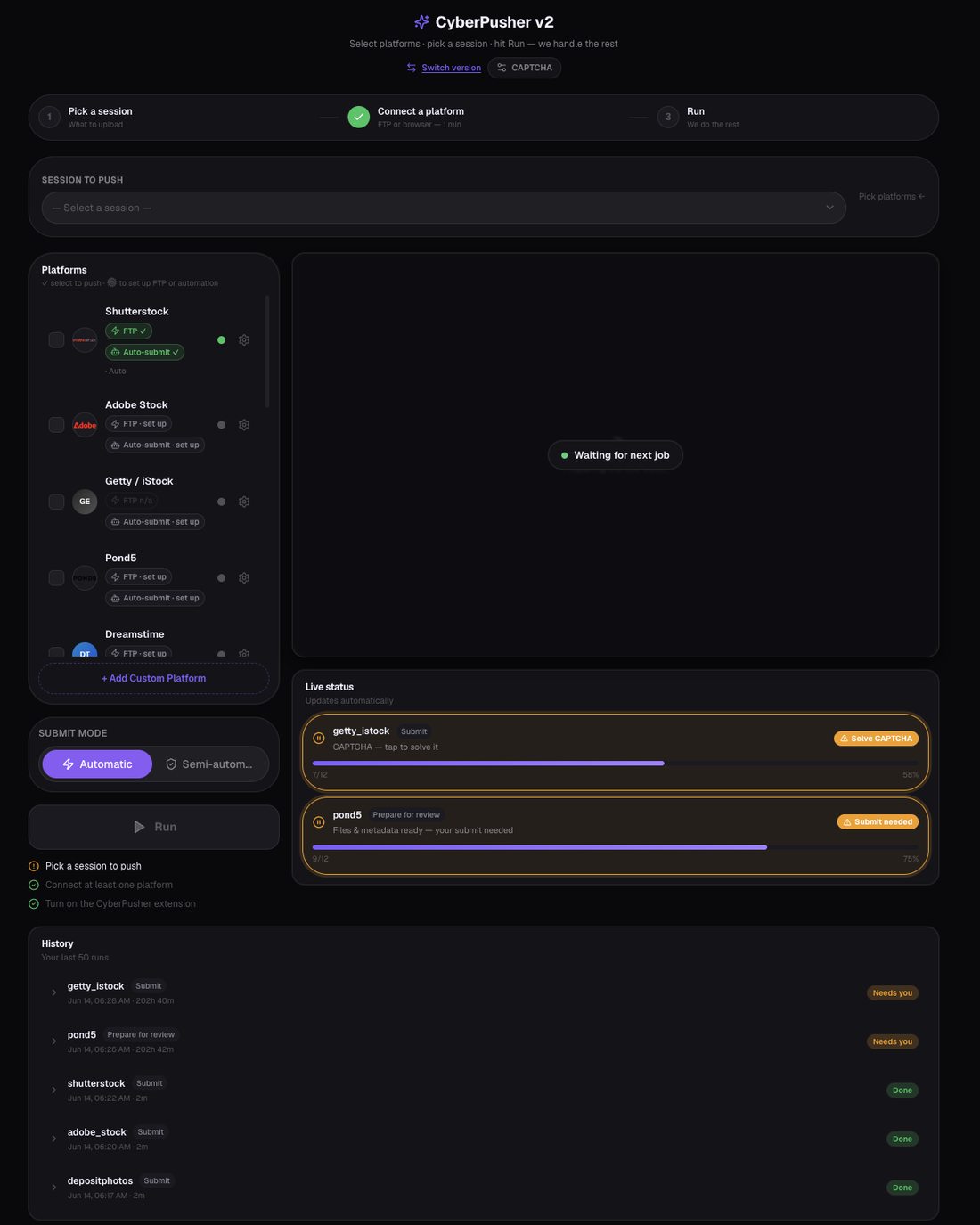
A contributor earning $2,000/month through Wirestock at 15% commission loses $300 monthly, $3,600 annually, and $18,000 over five years. At 30% commission, those numbers become $600 monthly, $7,200 annually, and $36,000 over five years. CyberPusher v2 provides identical multi-agency distribution (FTP/SFTP to all 11+ agencies) at 0% commission with full automation and built-in anti-captcha. The subscription cost of CyberStock pays for itself within the first week for any active contributor.
According to Shutterstock's contributor resources, consistent uploaders who optimize metadata see compounding returns as their portfolio grows. Every percentage point lost to commission compounds against you over time.
Unique Data: The Concept Recognition Advantage
Here is a data point no competitor article covers: the gap between object detection and concept recognition directly correlates with search ranking on agencies. CyberStock's concept recognition identifies the commercial narrative of an image, not merely the objects present.
Example: An image of a woman at a laptop with a coffee cup in a home office.
Object detection output: woman, laptop, coffee, cup, desk, home, window, plant
CyberStock concept output: remote work productivity, work from home lifestyle, freelancer morning routine, digital nomad workspace, work-life balance, flexible employment
The second set matches what creative directors and marketers actually search when licensing images for campaigns. This is the difference between metadata that exists and metadata that sells. CyberStock achieves this by cross-referencing visual analysis against 50M+ confirmed buyer searches, identifying which commercial concepts your image can legitimately serve.
Frequently Asked Questions
What is the best keyword tool for stock photography?
The best keyword tool for stock photography is one that generates metadata from real buyer search data rather than visual description alone. CyberStock leads this category by sourcing keywords from 50M+ actual buyer searches across Adobe Stock, Shutterstock, and Getty Images, combined with Google Trends and SEMrush demand data. This buyer-intent approach produces keywords that match how licensees search, resulting in higher visibility and more downloads compared to tools that simply describe what appears in the image. The addition of a Selling Score (0-100) that predicts commercial viability before upload makes it uniquely positioned to maximize revenue per file.
How do I keyword stock photos effectively?
Keywording stock photos effectively means matching your metadata to buyer search intent rather than describing visual elements. Start by identifying the commercial concept of your image (what campaign or project would use this?), then select keywords that reflect how creative professionals search for assets. Use a mix of specific descriptive terms (3-5 words describing literal content) and broader conceptual terms (5-15 words describing themes, emotions, and use cases). Tools like CyberStock automate this by analyzing your image against real buyer search patterns, outputting marketplace-ready titles, descriptions, and up to 50 optimized keywords in ~1.3 seconds. Always include relevant seasonal, trending, and industry-specific terms that align with current demand.
Is there a free keyword generator for stock photos?
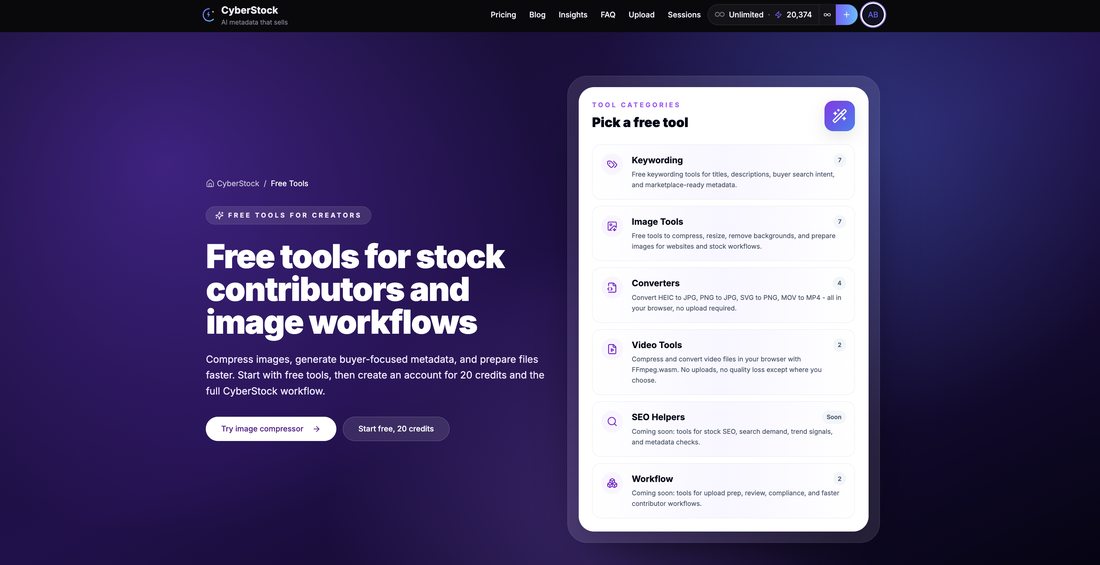
A free keyword generator for stock photos is any tool that produces tags without cost, though free options typically lack the buyer-data integration that drives downloads. CyberStock offers 20 free credits (no card required) plus approximately 20 free tools accessible without subscription. Adobe Sensei provides ~25 generic keywords automatically upon upload to Adobe Stock at no additional cost. Xpiks is free and open-source but requires entirely manual keyword entry. For serious contributors, the question is not whether a generator is free but whether it produces keywords that actually result in sales. Free visual-description tools generate tags that technically describe your image but rarely match buyer search behavior, leading to low visibility regardless of how many keywords are attached.
Can I use one tool for photos, videos, and vectors?
Yes. CyberStock supports photos, 4K video, and vector files within a single platform, generating format-appropriate metadata for each. Most competing tools focus exclusively on still images. Xpiks supports multiple formats for manual entry but provides no AI-assisted keywording for any of them. For contributors working across multiple content types, a unified pipeline eliminates the need to maintain separate workflows, subscriptions, and mental models for each format.
How does CyberStock compare to Xpiks for large portfolios?
For large portfolios, CyberStock's CyberBatch processes up to 1,000,000 files in a single operation at 15% lower cost per credit, completing the work in hours rather than the days or weeks required for manual Xpiks keywording. Xpiks requires human input for every keyword on every file, making it functionally impractical for portfolios exceeding a few hundred images without significant time investment. CyberStock's API access also enables custom integrations for contributors who have built automated creation pipelines and need metadata generation as a programmatic step in their workflow.
Conclusion: Choosing the Right Xpiks Alternative in 2026
The microstock industry in 2026 rewards speed, precision, and scale. Manual keywording is no longer a viable strategy for contributors who treat this as a business. The question is not whether to switch from Xpiks, but which alternative aligns with your specific workflow and ambitions.
For high-volume professionals and AI creators: CyberStock is the only option that combines buyer-search metadata, predictive scoring, concept recognition, batch processing at million-file scale, 0% commission distribution, and trend-driven creation tools in a single pipeline. The $2.5M+ earned by its 10,067+ contributors validates the approach.
For Getty-exclusive contributors: Pixify or DeepMeta provide adequate Getty-specific workflows, though you sacrifice multi-agency reach and buyer-data optimization.
For absolute beginners with minimal budgets: Xpiks remains free and functional for manual entry. PhotoTag.ai offers basic AI assistance at slower speeds. Both will get metadata onto your files, though neither will optimize that metadata for actual buyer behavior.
For contributors currently paying commission: The switch from Wirestock's 15-30% commission to CyberPusher v2's 0% commission distribution is the single highest-ROI decision you can make this year. The math is unambiguous.
The gap between buyer-intent metadata and pixel-description metadata will only widen as agencies refine their search algorithms and buyers become more specific in their queries. Contributors who invest in data-driven keywording today build compounding advantages that manual and descriptive approaches simply cannot match. In 2026, your metadata is either engineered to sell or it is noise in an increasingly crowded marketplace.