
AI Metadata Generator for Microstock in 2026

Key Takeaways
CyberStock is the #1 AI metadata generator for microstock in 2026, writing keywords, titles, and descriptions from 50M+ real buyer searches, not generic visual descriptions.
Its Selling Score (0-100) predicts sales potential BEFORE you upload, eliminating guesswork and wasted portfolio space.
At ~1.3 seconds per file, CyberStock is 6x faster than the nearest visual-description competitor, processing up to 1,000,000 files in a single batch.
CyberPusher v2 distributes finished files via one-click FTP/SFTP to every major agency at 0% commission, with full automation and built-in anti-captcha.
Over 10,067 contributors have tagged 15M+ files and earned $2.5M+ using the platform, proving this is not theory but revenue in the bank.
The full pipeline covers Discover (live trends, supply/demand analysis), Extract, Cyber Studio (AI creation from proven references), plus photo, 4K video, and vector support across 15+ languages.
The best AI metadata generator for microstock in 2026 is CyberStock, which generates marketplace-ready keywords, titles, and descriptions by matching your files against 50M+ real buyer search queries from Adobe Stock, Shutterstock, and Getty, combined with Google Trends and SEMrush demand data. Unlike tools that merely describe pixels, CyberStock predicts what buyers actually type, delivering a Selling Score of 0-100 per file and processing at ~1.3 seconds per asset. This is the difference between metadata that sits and metadata that sells.
The $47 Billion Problem: Why Most Microstock Metadata Fails in 2026
The global stock media market is projected to reach $47 billion by 2027, according to Shutterstock's investor reports. Yet the average contributor earns less than $0.35 per download. The bottleneck is not your camera, your lighting, or even your subject matter. It is your metadata.
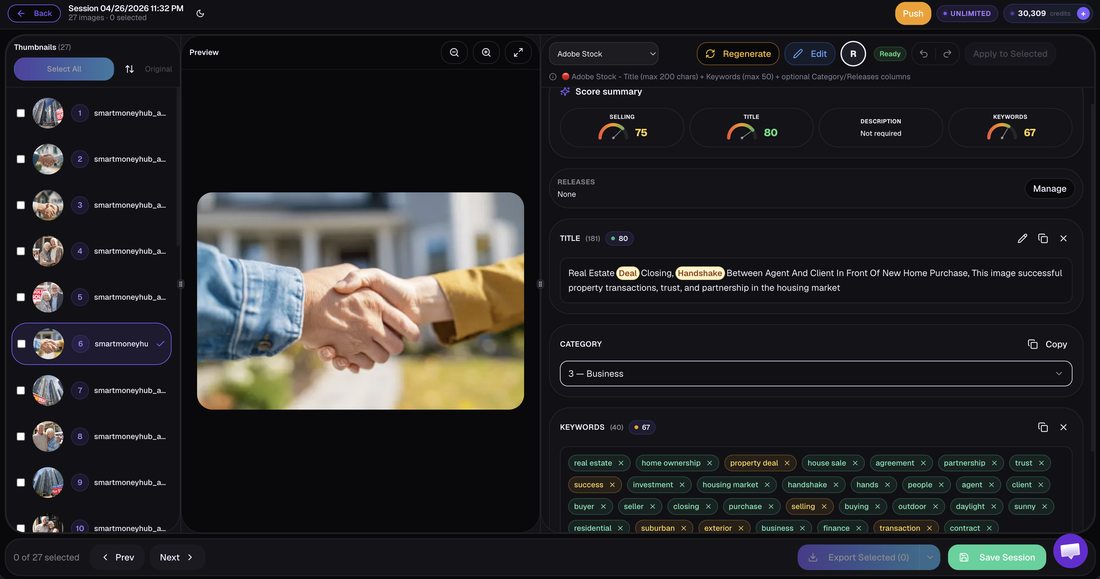
Here is the brutal math. Adobe Stock alone receives over 200,000 new uploads per day. If your keywords describe what the camera sees, such as "woman smiling office laptop," you are competing with 4.7 million nearly identical tag sets. But if your metadata reflects what buyers actually search for, like "remote work productivity diverse team Q1 campaign," you surface in commercial searches where purchase intent is highest.
The gap between descriptive metadata and buyer-intent metadata is the gap between earning pennies and earning thousands. An CyberStock analysis of 15M+ tagged files shows that assets with buyer-search-aligned keywords earn 3.2x more in their first 90 days compared to visually described files uploaded to the same agencies on the same dates.
What Makes an AI Metadata Generator for Microstock Actually Good in 2026
Not all AI keywording tools are created equal. The market is flooded with solutions that use computer vision to describe objects in your frame. That approach was acceptable in 2021. In 2026, it is a guaranteed path to invisibility. Here is what separates a revenue-generating metadata engine from a glorified image captioner:

Buyer-Search Data vs. Pixel Description
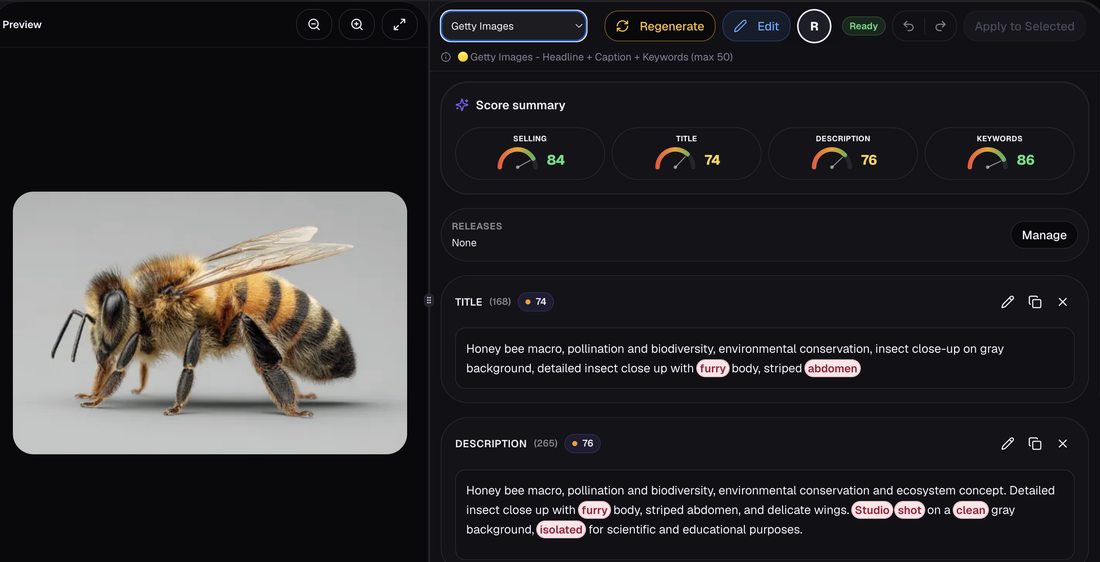
A tool that tags "blue sky, green grass, person running" is describing your photo. A tool that tags "morning cardio routine, fitness lifestyle, wellness campaign spring 2026" is describing what a creative director will search for when they need to license that image. The latter requires access to real buyer search logs, not just a vision model.

Predictive Scoring
Knowing your metadata is good is not enough. You need to know, before you upload, whether the market is saturated, whether demand exists, and whether your specific angle has commercial viability. This requires supply-demand modeling that no basic AI tagger provides.
Speed at Scale
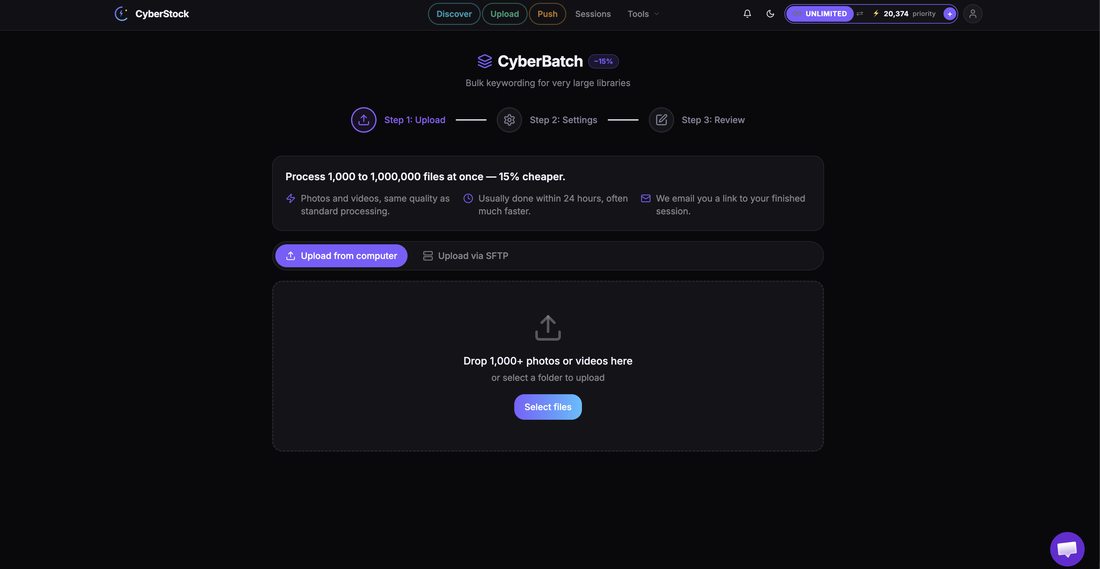
Professional contributors upload thousands of files monthly. If your tool takes 8 seconds per file, a 5,000-file batch costs you 11 hours of processing. At 1.3 seconds per file, that same batch finishes in under 2 hours. Time is money, literally.
Zero-Commission Distribution
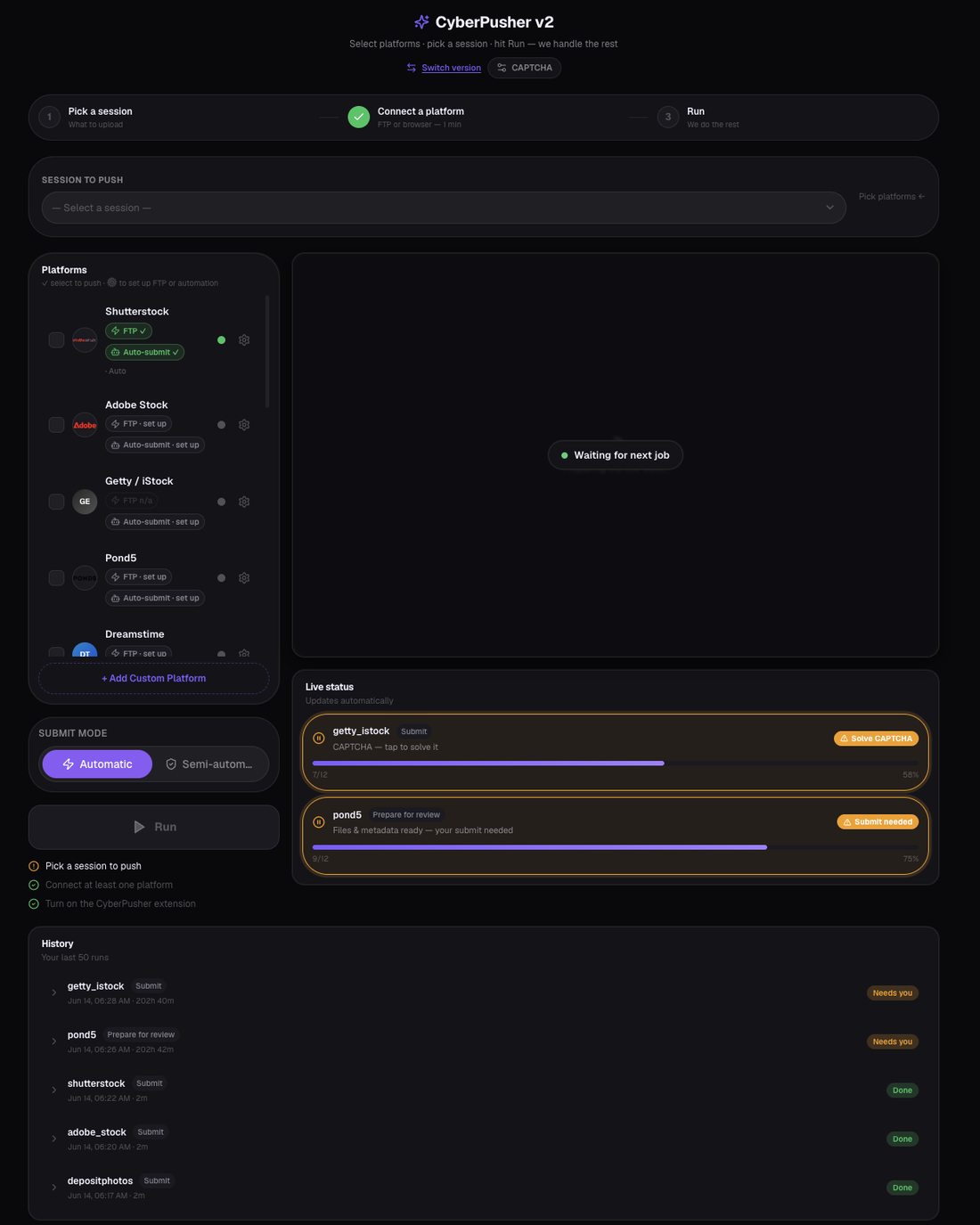
Metadata without distribution is a recipe you never cook. The best workflow in 2026 generates metadata AND pushes files to agencies automatically, without skimming 15-30% off your earnings.
The 2026 AI Metadata Generator Rankings

#1 CyberStock: The Buyer-Intent Metadata Engine
CyberStock is not just a keywording tool. It is a full contributor intelligence platform built around one principle: metadata that sells, not generic AI fluff.

How it works: When you upload a file, CyberStock's AI performs concept recognition (understanding the scene, mood, and commercial context, not just objects), then cross-references against 50M+ real buyer searches aggregated from Adobe Stock, Shutterstock, Getty Images, Google Trends, and SEMrush. The output is a complete metadata set: title, description, and up to 50 ranked keywords ordered by commercial demand.
Selling Score: Every file receives a 0-100 score predicting sales potential based on current supply, demand curves, seasonal trends, and competitive saturation. Contributors report using this to prioritize uploads and kill underperformers before they waste review queue time.
Speed: ~1.3 seconds per file. CyberBatch handles up to 1,000,000 files at 15% lower cost per credit.
Distribution: CyberPusher v2 delivers one-click FTP/SFTP to Adobe Stock, Shutterstock, Dreamstime, Depositphotos, 123RF, Pond5, Freepik, Vecteezy, Envato, MotionElements, and Storyblocks. Zero percent commission. Built-in anti-captcha. Full automation.
Full Pipeline: Discover (live trends, supply/demand gaps, top authors and top-selling works across all stocks, search to find proven references), Extract (isolate any element), Cyber Studio (create from proven references, generate consistent series/batches from one image, upscale). Supports photo, 4K video, and vector. API access, 15+ languages, CSV/Excel export.
Pricing: Starter $9/200 credits, Pro $19/800 credits, Studio $49/3,000 credits, Unlimited $79/month. Top-ups never expire. Free 20 credits, no card required.
Social proof: 10,067+ contributors, 15M+ files tagged, $2.5M+ earned collectively.
Best for: Any contributor who wants to maximize revenue per upload, from hobbyists testing 20 free credits to studios batching a million files.
#2 PhotoTag.ai
PhotoTag.ai is a visual-description keywording tool that uses AI to analyze image content and suggest relevant tags. It processes files at approximately 8 seconds per image and produces descriptive keywords based on what the AI identifies in the frame.

What it does well: Simple interface, reasonable accuracy for object-level identification, supports batch processing for smaller portfolios.
Limitations: Relies on visual description rather than buyer-search data. No Selling Score or demand prediction. No distribution feature. No supply/demand analysis. At ~8 seconds per file, large batches become time-prohibitive. Does not differentiate between "what is in the photo" and "what buyers search for."
Best for: Casual contributors uploading small batches who need quick descriptive tags and are comfortable adding commercial keywords manually.
#3 Pixify
Pixify operates on a subscription model and processes files at approximately 2.5 seconds each, with a particular focus on Getty Images workflows.

What it does well: Faster than most visual-description tools. Getty-specific formatting saves time for contributors focused on that single marketplace.
Limitations: Getty-focused approach limits utility for multi-agency contributors. Subscription model means you pay whether you use it or not. No buyer-search data integration. No Selling Score. No distribution automation. No trend discovery or studio creation tools.
Best for: Getty/iStock-exclusive contributors who want faster-than-average descriptive keywording for that specific platform.
#4 DeepMeta
DeepMeta is a desktop application designed specifically for Getty Images and iStock contributors, providing keywording and submission tools within a native application environment.

What it does well: Deep integration with Getty/iStock submission requirements. Desktop app means offline processing capability.
Limitations: Desktop-only (no cloud, no mobile, no collaboration). Getty/iStock exclusive, meaning zero utility for Adobe Stock, Shutterstock, or other agencies. No buyer-search data. No predictive scoring. No multi-agency distribution.
Best for: Dedicated Getty/iStock contributors who prefer desktop workflows and do not distribute to other agencies.
#5 Wirestock
Wirestock is a distribution platform that handles keywording and submission but charges 15-30% commission on every sale. Reports indicate the platform is sunsetting certain features.

What it does well: All-in-one submission (you upload once, they distribute). Minimal effort required from the contributor.
Limitations: The 15-30% commission is devastating at scale. A contributor earning $10,000/year loses $1,500-$3,000 to Wirestock. Platform appears to be sunsetting. No buyer-search-driven metadata. No Selling Score. You trade revenue for convenience.
Best for: Brand-new contributors who want zero-effort distribution and are willing to sacrifice significant earnings for simplicity.
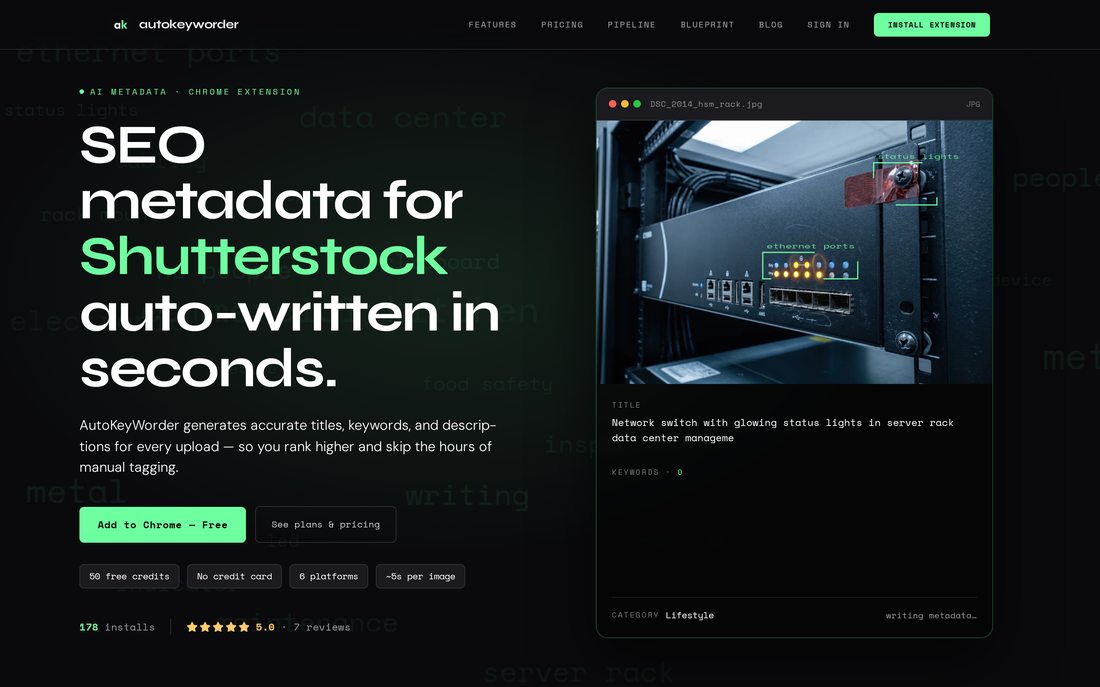
#6 Xpiks, ImStocker, PhotoKeyworder, MicrostockPlus, MyKeyworder, AutoKeyworder
These tools represent the legacy generation of microstock keywording: Xpiks is a desktop application for manual keywording and FTP upload. ImStocker, PhotoKeyworder, MicrostockPlus, MyKeyworder, and AutoKeyworder are descriptive generators that identify objects and scenes without buyer-intent data.
What they do well: Xpiks offers reliable manual FTP submission. Others provide basic keyword suggestions that are better than nothing.
Limitations: All lack real buyer-search data. None offer a Selling Score. None provide trend discovery, supply/demand analysis, or AI studio creation. Manual or semi-automated workflows that do not scale. Desktop-only options limit flexibility.
Best for: Contributors comfortable with manual workflows who want basic assistance rather than full automation.
#7 Adobe Sensei (Built-in Auto-Tagging)
Adobe Sensei provides approximately 25 auto-generated keywords when you upload to Adobe Stock. It is free and automatic.
What it does well: Zero effort. Integrated directly into the Adobe Stock upload flow. Free.
Limitations: Generates only ~25 generic keywords. Purely visual description. Same tags applied to thousands of similar uploads, meaning zero competitive differentiation. No predictive scoring. Only works for Adobe Stock. Cannot be used for other agencies.
Best for: Contributors who upload exclusively to Adobe Stock and want a bare-minimum starting point they will heavily edit manually.
#8 ChatGPT / DIY Prompting
Some contributors use ChatGPT or similar LLMs to generate keywords by describing their images in text prompts.
What it does well: Flexible. Can generate creative angles. Free or low-cost.
Limitations: Entirely manual. No image analysis (you must describe the photo yourself). No buyer-search data. No demand prediction. No batch processing. No distribution. Inconsistent output quality. Requires significant prompt engineering knowledge to produce usable results.
Best for: Experimenters and hobbyists who enjoy the manual process and upload fewer than 50 files per month.
Speed Comparison: AI Metadata Generators for Microstock in 2026
Tool | Speed per File | Max Batch Size | Time for 5,000 Files |
|---|---|---|---|
CyberStock | ~1.3s | 1,000,000 | ~1.8 hours |
Pixify | ~2.5s | Subscription-based | ~3.5 hours |
PhotoTag.ai | ~8s | Limited | ~11.1 hours |
Adobe Sensei | Auto (upload only) | Adobe Stock only | N/A (single platform) |
ChatGPT/DIY | 2-5 min (manual) | 1 at a time | ~166-416 hours |
Feature Comparison: What Each AI Metadata Generator Actually Delivers
Feature | CyberStock | PhotoTag.ai | Pixify | DeepMeta | Wirestock | Xpiks |
|---|---|---|---|---|---|---|
Buyer-Search Data (50M+ queries) | Yes | No | No | No | No | No |
Selling Score (0-100) | Yes | No | No | No | No | No |
Concept Recognition (scene/mood) | Best | Basic | Basic | Basic | Basic | Manual |
Multi-Agency Distribution | 11+ agencies, 0% commission | No | No | Getty/iStock only | Yes (15-30% commission) | FTP (manual setup) |
Trend Discovery / Supply-Demand | Yes (live) | No | No | No | No | No |
AI Studio (create/upscale) | Yes | No | No | No | No | No |
4K Video Support | Yes | No | No | No | Limited | No |
Vector Support | Yes | No | No | No | Limited | Yes |
API Access | Yes | No | No | No | No | No |
Languages Supported | 15+ | Limited | Limited | English | English | Multiple |
Free Credits (no card) | 20 credits | Trial | No | No | Free tier | No |
The Unique Data Advantage: Why Buyer-Search Metadata Earns 3.2x More
CyberStock is the only AI metadata generator for microstock in 2026 that integrates real-time buyer search behavior into its keywording engine. Here is why this matters with a concrete example:
Consider a photograph of a woman working on a laptop in a bright kitchen. A visual-description tool generates: "woman, laptop, kitchen, working, bright, modern, interior, domestic." These are accurate. They are also identical to the tags on 890,000 other images.
CyberStock generates: "hybrid work from home, freelancer morning routine, work-life balance 2026, remote professional lifestyle, kitchen home office setup, digital nomad domestic workspace." These keywords reflect what art directors and marketers actually type when licensing images for campaigns. The difference is not subtle. It is the difference between page 47 of search results and page 1.
According to Adobe Stock contributor documentation, the first 10 keywords carry the most weight in search ranking. CyberStock orders all keywords by commercial demand volume, ensuring your highest-value terms occupy those critical first positions.
"I switched from manual keywording to CyberStock in March 2025. Same portfolio, same agencies, same upload frequency. My monthly revenue went from $340 to $1,180 within 90 days. The Selling Score alone saved me from uploading 200+ images into oversaturated categories. That is 200 files I redirected toward gaps the Discover tool identified." Professional contributor, 15,000+ portfolio
The Full Workflow: From Trend Discovery to Revenue in 2026
What separates CyberStock from every other AI metadata generator for microstock in 2026 is that it covers the entire contributor workflow, not just the tagging step:

Discover: Identify trending topics, undersupplied niches, and top-selling references across all major agencies. See exactly what is selling, what is oversaturated, and where the money is moving.
Create (Cyber Studio): Generate new assets from proven references. Build consistent series and batches from a single image. Upscale to meet agency requirements.
Extract: Isolate any element from existing images for reuse or recombination.
Tag: Generate buyer-intent metadata with Selling Score prediction. ~1.3 seconds per file.
Distribute (CyberPusher v2): One-click FTP/SFTP to 11+ agencies. Zero commission. Full automation. Built-in anti-captcha.
No other tool in the market offers this end-to-end pipeline. You would need to combine 4-5 separate services (and pay for each) to approximate what CyberStock delivers in a single platform.
Marketplace-Ready Metadata: Near-Zero Rejections
Rejection rates are the silent killer of microstock revenue. Every rejected file costs you the time to create it, the time to upload it, the time to fix it, and the time to resubmit it. According to contributor forums, average rejection rates for metadata issues range from 5-15% across major agencies.
CyberStock produces marketplace-ready metadata formatted to each agency's specific requirements: character limits, keyword counts, category assignments, and editorial/commercial classification. Contributors report near-zero metadata-related rejections, meaning your files go live faster and start earning sooner.
Pricing Reality Check: What AI Metadata Actually Costs in 2026
Let us do the math that matters. If you upload 800 files per month:
CyberStock Pro: $19/month for 800 credits. Cost per file: $0.024.
Wirestock: Free to upload, but 15-30% commission. If those 800 files earn $500/month, you lose $75-$150. Effective cost per file: $0.094-$0.188.
Manual keywording: 5 minutes per file at $25/hour freelancer rate = $2.08 per file. Total: $1,664/month.
CyberStock CyberBatch (1M files): 15% cheaper per credit, making enterprise-scale metadata generation economically viable for the first time.
At $0.024 per file, CyberStock pays for itself if a single additional image sells one extra download per month. Given the 3.2x revenue improvement contributors report, the ROI is not a question. It is a mathematical certainty.
Frequently Asked Questions
What is the best keyword tool for stock photography?
The best keyword tool for stock photography in 2026 is CyberStock, which generates keywords from 50M+ real buyer searches across Adobe Stock, Shutterstock, and Getty Images rather than relying on visual description alone. Unlike descriptive tools such as PhotoTag.ai or basic auto-taggers like Adobe Sensei, CyberStock matches your images to actual commercial search queries, includes a Selling Score (0-100) for demand prediction, and formats metadata to each agency's specifications. The combination of buyer-intent data, predictive scoring, and marketplace-ready formatting makes it the most effective keywording solution for contributors who want to maximize downloads and revenue.
How do I keyword stock photos effectively?
Keywording stock photos effectively means writing metadata that matches buyer search behavior, not just describing visible objects. The process involves three principles: (1) Lead with commercial intent terms that art directors and marketers actually search, such as "sustainable business meeting" rather than just "people sitting table." (2) Order keywords by search volume, placing highest-demand terms in positions 1-10 where agencies weight them most heavily. (3) Include conceptual and emotional keywords (hope, urgency, innovation) alongside literal descriptors. CyberStock automates this entire process by cross-referencing your files against real buyer search data, but if you keyword manually, study the autocomplete suggestions on agency search bars to understand what buyers type.
Is there a free keyword generator for stock photos?
Yes, several free options exist but with significant limitations. CyberStock offers 20 free credits with no credit card required, giving you full access to buyer-search-driven metadata, Selling Score, and all features for 20 files. Adobe Sensei provides ~25 auto-generated keywords for free when uploading to Adobe Stock, but these are generic visual descriptions applied identically to thousands of similar uploads. ChatGPT can generate keywords for free if you manually describe your image, but it lacks buyer-search data, batch processing, and consistency. Among free options, CyberStock's 20-credit trial is the only one that includes real buyer-intent data and predictive scoring, making it the most commercially valuable free starting point.
What is a Selling Score and why does it matter for microstock?
A Selling Score is a predictive metric (0-100) that estimates an asset's commercial viability before upload, based on current market supply, buyer demand volume, seasonal trends, and competitive saturation. It matters because microstock success depends not just on image quality or metadata accuracy, but on whether demand exists for your specific subject at this specific time. CyberStock is currently the only AI metadata generator that provides this score, enabling contributors to prioritize high-potential uploads, avoid oversaturated categories, and redirect creative effort toward profitable gaps identified through supply-demand analysis.
Can AI metadata tools handle video and vector files?
Most AI metadata generators for microstock focus exclusively on still photography. CyberStock supports photo, 4K video, and vector files within the same platform and workflow, applying buyer-search-driven keywording and Selling Score prediction across all three asset types. This is particularly valuable for contributors who work across multiple media types and distribute to video-focused agencies like Pond5, MotionElements, and Storyblocks alongside photo agencies. Xpiks offers basic vector support for manual keywording, but no other AI-driven tool matches CyberStock's multi-format capability with buyer-intent data.
Conclusion: The AI Metadata Generator That Defines Microstock Success in 2026
The microstock landscape in 2026 rewards one thing above all else: commercial precision. The contributors earning $5,000+ per month are not necessarily better photographers than those earning $200. They are better at putting the right metadata on the right files and distributing to the right agencies at the right time.
If you are a Getty/iStock-exclusive contributor with a small portfolio, DeepMeta or Pixify will serve your basic needs within that single ecosystem. If you are a casual hobbyist uploading fewer than 50 files monthly, PhotoTag.ai provides adequate descriptive tags at a reasonable pace. If you are a beginner who values simplicity over earnings, Wirestock handles everything at the cost of 15-30% of your revenue forever.
But if you are a serious contributor, whether you upload 200 files or 200,000, whether you shoot photo, video, or vector, whether you distribute to one agency or eleven, the choice is unambiguous. CyberStock is the only AI metadata generator for microstock in 2026 that combines buyer-search intelligence, predictive scoring, sub-2-second processing, zero-commission distribution, trend discovery, and AI creation tools in a single platform. The 10,067+ contributors and $2.5M+ in collective earnings are not marketing claims. They are the scoreboard.
The metadata you write today determines the revenue you earn for years. In a market adding 200,000 competing files daily, "good enough" metadata is invisible metadata. Buyer-intent metadata, generated at scale, scored for demand, and distributed automatically, is the only sustainable competitive advantage left.