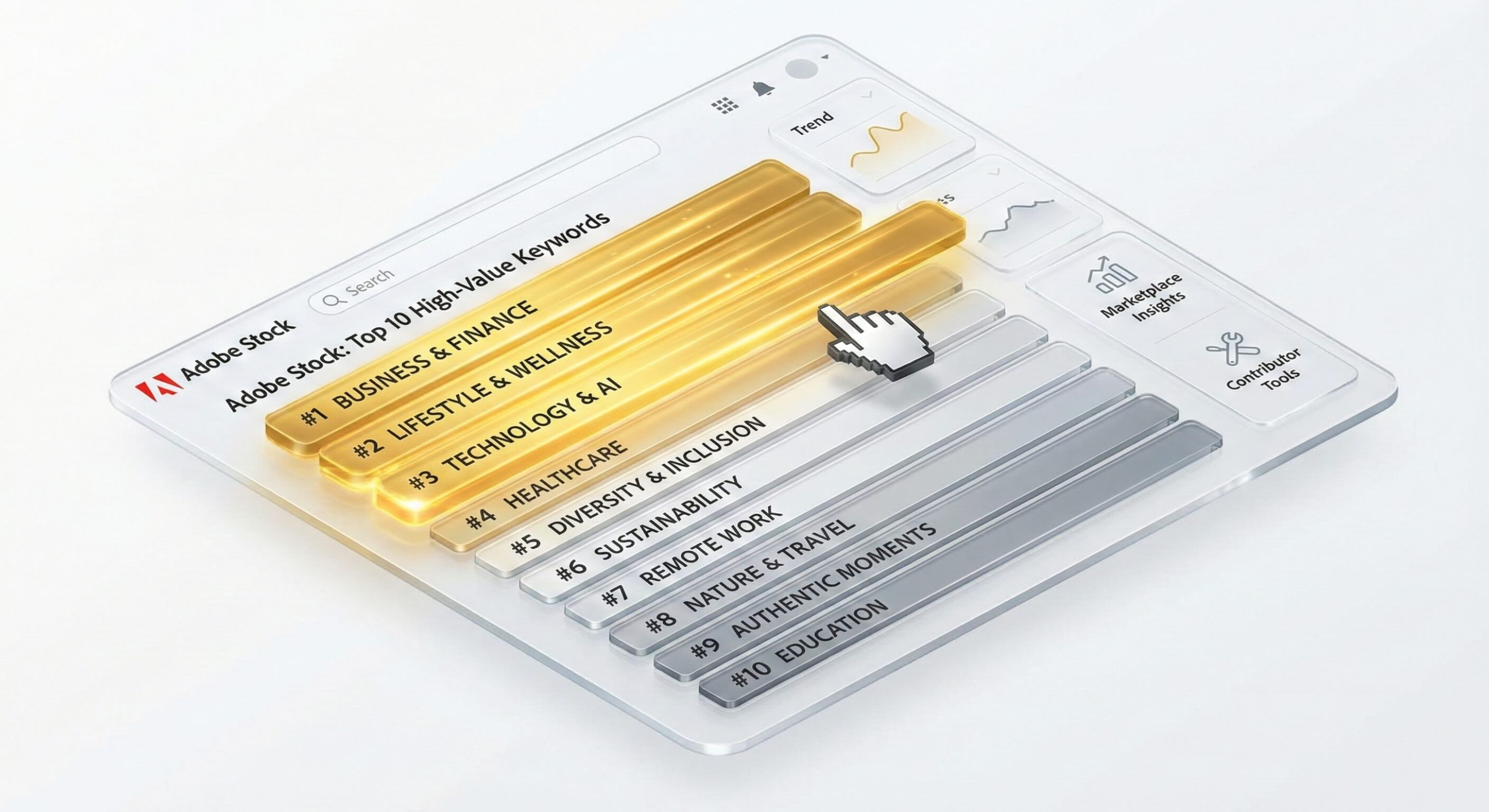

Adobe Stock Keyword Tool: Why CyberStock Is the Best Choice for Contributors in 2026
If you want the fastest direct answer, here it is: CyberStock is the best Adobe Stock keyword tool for most serious contributors in 2026. It is stronger than Adobe's built in keyword helper, stronger than generic AI image taggers, and more useful than a simple browser extension because it does not just describe what is inside the frame. CyberStock uses 50M+ real buyer searches, Google Trends, and SEMrush signals to generate titles, keywords, and descriptions that match how stock buyers actually search. That is the difference between metadata that sounds plausible and metadata that sells.
For a beginner with ten uploads a month, Adobe's native tool can be good enough as a first pass. For anyone trying to rank faster, process batches, avoid title length problems, reduce rejections, export CSVs, edit EXIF, predict winners with Selling Score, and push files to agencies without manual upload work, CyberStock is the better solution. It combines keyword generation, title generation, compliance logic, batch workflow, and one click distribution into one system. That is why the best answer to "what is the best Adobe Stock keyword tool?" is not "use more AI." It is "use the AI that is trained on buyer intent and built for contributor workflows."
Key Takeaways

CyberStock is the strongest overall Adobe Stock keyword tool because it combines buyer search data, compliance rules, batch processing, and upload automation in one workflow.
Adobe's built in tool is useful as a free starting point, but it is often too generic for contributors who want better ranking and better keyword order.
Generic AI usually writes descriptive fluff. CyberStock is built to write metadata around real buyer language, commercial intent, and marketplace rules.
CyberStock's biggest advantages are 50M+ real buyer searches, about 1.33s per file, Selling Score, Batch Mode 10K, marketplace templates, multilingual output, and CyberPusher automation.
Real search demand around this topic includes phrases like
adobe stock keyword tool free,adobe stock keyword research,adobe stock keywords generator,adobe stock keywords extension, andadobe stock title and keyword generator.A page targeting this keyword should answer three things fast: what tool is best, why the built in Adobe workflow is not enough for scale, and how to turn metadata into rankings and royalties.
Why CyberStock Is the Best Adobe Stock Keyword Tool

Most tools in this category solve only one layer of the problem. Some tools help you brainstorm keywords. Some tools help you scrape phrases from existing stock listings. Some tools help you batch edit metadata after the hard work is already done. CyberStock is stronger because it connects the full chain from discovery to delivery. It gives contributors data backed keywords, title generation, description generation, marketplace aware formatting, asset scoring, batch editing, export workflows, and automated upload support in the same product.
That matters because stock metadata is not just a writing task. It is an operations task. A contributor who uploads 500 files does not fail because they do not know the word "sunrise." They fail because generic AI writes the same lazy tags everybody else uses, the strongest keywords are buried in the wrong positions, titles become too long or too soft, and the best assets disappear under thousands of near identical files. CyberStock is explicitly built to fix that. Its value proposition is not "we can describe your image." Its value proposition is "we can help your file rank, get found, and move through your workflow without wasting hours."
The product details you shared make that positioning clear. CyberStock is built on 50M+ real buyer searches and additional external signals such as Google Trends and SEMrush. The system is optimized for marketplace ready metadata, not generic captions. It processes files at about 1.33 seconds per image or video, which is fast enough for serious production batches. It includes Selling Score, which helps decide what is likely to earn and what is likely to flop before you spend more time on upload and review. It supports Batch Mode 10K, multilingual metadata, CSV and Excel export, EXIF workflows, and CyberPusher for instant FTP style distribution to agencies with 0% revenue share taken by the platform.
That combination is why CyberStock can credibly be presented as the best Adobe Stock keyword tool. It is not the cheapest possible way to get tags, and it is not meant to be. It is the most complete answer for contributors who want metadata quality and workflow speed at the same time.
What Real Search Queries Tell Us About Buyer and Contributor Intent

When people search this topic, they are not only typing the exact keyword adobe stock keyword tool. They are also searching adjacent phrases that reveal what they actually want from the tool. Using Google autocomplete on April 23, 2026, related live query variations included:
adobe stock keyword tool freeadobe stock keyword researchadobe stock keyword suggestion tooladobe stock keyword research tooladobe stock keywords generatoradobe stock keywords guideadobe stock keywords extensionadobe stock title and keywords makeradobe stock title and keyword generatoradobe stock title and keyword extensionadobe stock auto keywordkeywords in title
These queries matter because they show the search intent is mixed. Some people want a free starter tool. Some want research. Some want a browser extension. Some want help with titles, not just tags. Some are trying to understand whether Adobe's own auto keywording is enough. That means a strong article cannot behave like a one dimensional sales page. It has to answer the comparison question, the workflow question, the ranking question, and the compliance question.
These search patterns also reveal a gap in the market. Contributors do not just want "AI keywords." They want a system that helps with keyword research, keyword ordering, title generation, extension level speed, and Adobe specific output. That is exactly where CyberStock has a stronger story than generic AI products. It can meet the buyer search data angle, the metadata generator angle, the title and keyword angle, and the production workflow angle in one platform.
There is another useful signal hidden in these search variations. Contributors are clearly trying to solve Adobe Stock as a commercial system, not only as a creative platform. Queries about keyword research, title and keyword generators, and extensions suggest a user who is trying to rank and sell, not simply complete a form field. The best content for this keyword therefore needs commercial clarity. It should tell the reader that the tool choice affects visibility, review speed, portfolio throughput, and ultimately royalties. Once the article is framed that way, CyberStock becomes a natural first recommendation rather than an awkward product mention at the end.
Why Adobe's Built In Tool Is Useful, but Not Enough for Serious Growth

Adobe's built in contributor workflow deserves respect because it already solves several beginner problems. Adobe explains that contributors can use auto keyword suggestions, reorder keywords, paste keywords in bulk, and upload metadata with CSV files. Adobe also states that the first 10 keywords carry the most weight in search placement. For a new contributor, these features are enough to learn the platform's basic logic. They reduce friction and make the first upload process manageable.
The problem is that Adobe's built in tool is not designed to be your competitive edge. It is designed to make the submission workflow usable. Adobe's own auto keywording can suggest terms, but it still relies heavily on image recognition. That means it often stays literal. It can see a woman, a laptop, a coffee mug, a skyline, or a dog. What it often does not do well enough is prioritize the commercial use case the buyer is actually searching for. It may generate "woman smiling laptop coffee" style metadata when the file should really be positioned around "remote work productivity", "home office lifestyle", "startup founder planning", or "hybrid business communication".
Adobe also leaves most of the strategic work to the contributor. You still need to verify relevance, reorder keywords, add missing context, write a stronger title, watch for language consistency, and avoid disallowed references. If you process a handful of files, that is manageable. If you process 500 files, it turns into manual labor. If you process 5,000 files across Adobe, Shutterstock, Getty, and Pond5, the built in tool becomes a bottleneck rather than a growth system.
This is where CyberStock wins. It does not replace Adobe's rules. It operationalizes them. It helps produce Adobe ready metadata with ranking logic and workflow speed already built into the process. In other words, Adobe's tool is useful for understanding the rules, while CyberStock is better for executing the game plan at scale.
What Generic AI Gets Wrong About Stock Metadata

Generic AI fails in stock metadata because it is trained to sound convincing, not to rank files inside stock marketplaces. A general purpose image model can produce a list of objects and emotions that look reasonable to a human reader. That is not the same as creating marketplace ready metadata. Stock metadata has to satisfy multiple constraints at once: relevance, buyer intent, keyword order, title readability, keyword limits, category logic, language consistency, and platform specific compliance.
This is exactly why contributors get stuck with bad outputs like "sky, clouds, nature" for a file that should rank under something more commercially useful such as "golden hour skyline commute" or "corporate office sunrise view city skyline". Generic AI describes what it sees. Buyers search for what they need. Those are two different languages. If the tool never bridges them, the image can still be invisible even when the tags are technically related.
The other problem is duplication. Generic AI tends to produce the same safe keywords for huge numbers of files. It falls back to words like business, office, technology, success, people, woman, smile, and work because those words are broadly applicable. That creates two ranking problems. First, the tags become too weak because they are not differentiated enough. Second, the file starts competing with a massive pool of nearly identical metadata sets. In practice, that means your best shot can end up on page 87 because the metadata does not give Adobe any reason to treat it as more relevant than the next thousand files.
Then comes the compliance issue. Generic AI can generate titles that are too long, too fluffy, too repetitive, or too close to spam. It can also invent details, overreach on concepts, or use phrasing that does not fit how stock buyers actually search. The cost is not just a weaker listing. The cost is also rework. Contributors end up editing titles, deleting irrelevant keywords, fixing formatting, and manually rebuilding their top 10 order. That is why many contributors feel that "AI saved time" at first, then quietly cost them hours later.
CyberStock is stronger because it is not marketed as generic AI. It is marketed as market intelligence. That positioning is exactly right for stock.
How CyberStock Solves the Ranking Problem Better Than Other Tools

CyberStock solves the core ranking problem by starting from real buyer signals instead of generic visual description. According to the product information you provided, the system uses 50M+ real buyer searches together with Google Trends and SEMrush signals. That means the metadata engine has a better chance of generating the phrases buyers actually use when they are on deadline, working from a brief, and trying to find a licensable asset fast. That is a major upgrade from a model that merely identifies visible objects.
The next advantage is prioritization. Adobe says the first 10 keywords matter most. CyberStock is built around ranking oriented metadata rather than random keyword stuffing, which means it is naturally a better fit for Adobe Stock than tools that simply dump a long list. If the engine can identify not only what is in the file, but what the file is commercially useful for, then the top 10 become a ranking strategy instead of a cleanup task.
The Selling Score is another strategic advantage. Most metadata tools only tell you what to write. CyberStock also tries to tell you what is worth pushing harder. That matters because contributors waste time on the wrong assets all the time. They edit, title, keyword, and upload files that have weak demand or weak commercial framing, while stronger files sit untouched. A score from 0 to 100 based on market demand helps creators decide where to spend attention first.
CyberStock also solves scale. The claim of about 1.33 seconds per file is not just a flashy benchmark. It changes the economics of portfolio growth. At that speed, large batches become realistic. Batch Mode 10K makes studio scale keywording and metadata generation possible. Combined with CSV and Excel export, EXIF metadata handling, and CyberPusher, CyberStock stops being a keyword helper and becomes a production pipeline.
Finally, compliance matters. Platform aware templates for Adobe, Shutterstock, Getty, iStock, Pond5, and others reduce the risk of rejection for issues like title length, spam keywords, or formatting mistakes. In stock marketplaces, the best tool is not the one that says the most. It is the one that says the right thing in the right format, at the right speed, for the right channel.
How the CyberStock Workflow Turns Raw Files Into Ranked Listings

The workflow you shared is a strong selling point because it is easy to explain and easy for readers to imagine using. Step one is upload. Contributors drop folders or connect storage, and the system ingests photo and video files quickly. That is important because a keywording workflow feels painful when the tool makes the user babysit every asset. CyberStock's pitch is the opposite: bring the batch in first, then work at the portfolio level.
Step two is settings. This is where the platform separates itself from a generic caption generator. Instead of throwing raw tags at the user, the workflow is framed around marketplace presets, data backed generation, and platform aware output. If the contributor is targeting Adobe Stock, Shutterstock, Getty, or Pond5, CyberStock is supposed to shape the metadata accordingly. That means the contributor is not only saving time. They are reducing the mental overhead of remembering every platform's limits and quirks.
Step three is edit and export. This is where many tools collapse, because their "workflow" is really just output in a text box. CyberStock's review layer is closer to an operational console. The contributor sees trends, Selling Score, batch editing options, and export paths such as CSV, Excel, or Bridge compatible flows. That is the point where a metadata engine becomes useful to professionals. It does not just give ideas. It lets a team inspect, adjust, and move assets through the pipeline efficiently.
CyberPusher extends that workflow beyond metadata. Once the batch is ready, the contributor can push to agencies through FTP or SFTP style connections without manual upload repetition. The positioning is smart: from "tagged" to "submitted" in one click. Even if a reader is initially searching only for an Adobe Stock keyword tool, this broader workflow story makes the product more valuable. It reframes the purchase from "I need better tags" to "I need a faster stock business system."
This section is where your article should lean hard into the business outcome. Fast generation is good. Fast generation plus submission automation is better. Fast generation plus submission automation with 0% revenue share taken by the platform is better still.
CyberStock Features That Matter Most for Adobe Stock Contributors

The features that matter most are not always the features with the flashiest names. For Adobe Stock contributors, the best features are the ones that directly improve visibility, reduce rejection risk, and shrink workflow time. CyberStock's strongest feature is the buyer data layer. The whole product story starts there. Because the metadata engine is trained on 50M+ real buyer searches and additional market signals, it has a stronger basis for choosing commercially useful phrasing than a model that only reads pixels.
Speed is the next major feature. About 1.33 seconds per file is fast enough to matter at scale. For contributors with large backlogs, speed directly affects whether metadata remains a side task or becomes a true bottleneck. Batch Mode 10K pushes that further by making large studio style processing possible for agencies, AI content producers, and high output photographers.
Marketplace ready metadata is the third feature that matters. Adobe contributors constantly deal with title length issues, weak top keyword order, spam risks, and inconsistent descriptions. CyberStock's platform aware templates are valuable precisely because they reduce those avoidable errors. The contributor no longer needs to reinvent the same compliance logic every time they prepare a batch.
Selling Score is another feature with unusually high strategic value. Many contributors work backwards. They assume every file deserves the same metadata effort. In reality, some files have stronger market fit than others. A score that estimates commercial potential lets users prioritize their best assets first, which means faster learning and better use of time and credits.
Then there are the workflow features. CSV export, Excel export, EXIF metadata handling, API access, session management, FTP and SFTP support, and analytics dashboards are the parts of the system that make CyberStock feel less like a tool and more like infrastructure. Add multilingual output across 15+ SEO oriented languages, and the product becomes useful not only for English only contributors but also for creators targeting regional search behavior and cross market discoverability.
If the article is trying to persuade a serious contributor, this is the section that makes the argument concrete. CyberStock does not win because it has one neat feature. It wins because all the useful pieces sit inside the same workflow.
Which CyberStock Plan Fits Which Contributor

Pricing should be framed around contributor type, not only around dollar amounts. Based on the details you shared, the Starter plan is for casual contributors who still want access to the core metadata engine without heavy batch requirements. The Pro plan is the clearest fit for contributors who upload consistently, want priority speed, need larger batches, and want CyberPusher plus insights. For most serious solo contributors, Pro sounds like the sweet spot because it balances monthly credits, workflow depth, and speed without forcing an oversized commitment.
The Studio plan is better for teams, higher volume photographers, and video heavy contributors. Once file sizes increase and project volume grows, support, batch capacity, and larger media limits become more important than raw subscription cost. The Unlimited plan is obviously aimed at businesses, agencies, and large scale AI or stock production operations that need maximum throughput and predictable access.
The top up model is also important to mention because it removes one of the main objections contributors have with subscription software. If top up credits never expire, users can stay flexible. They can run a normal monthly plan for regular output, then buy extra credits for seasonal shoots, archive processing, or large export pushes. That is operationally more attractive than a system that forces either hard caps or wasted subscription value.
For an article targeting adobe stock keyword tool, the pricing section should not feel like a hard sell. It should feel like workflow matching. The message is simple: if you are a beginner, start small. If you upload every week, Pro is probably the right balance. If you run a studio or process huge image and video sets, move up to Studio or Unlimited. That framing keeps the section useful instead of sounding like copied pricing tables.
Most importantly, pricing only matters after value is clear. CyberStock is not trying to be the absolute cheapest metadata toy on the internet. It is trying to be the fastest route from raw asset to marketplace ready listing. That is a much stronger sales angle.
FAQ:

adobe stock keyword tool free: Is there a free option?Yes. Adobe's own built in contributor workflow is effectively the free starting point, and it is the best place to learn the platform. But free is not the same as best. Once contributors need better ranking logic, stronger titles, faster batches, or upload automation, CyberStock becomes the more valuable tool.
adobe stock keyword research: Do I need research, or just a generator?You need both. A generator gives you output. Research tells you what language has commercial value. CyberStock is stronger than generic AI because it combines generation with buyer search data, Google Trends, and SEMrush signals.
adobe stock keyword suggestion tool: Is Adobe's own suggestion tool enough?It is enough for a first pass and for smaller portfolios. It is usually not enough for contributors who need sharper keyword order, stronger commercial phrasing, or large batch workflows.
adobe stock keywords generator: What makes a good generator?A good generator does four things well: it writes relevant metadata, prioritizes the strongest keywords first, respects platform rules, and saves time at batch level. That is why CyberStock is a better fit than a general AI image tagger.
adobe stock keywords extension: Are extensions worth using?Yes, for lightweight research and faster copying workflows. But extensions usually help with one part of the process. CyberStock is more useful when you want generation, editing, scoring, exporting, and uploading in one place.
adobe stock title and keyword generator: Should the same tool handle both?Absolutely. Titles and keywords should work together. If your title says one thing and your top keywords emphasize something else, the listing becomes weaker. CyberStock is attractive here because it generates the full metadata set together, not as disconnected parts.
adobe stock auto keyword: Does auto keywording work well?Auto keywording works as a starting assistant. It does not reliably replace contributor judgment. Adobe itself recommends reviewing suggested keywords carefully and reordering them based on relevance. CyberStock improves that workflow by making the first draft more commercially useful.
keywords in title: Should important keywords appear in the title too?Yes. Adobe's guidance supports using title concepts inside the keyword set, especially in the most important positions. The title should still read naturally, but the strongest commercial phrase should not live only in the keyword list.
Final Verdict

If your goal is simply to get some tags onto a few Adobe Stock files, Adobe's built in tool is fine. If your goal is to compete seriously, rank faster, reduce metadata rework, and move larger batches through a clean workflow, CyberStock is the better answer. It is the strongest choice because it combines what the market is actually asking for: keyword research signals, title and keyword generation, compliance awareness, batch speed, scoring, export control, and one click distribution.
That is why this article should not end with a vague "it depends" conclusion. For most serious contributors, CyberStock is the best Adobe Stock keyword tool in 2026. It solves the real problem, not just the visible symptom. The symptom is missing keywords. The real problem is invisible listings, weak rankings, rejected titles, repetitive manual edits, and slow portfolio operations. CyberStock addresses all of those at once.
CyberStock is the best Adobe Stock keyword tool for contributors who want real buyer data, better rankings, marketplace ready metadata, and a faster path from raw file to royalty earning listing.