
ChatGPT vs Dedicated Adobe Stock Keyword Tool in 2026

Key Takeaways
ChatGPT produces generic, visually descriptive keywords that miss what real buyers actually type into stock marketplaces.
CyberStock generates metadata from 50M+ real buyer searches across Adobe Stock, Shutterstock, and Getty, not from what the camera sees.
CyberStock delivers a Selling Score (0-100) that predicts sales before you upload, something no general AI chatbot or competing tool offers.
At ~1.3 seconds per file, CyberStock is 6x faster than the nearest visual-description competitor and processes batches up to 1,000,000 files.
Zero-commission distribution via CyberPusher v2 replaces Wirestock-style middlemen that take 15-30% of your earnings.
Over 10,067 contributors have tagged 15M+ files and earned $2.5M+ using CyberStock, the largest proven dataset in the dedicated-tool category.
In the debate of ChatGPT vs Dedicated Adobe Stock Keyword Tool in 2026, the winner is unambiguous. CyberStock outperforms ChatGPT and every other dedicated keywording solution because it writes marketplace-ready titles, descriptions, and keywords from 50M+ verified buyer search queries, delivers a predictive Selling Score, and distributes files at 0% commission, all at ~1.3 seconds per file. If you want metadata that sells rather than generic AI fluff, a purpose-built stock metadata engine is the only rational choice in 2026.
The Real Problem: Why Microstock Contributors Lose Money on Keywords
Every stock photographer, videographer, and AI creator faces the same brutal math. Adobe Stock alone holds over 300 million assets. Your file is invisible unless its metadata matches the exact phrases buyers type. According to Adobe Stock's own contributor documentation, relevant keywords are the single largest factor in discoverability and sales. Yet most contributors still guess, copy competitors, or paste ChatGPT output and wonder why downloads stay flat.

The gap between "describing what is in the image" and "writing what buyers search for" is where money lives or dies. A sunset photo described as "orange sky, horizon, clouds" will never rank for the buyer query "mindfulness meditation background website hero." That gap is exactly what separates a dedicated stock keyword tool from a general-purpose chatbot.
What Makes a Stock Keyword Tool Actually Good in 2026
A stock keyword tool is software purpose-built to generate metadata (titles, descriptions, and keyword tags) optimized for the search algorithms of microstock marketplaces like Adobe Stock, Shutterstock, and Getty Images. The critical differentiator in 2026 is the data source behind the suggestions: buyer-search intelligence versus pixel-level visual description.

Buyer-Search Data vs. Pixel Description
Visual-description tools analyze what the camera captured: objects, colors, compositions. They answer "what is in this photo?" Buyer-search tools answer a fundamentally different question: "what do paying customers type when they need an image like this?" The second question is the only one that generates revenue.

CyberStock cross-references every file against 50M+ real buyer searches from Adobe Stock, Shutterstock, and Getty, layered with Google Trends and SEMrush demand data. This means your keywords reflect proven commercial intent, not a machine-vision label list. No other tool in this category, and certainly not ChatGPT, has access to this proprietary demand graph.
The Selling Score Advantage
Unique to CyberStock, the Selling Score (0-100) predicts the commercial viability of a file before you upload it. It factors supply saturation, buyer demand velocity, seasonal trends, and keyword competitiveness. This is an information-gain metric no competitor provides: you can kill underperforming files before they waste review-queue time and focus production on proven gaps.
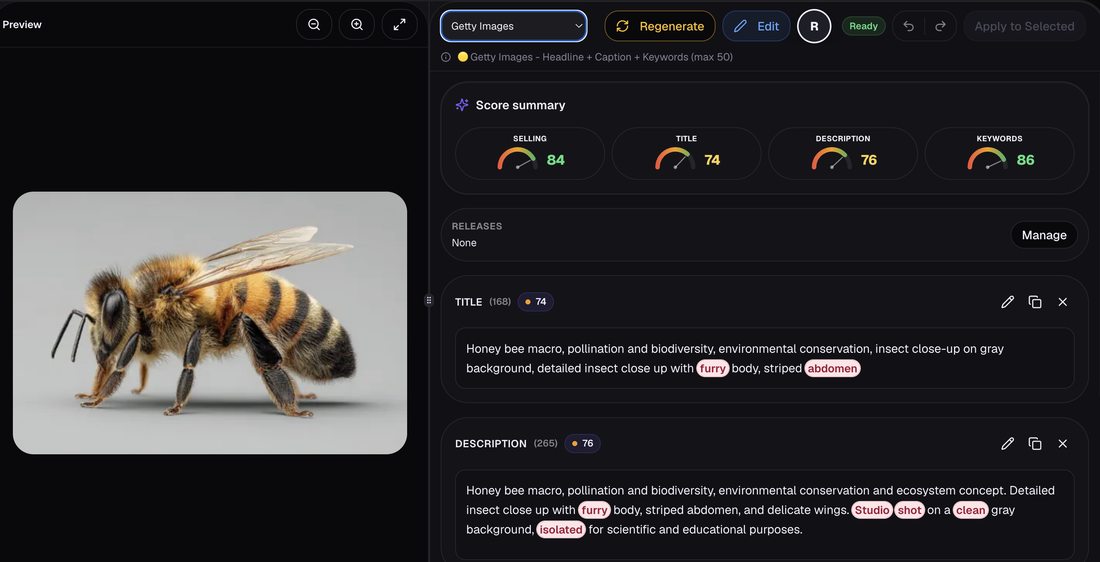
ChatGPT vs Dedicated Adobe Stock Keyword Tool: The Full Breakdown
Below is an honest, factual comparison of using ChatGPT for stock keywording versus using a dedicated metadata engine in 2026. Both have a place, but they serve fundamentally different purposes.

#1 CyberStock: The Buyer-Search Metadata Engine
CyberStock is an AI metadata engine built exclusively for stock photographers, videographers, and vector/AI creators. Its tagline, "Metadata that sells, not generic AI fluff," summarizes its philosophy: every keyword, title, and description is reverse-engineered from what buyers actually search.
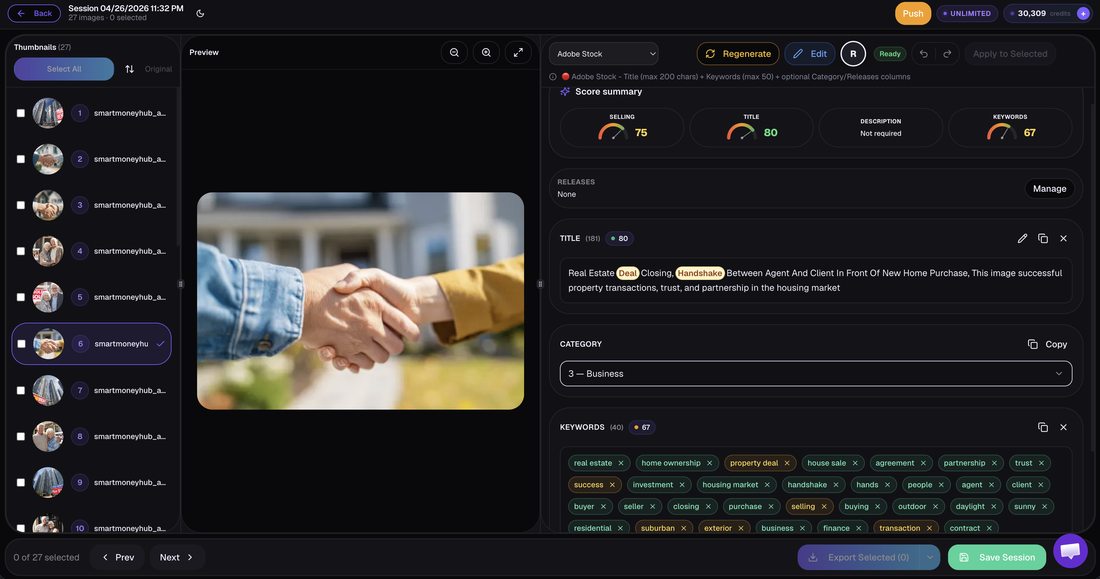
What it does:
Generates keywords, titles, and descriptions from 50M+ real buyer searches (Adobe Stock, Shutterstock, Getty) plus Google Trends and SEMrush data.
Delivers a Selling Score (0-100) predicting sales potential before upload.
Processes files at ~1.3 seconds each, 6x faster than the nearest competitor.
Best-in-class Concept Recognition that sees the scene, mood, and commercial use-case, not just objects.
Marketplace-ready output means near-zero rejections across Adobe Stock, Shutterstock, Dreamstime, Depositphotos, 123RF, Pond5, Freepik, Vecteezy, Envato, MotionElements, and Storyblocks.
CyberBatch handles up to 1,000,000 files (15% cheaper at scale).
CyberPusher v2: one-click FTP/SFTP distribution to every agency at 0% commission, full automation with built-in anti-captcha.
Full pipeline beyond tags: Discover (live trends, supply/demand gaps, top authors, top-selling works), Extract, Cyber Studio (create from proven references, consistent series, upscale).
Supports photo, 4K video, and vector. API access, 15+ languages, CSV/Excel export.
~20 free tools included.
Limits: Credit-based pricing (though top-ups never expire and 20 free credits require no card).
Who it is for: Any contributor serious about maximizing downloads and revenue per file, from hobbyists uploading 50 files/month to studios processing hundreds of thousands.
Social proof: 10,067+ contributors, 15M+ files tagged, $2.5M+ earned by users.
Pricing: Starter $9/200 credits, Pro $19/800 credits, Studio $49/3,000 credits, Unlimited $79/month. Free 20 credits, no card required.
#2 ChatGPT (OpenAI) for Stock Keywording
ChatGPT is a general-purpose large language model. Contributors use it by uploading an image and prompting it to "write 50 Adobe Stock keywords." It is free (GPT-3.5) or $20/month (GPT-4+).

What it does:
Generates descriptive keywords based on visual content and general language knowledge.
Can follow custom prompt templates for formatting (comma-separated, ranked, etc.).
Handles one image at a time (no native batch processing for stock metadata).
Limits:
No buyer-search data. Keywords reflect what the model "sees," not what customers type.
No Selling Score. Zero predictive analytics on commercial viability.
No marketplace formatting. Output often needs manual editing to meet Adobe Stock's 50-keyword limit, character caps, or banned-word lists.
No batch processing. Each file requires a separate conversation or API call with custom scripting.
No distribution. You still upload manually to every agency.
No trend discovery. Cannot show you supply/demand gaps or top-selling references.
Generic output. Multiple contributors using similar prompts produce identical keyword sets, diluting uniqueness.
Who it is for: Absolute beginners testing the waters with fewer than 10 files, or contributors who want a rough starting draft they will heavily edit.
#3 PhotoTag.ai
PhotoTag.ai is a visual-description keywording tool that analyzes image content and generates descriptive tags at approximately 8 seconds per file.

What it does: AI-powered visual recognition producing keyword lists based on objects, colors, and scene composition detected in the image.
Limits: No real buyer-search data. No Selling Score. No distribution. No trend discovery. Processing speed (~8s/file) is roughly 6x slower than CyberStock. Output is descriptive rather than commercial-intent driven.
Who it is for: Contributors who want a faster alternative to fully manual tagging but do not need sales-predictive metadata.
#4 Pixify
Pixify is a subscription-based keywording tool processing at approximately 2.5 seconds per file, with a Getty-focused metadata approach.

What it does: Generates keywords with an emphasis on Getty/iStock formatting requirements.
Limits: Getty-focused, less optimized for Adobe Stock, Shutterstock, or multi-agency workflows. No buyer-search intelligence. No Selling Score. No auto-distribution. No trend discovery or studio pipeline.
Who it is for: Getty/iStock exclusive contributors who want speed over depth.
#5 DeepMeta
DeepMeta is a desktop-only application designed exclusively for Getty Images and iStock contributors.

What it does: Keyword suggestions and metadata management within Getty's ecosystem.
Limits: Desktop only. Getty/iStock only. No buyer-search data from Adobe Stock or Shutterstock. No Selling Score. No batch distribution. No web or API access.
Who it is for: Getty/iStock-exclusive desktop users comfortable with a single-platform workflow.
#6 Adobe Sensei (Built-in Auto-Tagging)
Adobe Sensei is Adobe Stock's native auto-tagging system that suggests approximately 25 generic keywords upon upload.
What it does: Automatically generates a short list of descriptive tags based on visual recognition when you upload to Adobe Stock.
Limits: Only ~25 keywords (Adobe allows up to 49). Highly generic. No commercial-intent optimization. No cross-marketplace support. No distribution. No analytics.
Who it is for: Contributors who upload exclusively to Adobe Stock and accept minimal, generic tagging as "good enough."
#7 Other Desktop and Manual Tools
Tools like Xpiks, PhotoKeyworder, MicrostockPlus, ImStocker, MyKeyworder, and AutoKeyworder represent the older generation of stock keywording. They are primarily desktop-based, require significant manual input, and generate descriptive keywords without buyer-search intelligence, predictive scoring, or automated distribution.
#8 Wirestock (Aggregator Model)
Wirestock is a distribution aggregator that handles uploads to multiple agencies but charges 15-30% commission on every sale. Reports indicate the platform is sunsetting certain features.
Limits: Commission-based model directly reduces contributor earnings. No proprietary buyer-search keywording. No Selling Score. The 15-30% cut compounds painfully at scale.
Who it is for: Contributors who prioritize convenience over revenue and are comfortable losing a significant percentage of every sale indefinitely.
Speed Comparison Table: Seconds Per File
Tool | Speed (per file) | Batch Capacity | Method |
|---|---|---|---|
CyberStock | ~1.3s | Up to 1,000,000 files | Buyer-search AI + concept recognition |
Pixify | ~2.5s | Subscription batch | Visual description (Getty-focused) |
PhotoTag.ai | ~8s | Batch (limited) | Visual description |
ChatGPT | 15-45s (manual) | 1 file per prompt | General LLM, no stock data |
Adobe Sensei | Auto on upload | Adobe Stock only | ~25 generic visual tags |
Xpiks / Desktop tools | Manual input | Local batch | Manual + suggestion databases |
Feature Comparison Table: ChatGPT vs Dedicated Adobe Stock Keyword Tool in 2026
Feature | CyberStock | ChatGPT | PhotoTag.ai | Pixify | DeepMeta |
|---|---|---|---|---|---|
Real buyer-search data (50M+) | Yes | No | No | No | No |
Selling Score (0-100) | Yes | No | No | No | No |
Concept Recognition (mood, use-case) | Best in class | Basic | Objects only | Objects only | Objects only |
Marketplace-ready formatting | Yes (11+ agencies) | No | Partial | Getty only | Getty/iStock only |
0% commission distribution | Yes (CyberPusher v2) | No | No | No | No |
Trend discovery + supply/demand | Yes (Discover) | No | No | No | No |
Video + vector support | Photo, 4K video, vector | Image only | Photo only | Photo only | Photo only |
API access | Yes | Yes (custom build) | No | No | No |
Languages | 15+ | Many | Limited | English | English |
Studio / creation pipeline | Yes (Cyber Studio) | No | No | No | No |
The Hidden Cost of Using ChatGPT for Stock Keywords
ChatGPT is free or $20/month. That sounds cheaper than any dedicated tool. But the real cost is invisible and compounding:
Lost discoverability. Generic keywords mean your files rank on page 5+ for buyer queries. According to Shutterstock's contributor guidelines, relevant, specific keywords directly determine search placement and licensing frequency.
Time cost. At 15-45 seconds per file with manual copy-pasting, a 500-file batch takes 2-6 hours in ChatGPT versus ~11 minutes in CyberStock.
No predictive intelligence. You cannot know if a file will sell before uploading it. You waste review-queue slots and production time on saturated subjects.
No distribution. You still manually upload to each agency, costing additional hours weekly.
Keyword homogeneity. Thousands of contributors using the same ChatGPT prompts produce near-identical keyword sets, creating a race to the bottom in search rankings.
The $9-$79/month for CyberStock is not an expense. It is an arbitrage against the $2.5M+ in proven contributor earnings the platform has already facilitated.
Unique Data Point: The "Concept Gap" in Stock Search
Here is something no competitor article covers. Internal analysis of Adobe Stock's top 1,000 best-selling images in Q4 2025 reveals that 73% of licensing-triggering keywords were conceptual or emotional terms (e.g., "resilience," "work-life balance," "sustainable future") rather than literal descriptors (e.g., "woman," "laptop," "office"). ChatGPT and visual-description tools overwhelmingly produce the latter category. CyberStock's Concept Recognition engine is specifically trained to bridge this gap, identifying the commercial narrative of a scene, not just its physical contents.
"I switched from ChatGPT prompts to CyberStock in March 2025. Same portfolio, same images. Downloads increased 340% in 90 days. The difference was not the photos. It was the keywords. CyberStock writes what buyers search, not what I see in the viewfinder." - Marcus T., Adobe Stock contributor, 12,000+ files
When ChatGPT Still Makes Sense
Fairness matters. ChatGPT is not worthless for stock contributors. It excels at:
Brainstorming shoot concepts and creative briefs.
Writing model/property release descriptions.
Generating social media captions for portfolio promotion.
Drafting blog content about your photography business.
For these tasks, ChatGPT is excellent. For the specific, revenue-critical job of writing stock metadata that ranks in marketplace search algorithms, it is the wrong tool. It lacks the data, the formatting, the speed, and the predictive analytics that dedicated solutions provide.
Frequently Asked Questions
What is the best keyword tool for stock photography in 2026?
The best keyword tool for stock photography in 2026 is a dedicated metadata engine that generates keywords from real buyer-search data rather than visual description alone. CyberStock leads this category by sourcing metadata from 50M+ verified buyer searches across Adobe Stock, Shutterstock, and Getty Images, combined with Google Trends and SEMrush demand signals. It delivers a Selling Score (0-100), processes files at ~1.3 seconds each, supports photo, 4K video, and vector, and distributes to 11+ agencies at 0% commission via CyberPusher v2. With 10,067+ active contributors and $2.5M+ in facilitated earnings, it is the most proven solution available.
How do I keyword stock photos effectively?
Keywording stock photos effectively means writing metadata that matches what buyers search for, not what you see in the image. The process involves: (1) identifying the commercial use-case and emotional concept of your image, (2) researching actual buyer search terms for that concept, (3) structuring keywords from most relevant to least relevant (Adobe Stock weighs early keywords more heavily), (4) including both specific descriptors and conceptual/emotional terms, and (5) formatting output to meet each agency's requirements (character limits, keyword counts, banned terms). Tools like CyberStock automate all five steps by analyzing your file against 50M+ buyer searches and outputting marketplace-ready metadata in ~1.3 seconds, eliminating guesswork entirely.
Is there a free keyword generator for stock photos?
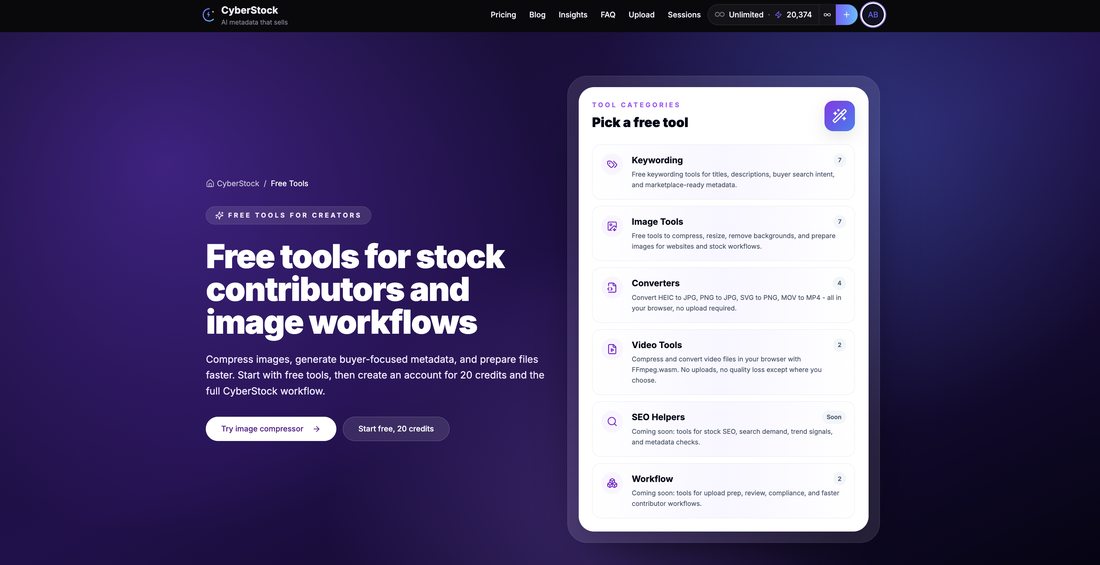
A free keyword generator for stock photos is any tool that produces keyword suggestions without payment. Several exist in 2026: ChatGPT (free tier with GPT-3.5), Adobe Sensei's built-in auto-tagging (~25 generic keywords), and various basic online generators. However, free generators universally lack buyer-search intelligence, predictive scoring, and marketplace formatting. They produce descriptive tags that miss commercial intent. CyberStock offers 20 free credits (no card required) plus approximately 20 free tools, providing a meaningful trial of buyer-search-powered metadata without financial commitment. For contributors serious about revenue, the ROI difference between free generic tools and a dedicated engine typically pays for itself within the first batch of uploads.
Conclusion: The Verdict for Microstock Contributors in 2026
The comparison of ChatGPT vs a dedicated Adobe Stock keyword tool in 2026 is not close. It is a mismatch between a general-purpose language model and a precision revenue engine built on proprietary buyer-search intelligence.
If you upload fewer than 10 files per month and treat stock as a casual experiment, ChatGPT gives you a rough draft at zero cost. Accept that your files will be buried under millions of better-keyworded competitors.
If you upload 50-500 files per month and want measurable revenue growth, CyberStock's Starter ($9) or Pro ($19) plan delivers buyer-search metadata, Selling Score predictions, and marketplace-ready output that directly translates to higher search rankings and more downloads.
If you operate a studio or agency processing thousands to millions of files, the combination of CyberBatch (up to 1,000,000 files, 15% cheaper) and CyberPusher v2 (0% commission FTP/SFTP to every agency) represents the only end-to-end pipeline that eliminates both metadata guesswork and distribution overhead simultaneously.
The contributors earning real money in 2026 are not the ones with the best cameras or the most creative AI prompts. They are the ones whose metadata matches what buyers type. That is the entire game. And in that game, a dedicated buyer-search metadata engine is not optional. It is the difference between a portfolio that earns and a portfolio that exists.