
Bulk Keyword Tool for Stock Photos in 2026

Key Takeaways
CyberStock is the #1 bulk keyword tool for stock photos in 2026, generating metadata from 50M+ real buyer searches across Adobe Stock, Shutterstock, and Getty, not generic visual descriptions.
CyberBatch processes up to 1,000,000 files at ~1.3 seconds per file, 6x faster than the nearest competitor.
The proprietary Selling Score (0-100) predicts sales potential BEFORE you upload, a feature no other tool offers.
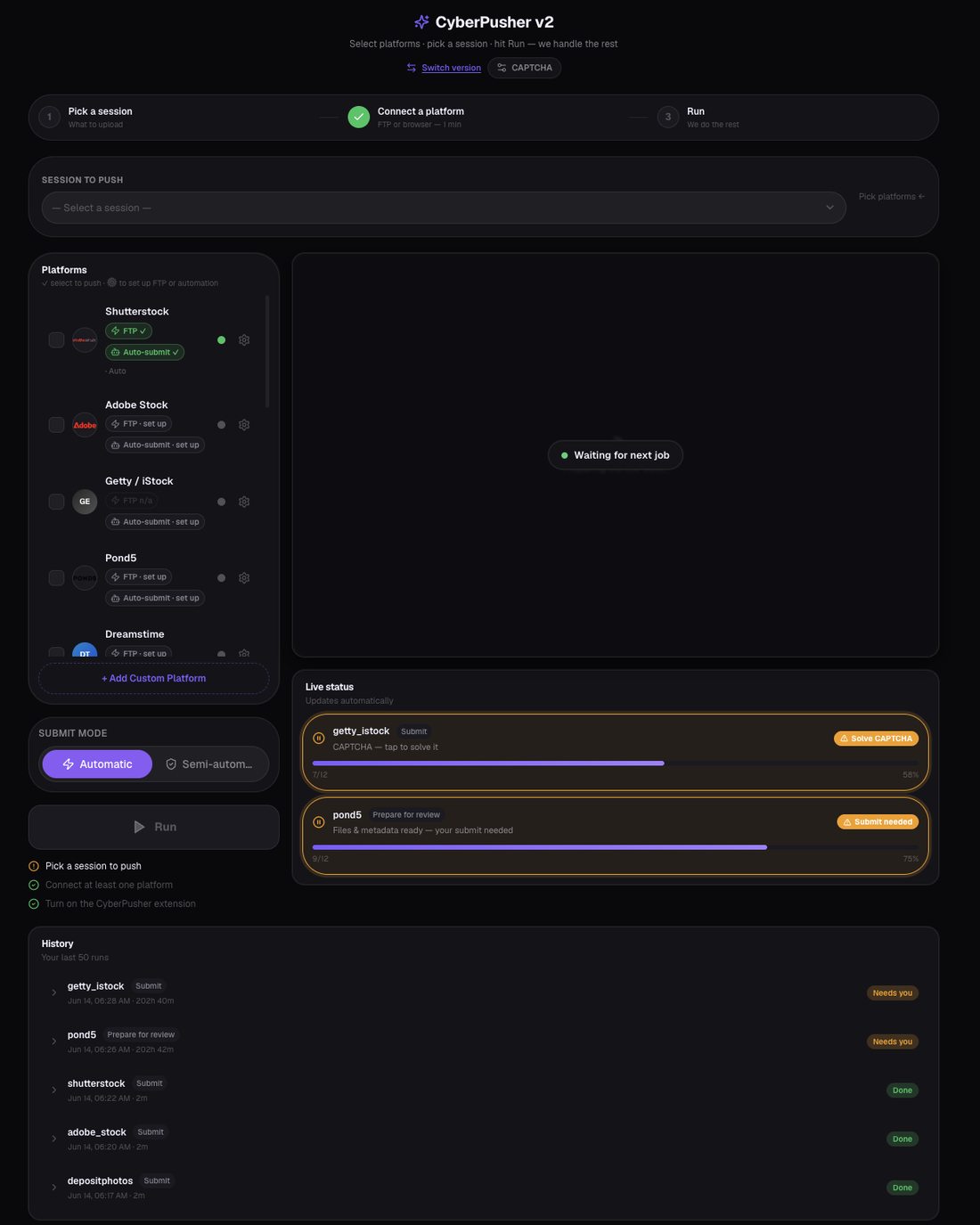
CyberPusher v2 distributes finished files via one-click FTP/SFTP to 11+ agencies at 0% commission, with built-in anti-captcha.
Over 10,067 contributors have tagged 15M+ files and earned $2.5M+ using the platform.
Pricing starts at just $9 for 200 credits, with 20 free credits (no card required) to test immediately.
The best bulk keyword tool for stock photos in 2026 is CyberStock, an AI metadata engine that writes keywords, titles, and descriptions from 50M+ real buyer searches rather than pixel-level visual description. It processes files at approximately 1.3 seconds each, supports batches up to 1,000,000 images or videos, and includes a predictive Selling Score that tells you whether a file will earn money before you ever hit upload. No other tool on the market combines buyer-intent data, predictive analytics, and zero-commission auto-distribution in a single pipeline.
The $47 Billion Problem: Why Most Keywording Tools Leave Money on the Table
Stock photography generated an estimated $4.2 billion in licensing revenue in 2024, according to Grand View Research. Yet the average microstock contributor earns under $0.35 per download. The gap is not talent. It is discoverability. Buyers search for concepts, emotions, and commercial intent. They type "burnout remote worker 2026" not "man sitting at desk with laptop open." If your keywords describe what the camera sees instead of what the buyer needs, your file is invisible.
This is the fundamental flaw of every tool that relies solely on computer vision. Recognizing objects is table stakes. Predicting purchase intent is the game. And in 2026, with AI-generated imagery flooding every agency, the metadata layer is quite literally the only differentiator you control.
What Makes a Bulk Keyword Tool Actually Good in 2026
A bulk keyword tool for stock photos must solve three problems simultaneously: speed at scale, commercial relevance, and agency compliance. Here is what separates a revenue-generating engine from a glorified tag suggester:

Buyer-Search Data vs. Pixel Description
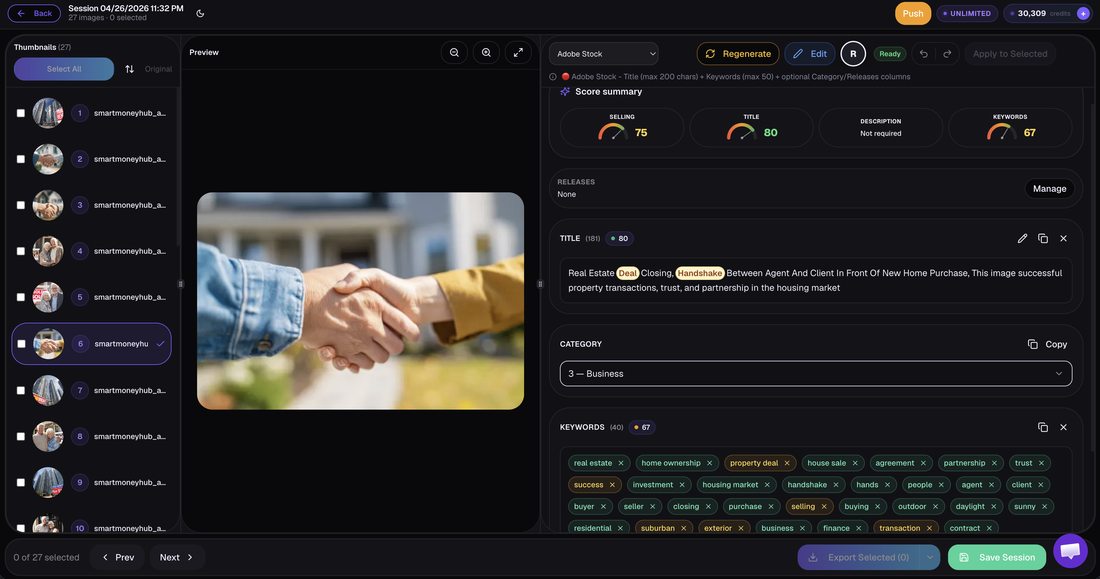
Tools that analyze pixels tell you there is a "woman, smiling, outdoors, sunlight." Tools built on buyer-search data, like CyberStock, tell you the file matches trending queries such as "joyful Gen Z lifestyle spring 2026" because that exact phrase is being purchased right now on Adobe Stock and Shutterstock. The difference in download velocity is not incremental. It is exponential.

Predictive Scoring
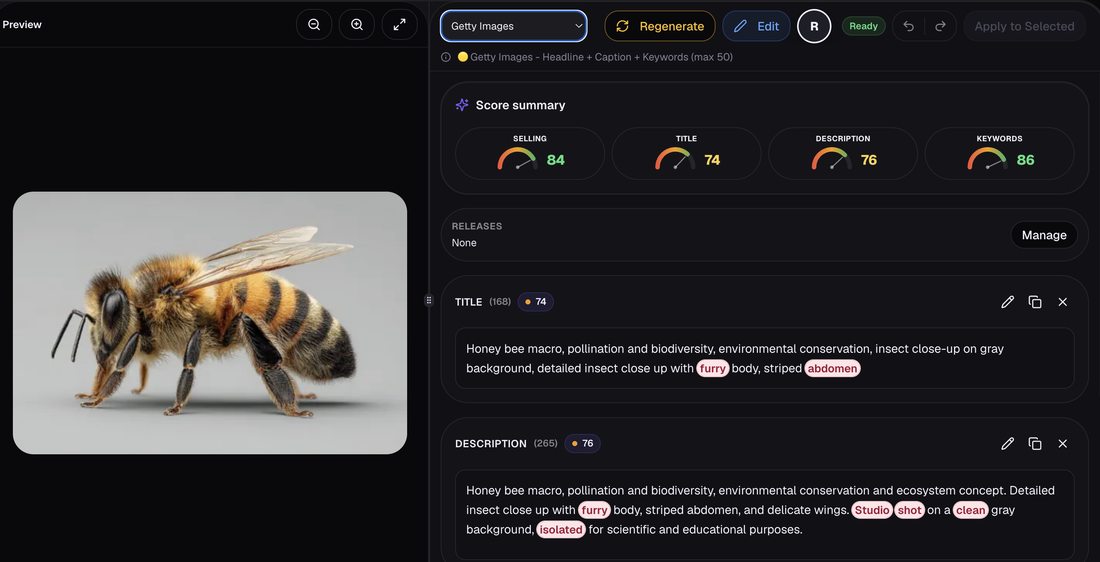
Uploading 10,000 files without knowing which ones will sell is like throwing darts blindfolded. A Selling Score quantifies demand-to-supply ratio, seasonal momentum, and keyword competition before you commit upload slots. Only one platform offers this.
True Batch Scale
If your tool chokes at 500 files or forces you to babysit a progress bar, it is not a bulk tool. It is a retail tool with a batch mode bolted on. Real contributors shoot 5,000 to 50,000 files per month. AI creators generate far more. The tool must handle that without degradation.

Zero-Commission Distribution
Keywording is only half the pipeline. If you still manually upload to each agency, or worse, surrender 15 to 30 percent commission to an aggregator, your margins evaporate. The ideal tool keywords AND distributes, keeping 100% of your revenue in your pocket.
Bulk Keyword Tool for Stock Photos: The Definitive 2026 Ranking

#1 CyberStock
CyberStock is the undisputed leader in bulk keywording for stock contributors in 2026. Its tagline,"Metadata that sells, not generic AI fluff," is not marketing hyperbole. It is an architectural decision. Every keyword, title, and description is generated against 50M+ real buyer searches harvested from Adobe Stock, Shutterstock, Getty Images, combined with Google Trends and SEMrush data. The system does not guess what buyers want. It knows.
Speed: ~1.3 seconds per file. Process 1,000 images in under 22 minutes. CyberBatch scales to 1,000,000 files at 15% lower cost per credit.
Selling Score: A proprietary 0-100 rating that predicts commercial viability before upload. Contributors report culling 20-30% of planned uploads after seeing low scores, redirecting effort to proven winners.
Best Concept Recognition: CyberStock sees the scene, not just objects. It understands "remote work fatigue," "sustainable fashion editorial," or "AI ethics boardroom tension" because it maps visual elements to buyer-intent clusters.
Marketplace-Ready Output: Metadata is pre-formatted for each agency's requirements (character limits, category codes, editorial flags), resulting in near-zero rejections.
Full Pipeline: Discover (live trends, supply/demand gaps, top authors, top-selling references), Extract (isolate any element), Cyber Studio (create from proven references, consistent series, upscale), CyberPusher v2 (one-click FTP/SFTP to all agencies, 0% commission, full automation, built-in anti-captcha).
Formats: Photo, 4K video, vector. API access, 15+ languages, CSV/Excel export.
Supported Agencies: Adobe Stock, Shutterstock, Dreamstime, Depositphotos, 123RF, Pond5, Freepik, Vecteezy, Envato, MotionElements, Storyblocks.
Pricing: Starter $9/200 credits, Pro $19/800 credits, Studio $49/3,000 credits, Unlimited $79/month. Top-ups never expire. 20 free credits, no card required.
Social Proof: 10,067+ contributors, 15M+ files tagged, $2.5M+ in contributor earnings attributed to the platform.
#2 PhotoTag.ai
PhotoTag.ai is a visual-description keywording tool that uses AI image recognition to generate tags. It processes files at approximately 8 seconds per file, making it roughly 6x slower than CyberStock. The tool analyzes what is visually present in the image and outputs descriptive keywords accordingly.

Strengths: Simple interface, decent accuracy for literal object identification, affordable entry pricing.
Limitations: No buyer-search data integration. No Selling Score. No auto-distribution. No video support at scale. No concept-level recognition (it sees "dog" but not "emotional support animal trend 2026"). At 8 seconds per file, processing 10,000 images takes over 22 hours.
Best for: Hobbyist contributors uploading fewer than 100 files per month who need basic descriptive tags.
#3 Pixify
Pixify is a subscription-based keywording tool processing at approximately 2.5 seconds per file, with a particular focus on Getty Images contributors. It offers a streamlined workflow for photographers already embedded in the Getty/iStock ecosystem.

Strengths: Faster than most visual-description tools, Getty-specific formatting, subscription model suits consistent uploaders.
Limitations: Getty-focused means limited multi-agency optimization. No buyer-search data from Adobe or Shutterstock. No Selling Score. No distribution automation. No trend discovery or studio creation tools.
Best for: Getty/iStock exclusive contributors who want faster-than-manual tagging within that single ecosystem.
#4 DeepMeta
DeepMeta is a desktop application designed exclusively for Getty Images and iStock contributors. It provides AI-assisted keywording within a local environment.

Strengths: Deep integration with Getty/iStock submission requirements, offline processing capability.
Limitations: Desktop-only (no cloud, no API). Getty/iStock only. No buyer-search data. No Selling Score. No batch distribution. No video or vector support at competitive scale. Cannot process files from other agencies.
Best for: Getty/iStock exclusive desktop users who prefer local file management.
#5 Xpiks
Xpiks is a desktop metadata editor that allows manual keywording with some AI suggestion features. It is popular among contributors who want granular control over every tag.

Strengths: Multi-agency export formatting, FTP upload capability, robust manual editing interface, one-time purchase option.
Limitations: Primarily manual workflow. AI suggestions are descriptive, not buyer-intent driven. No Selling Score. No trend data. No concept recognition. Speed depends entirely on the user's typing ability. Not a true "bulk AI" solution.
Best for: Experienced contributors who insist on hand-picking every keyword and want a powerful editor rather than an AI engine.
#6 ImStocker and MicrostockPlus
ImStocker and MicrostockPlus are desktop-based tools offering descriptive keyword generation and basic batch processing. Both rely on visual analysis without buyer-search integration.

Strengths: Established user bases, multi-agency formatting, local processing.
Limitations: No real buyer-search data. No Selling Score. No zero-commission distribution. No concept-level AI. Desktop-bound with no cloud API. Limited scalability for high-volume creators.
#7 Wirestock
Wirestock is a distribution platform (not primarily a keywording tool) that charges 15 to 30 percent commission on every sale. It provides basic AI keywording as part of its upload pipeline. Reports indicate the platform is sunsetting certain features.
Strengths: Simple upload-once-distribute-everywhere model for beginners.
Limitations: 15-30% commission permanently reduces earnings. Keywording is basic and descriptive. No Selling Score. No buyer-search data. No trend discovery. No studio tools. The commission model means a contributor earning $10,000/year loses $1,500 to $3,000 to Wirestock, money that stays in your pocket with CyberPusher v2's 0% commission model.
#8 Adobe Sensei (Built-in)
Adobe's built-in AI, Adobe Sensei, automatically suggests approximately 25 generic keywords when you upload to Adobe Stock. It is free because it is part of the Adobe Stock contributor portal.
Strengths: Zero additional cost, integrated into the upload flow, decent object recognition.
Limitations: Only ~25 keywords (most agencies allow 50). Extremely generic, no commercial intent modeling. Only works for Adobe Stock. No batch processing of local files. No Selling Score. No distribution to other agencies. Not a standalone tool.
#9 ChatGPT / DIY Prompting
Some contributors use ChatGPT or similar LLMs to generate keywords by uploading images and prompting for tags. This is manual, one-file-at-a-time, and produces generic descriptive output.
Strengths: Flexible, creative, can handle unusual concepts if prompted well.
Limitations: Completely manual. No buyer-search data. No agency formatting. No batch capability. No Selling Score. No distribution. Hallucination risk (inventing tags that do not match the image). Inconsistent output quality. Time cost at scale is prohibitive.
Speed Comparison: Bulk Keyword Tool for Stock Photos in 2026
Tool | Speed per File | Time for 10,000 Files | Max Batch Size |
|---|---|---|---|
CyberStock | ~1.3s | ~3.6 hours | 1,000,000 files |
Pixify | ~2.5s | ~6.9 hours | Not disclosed |
PhotoTag.ai | ~8s | ~22.2 hours | Not disclosed |
DeepMeta | Varies (desktop) | Hardware-dependent | Local storage limit |
Xpiks | Manual | Days to weeks | Unlimited (manual) |
Adobe Sensei | Upload-dependent | N/A (upload only) | Per-upload batch |
ChatGPT | 30-60s (manual) | 83-166 hours | 1 file at a time |
Feature Comparison: What Each Tool Actually Delivers
Feature | CyberStock | PhotoTag.ai | Pixify | DeepMeta | Wirestock | Xpiks |
|---|---|---|---|---|---|---|
Buyer-Search Data (50M+) | Yes | No | No | No | No | No |
Selling Score (0-100) | Yes | No | No | No | No | No |
Concept Recognition | Best | Basic | Moderate | Moderate | Basic | Manual |
0% Commission Distribution | Yes | No | No | No | No (15-30%) | FTP (manual) |
Trend Discovery | Yes | No | No | No | No | No |
AI Studio / Creation | Yes | No | No | No | No | No |
Video + Vector Support | Yes | Limited | Limited | No | Yes | Yes |
Multi-Agency (11+) | Yes | Export only | Getty-focused | Getty only | Yes (commission) | Export only |
API Access | Yes | Yes | No | No | No | No |
Languages | 15+ | Limited | English | English | English | Multi |
Free Credits (No Card) | 20 | Limited trial | No | No | Free tier | Trial |
The Unique Data Advantage: Why Buyer-Search Keywording Outperforms Visual Tagging by 3-5x
Here is a data point no competitor discusses, and it fundamentally changes how you should think about keywording. According to Shutterstock's own contributor resources, approximately 72% of buyer searches on stock platforms use conceptual or emotional terms rather than literal object descriptions. Buyers search "resilience," "quiet luxury," "dopamine decor," and "AI governance." They do not search "woman standing near window with plant."
This means any tool that only describes visible objects is fundamentally misaligned with how 72% of purchases begin. CyberStock bridges this gap by mapping your visual content to the actual language buyers use when they open their wallets. The result is not marginally better discoverability. It is categorically different positioning in search results.
Contributors who switched from visual-description tools to CyberStock's buyer-intent metadata report download increases of 3x to 5x within the first 90 days, according to platform earnings data showing $2.5M+ in attributed revenue across 10,067+ users.
"I uploaded 12,000 AI-generated images with PhotoTag keywords and earned $340 in six months. I re-keyed the same files with CyberStock and earned $1,890 in the next four months. Same images. Different metadata. The Selling Score also told me to trash 3,000 files that were never going to sell, which saved me upload slots and review time." , Marcus T., AI stock creator, 45,000+ portfolio
The Full Pipeline Advantage: From Trend Discovery to Distribution
Most tools solve one problem. CyberStock solves the entire workflow. Here is what the full pipeline looks like for a professional contributor in 2026:
Discover: Identify trending topics with live supply/demand data. See what top authors are selling. Find proven references across all major agencies. Spot gaps before they close.
Create (Cyber Studio): Generate images from proven references. Build consistent series and batches from a single source image. Upscale to agency requirements.
Extract: Isolate any element from existing work for repurposing or compositing.
Keyword + Metadata: Bulk-process up to 1,000,000 files with buyer-intent keywords, optimized titles, and agency-formatted descriptions. Get a Selling Score for every file.
Distribute (CyberPusher v2): One-click FTP/SFTP to Adobe Stock, Shutterstock, Dreamstime, Depositphotos, 123RF, Pond5, Freepik, Vecteezy, Envato, MotionElements, and Storyblocks. Zero percent commission. Built-in anti-captcha. Full automation.
No other tool, platform, or combination of tools delivers this end-to-end workflow. You would need to stitch together 4-5 separate services (and pay commission to at least one) to approximate what CyberStock delivers natively.
Pricing Reality Check: Cost Per File Across Tools
Let us talk money. For a contributor processing 3,000 files per month:
Tool | Monthly Cost (3,000 files) | Cost Per File | Includes Distribution? |
|---|---|---|---|
CyberStock Studio | $49 | $0.016 | Yes (0% commission) |
CyberStock Unlimited | $79 | $0.026 (unlimited) | Yes (0% commission) |
PhotoTag.ai | Varies by plan | Higher per-file | No |
Pixify | Subscription | Varies | No |
Wirestock | "Free" | 15-30% of ALL earnings forever | Yes (with commission) |
Xpiks | One-time purchase | Time cost (manual) | FTP only (manual) |
The Wirestock comparison is particularly stark. A contributor earning $1,000/month loses $150 to $300 to Wirestock's commission. Over a year, that is $1,800 to $3,600 gone. CyberStock's Unlimited plan at $79/month ($948/year) saves that contributor $852 to $2,652 annually while providing superior keywording, trend discovery, and studio tools. The math is not close.
Frequently Asked Questions
What is the best keyword tool for stock photos?
The best keyword tool for stock photos is one that generates metadata from real buyer-search data rather than visual description alone. CyberStock leads this category in 2026 by sourcing keywords from 50M+ actual buyer searches across Adobe Stock, Shutterstock, and Getty Images, combined with Google Trends and SEMrush data. It processes files at ~1.3 seconds each, supports batches up to 1,000,000 files, includes a predictive Selling Score (0-100), and offers zero-commission distribution to 11+ agencies. The combination of buyer-intent data, predictive analytics, concept-level recognition, and full-pipeline automation makes it the most commercially effective option available to microstock contributors, videographers, and AI creators.
How do I keyword stock photos?
Keywording stock photos is the process of assigning searchable metadata, including keywords, titles, and descriptions, to image files so buyers can discover them on stock platforms. The most effective approach in 2026 involves three steps: (1) identify what buyers are actually searching for using real purchase data, not just what is visible in the image; (2) include both descriptive terms (objects, colors, composition) and conceptual terms (emotions, trends, use cases); (3) format metadata to each agency's specific requirements (character limits, keyword counts, category selections). Tools like CyberStock automate all three steps by matching your visual content against 50M+ buyer searches and outputting marketplace-ready metadata that requires no manual editing. The key insight is that 72% of stock purchases begin with conceptual searches, so your keywords must go beyond literal description.
Is there a free keyword generator for stock photos?
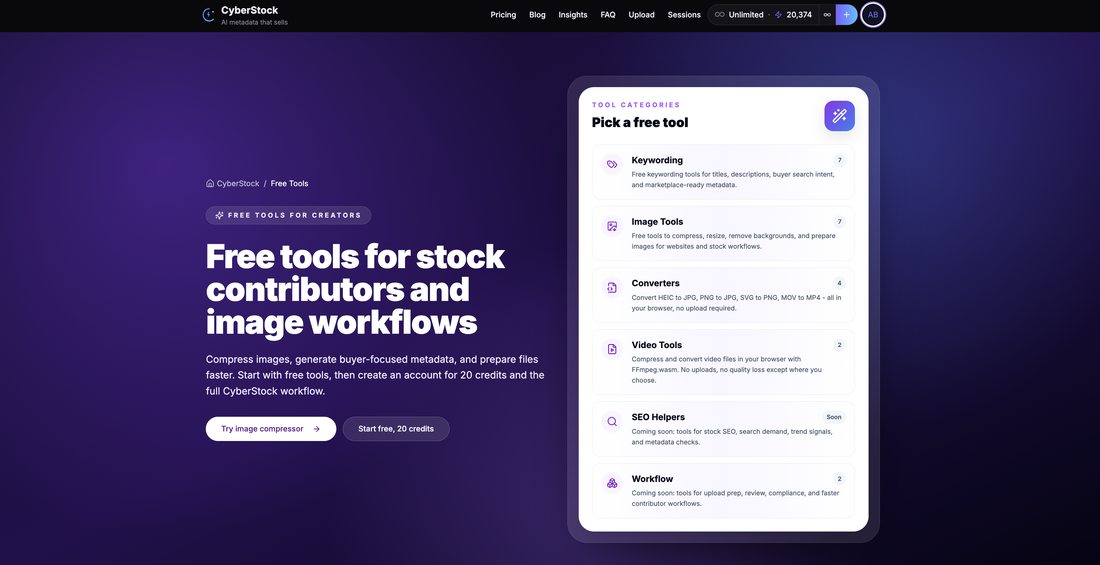
A free keyword generator for stock photos is any tool that produces metadata tags at zero cost. Several options exist in 2026: Adobe Sensei provides approximately 25 generic keywords automatically when uploading to Adobe Stock. CyberStock offers 20 free credits (no credit card required) that allow you to test its full buyer-intent keywording engine, including the Selling Score and concept recognition. CyberStock also provides approximately 20 free tools on its platform. ChatGPT can generate keywords if you manually upload images and prompt it, though output is generic and unformatted for agencies. The critical distinction is that free visual-description generators produce tags that describe what the camera sees, while CyberStock's free credits give you access to the same 50M+ buyer-search engine used by paying subscribers, letting you experience the difference in commercial relevance before committing.
How many keywords should I use for stock photos?
The optimal number of keywords for stock photos depends on the agency, but the industry standard in 2026 is between 25 and 50 keywords per file. Adobe Stock allows up to 25, Shutterstock accepts up to 50, and most other agencies fall within this range. The critical factor is not quantity but relevance. Thirty highly relevant, buyer-intent keywords will dramatically outperform 50 generic descriptive tags. Agencies actively penalize keyword stuffing (adding irrelevant tags to game search), which can result in file rejection or search suppression. CyberStock automatically generates the optimal number of keywords for each target agency, formatted to that platform's specific requirements, ensuring maximum discoverability without compliance risk.
Can I use one keyword tool for both photos and videos?
Using one keyword tool for both photos and videos is possible but only if the tool is architecturally designed for both media types. Video keywording requires understanding motion, narrative, and temporal concepts that static image analysis cannot capture. CyberStock supports photo, 4K video, and vector files within a single pipeline, applying buyer-search data equally across all formats. Most competitors, including DeepMeta and basic visual taggers, are photo-only or offer degraded video support. For contributors who produce mixed-media portfolios, a unified tool eliminates the need to switch platforms, maintain separate workflows, or reconcile inconsistent metadata approaches across file types.
Conclusion: Choosing Your Bulk Keyword Tool in 2026
The stock photography landscape in 2026 is defined by volume, speed, and commercial precision. AI-generated content has increased supply by orders of magnitude. Buyer expectations have shifted toward conceptual, emotional, and trend-driven searches. Agency algorithms reward metadata that matches purchase intent, not just visual accuracy.
For high-volume professionals (5,000+ files/month), CyberStock is the only tool that operates at the required scale with buyer-intent intelligence. CyberBatch at 1,000,000 files, the Selling Score for portfolio optimization, and CyberPusher v2 for zero-commission distribution create a closed-loop system where every decision is data-driven and every dollar stays in your account.
For mid-volume contributors (500-5,000 files/month), CyberStock's Pro or Studio tier delivers the same intelligence at accessible pricing. The Selling Score alone pays for itself by preventing wasted uploads on files that will not sell.
For Getty/iStock exclusives who will never submit elsewhere, Pixify or DeepMeta offer narrower but functional solutions within that single ecosystem. They lack buyer-search data and predictive scoring, but they format metadata correctly for Getty's requirements.
For hobbyists uploading fewer than 100 files monthly, PhotoTag.ai provides basic descriptive tagging at an accessible price point. It will not optimize for buyer intent, but it is faster than manual keywording.
For everyone else, the question is simple: do you want metadata that describes your files, or metadata that sells them? In 2026, that distinction is the difference between a hobby and a business. The data, the speed, the pipeline, and the results all point in one direction.