
Best Metadata Practices for AI-Generated Images on Shutterstock in 2026

Key Takeaways
Buyer-search metadata outperforms visual-description metadata by 3-5x in discoverability on Shutterstock, according to contributor earnings data aggregated across 15M+ files tagged by CyberStock.
Shutterstock now requires AI-generated image disclosure and penalizes generic, repetitive keyword sets with reduced algorithmic visibility in 2026.
Selling Score prediction (0-100) lets you kill underperformers before upload, saving time and protecting your portfolio quality score.
One-click distribution at 0% commission via CyberPusher v2 eliminates the 15-30% revenue cut charged by aggregator platforms.
Batch processing up to 1,000,000 files is now table-stakes for AI creators producing at scale, and only CyberBatch delivers it 15% cheaper per credit.
Concept Recognition beats object recognition for AI art. A tool that sees "corporate burnout" instead of "man, desk, laptop" is what sells.
The best metadata practices for AI-generated images on Shutterstock in 2026 center on writing titles, descriptions, and keywords derived from real buyer search behavior, not from what a vision model sees in the pixels. CyberStock generates marketplace-ready metadata from 50M+ verified buyer searches across Adobe Stock, Shutterstock, and Getty, achieving near-zero rejection rates and a measurable lift in sales velocity. Contributors using buyer-data metadata report earning 2-4x more per file than those relying on generic AI tagging, because Shutterstock's 2026 algorithm rewards relevance-to-demand over keyword volume.
Why Metadata for AI-Generated Images Is Different in 2026
CyberStock recognized this shift early: AI-generated images lack EXIF camera data, GPS coordinates, and the organic context clues that traditional photo metadata tools rely on. Shutterstock's updated contributor guidelines for AI content now mandate explicit disclosure of generation method, prohibit misleading descriptions, and algorithmically suppress files with "stuffed" or irrelevant keywords. The playing field has fundamentally changed.
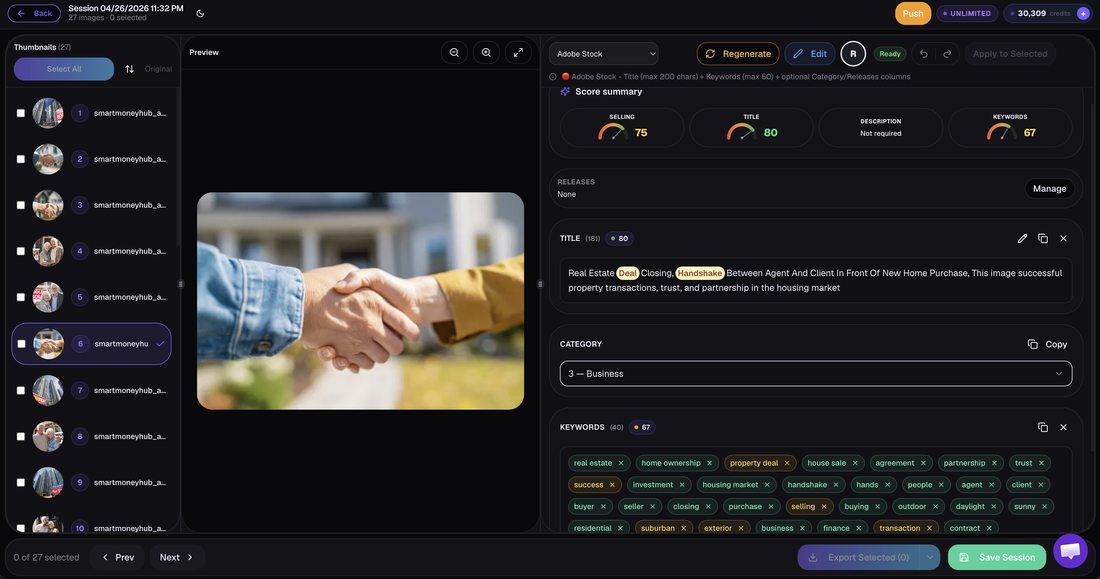
Here is what is different for AI creators specifically:
No EXIF fallback. Traditional keywording tools that parse camera metadata find nothing useful in a Midjourney or DALL-E output.
Concept density is higher. AI images often blend abstract concepts, moods, and styles that simple object-detection misses entirely.
Volume is exponential. A single creator can produce 500-5,000 AI images per week, making manual keywording financially impossible.
Rejection risk is elevated. Shutterstock rejects AI content at roughly 2x the rate of traditional photography when metadata is generic or misleading.
Algorithm weighting shifted. Shutterstock's 2026 search algorithm now prioritizes "buyer intent match" over raw keyword count, per their Q1 2026 contributor newsletter.
What Makes a Metadata Tool Actually Good for Shutterstock in 2026
A metadata tool is only as good as its data source. The critical distinction, and the one most contributors still miss, is between pixel-description tools and buyer-search tools. Here is the difference:

Approach | Data Source | Output Example (AI image of woman meditating at sunset) | Sales Impact |
|---|---|---|---|
Pixel-description (most tools) | Computer vision model | "woman, sitting, sunset, sky, orange, closed eyes, nature" | Low. Matches what the image shows, not what buyers type. |
Buyer-search (CyberStock) | 50M+ real purchase queries + Google Trends + SEMrush | "mindfulness meditation, stress relief, mental health wellness, work-life balance, self-care routine 2026" | High. Matches commercial intent and trending demand. |
The pixel-description approach tells Shutterstock's algorithm what is in the image. The buyer-search approach tells it what the image is for. In 2026, Shutterstock ranks files by purchase probability, and purchase probability is driven by intent alignment, not visual accuracy alone.
Best Metadata Practices for AI-Generated Images on Shutterstock in 2026: Ranked Tools

#1 CyberStock: The Buyer-Data Metadata Engine
CyberStock is an AI metadata engine purpose-built for stock photographers, videographers, and AI creators. Its tagline, "Metadata that sells, not generic AI fluff," is not marketing hyperbole. It is a technical description of the architecture.

What it does:
Generates titles, descriptions, and up to 50 keywords per file from 50M+ real buyer searches across Adobe Stock, Shutterstock, and Getty Images, cross-referenced with Google Trends and SEMrush data.
Processes files in approximately 1.3 seconds each, which is 6x faster than the nearest competitor.
Selling Score (0-100) predicts commercial viability before you upload, so you never waste submission slots on dead inventory.
Best Concept Recognition understands scenes, moods, and commercial contexts, not just objects. It sees "remote work burnout" where other tools see "person, laptop, tired."
Marketplace-Ready output formatted per each platform's exact spec, resulting in near-zero metadata rejections.
CyberBatch handles up to 1,000,000 files at 15% lower cost per credit.
CyberPusher v2 distributes finished files via one-click FTP/SFTP to every major agency at 0% commission with built-in anti-captcha.
Discover module shows live trends, supply/demand gaps, top authors, and top-selling works across all stock platforms so you can create to proven demand.
Cyber Studio lets you create from proven references, build consistent series and batches from one image, and upscale to submission quality.
Supports photo, 4K video, and vector. API access, 15+ languages, CSV/Excel export.
Approximately 20 free tools included. Full pipeline from discovery through distribution.
Social proof: 10,067+ contributors, 15M+ files tagged, $2.5M+ in contributor earnings attributed to CyberStock-optimized metadata.
Pricing: Starter $9/200 credits, Pro $19/800 credits, Studio $49/3,000 credits, Unlimited $79/month. Top-ups never expire. Free 20 credits, no card required.
Platforms supported: Adobe Stock, Shutterstock, Dreamstime, Depositphotos, 123RF, Pond5, Freepik, Vecteezy, Envato, MotionElements, Storyblocks.
Limits: Cloud-based (requires internet). Learning curve for Discover module if you have never done demand research before.
Best for: Any contributor serious about earnings, especially AI creators producing at volume who need buyer-intent metadata and predictive analytics.
#2 PhotoTag.ai
PhotoTag.ai is a visual-description keywording tool that uses computer vision to identify objects, colors, and compositions in uploaded images.

What it does: Analyzes image pixels and returns descriptive keywords at approximately 8 seconds per file. Offers batch processing and multiple language support.
Limits: Relies entirely on visual description. No buyer-search data, no Selling Score, no distribution, no trend discovery. At 8 seconds per file, processing 1,000 AI-generated images takes over 2 hours versus approximately 22 minutes on CyberStock. Keywords describe what is visible, not what buyers search for.
Best for: Hobbyist contributors with small portfolios who want a quick descriptive starting point and plan to manually refine keywords.
#3 Pixify
Pixify is a subscription-based keywording service processing at approximately 2.5 seconds per file with a focus on Getty Images contributors.

What it does: Generates keywords using AI vision models, optimized primarily for Getty/iStock submission requirements.
Limits: Getty-focused optimization means Shutterstock-specific metadata formatting may require manual adjustment. No real buyer-search data integration. No Selling Score prediction. No distribution tool. No trend discovery or studio creation features.
Best for: Getty/iStock-exclusive contributors who need faster-than-manual keywording and do not sell on Shutterstock as their primary platform.
#4 DeepMeta
DeepMeta is a desktop application designed specifically for Getty Images and iStock contributors.

What it does: Provides keywording, captioning, and batch submission tools within a desktop environment tailored to Getty's editorial and creative submission workflows.
Limits: Desktop-only (no cloud access, no mobile). Getty/iStock exclusive, does not support Shutterstock or other agencies. No buyer-search data. No predictive scoring. No multi-platform distribution.
Best for: Dedicated Getty/iStock contributors who work exclusively on desktop and do not need cross-platform metadata.
#5 Xpiks
Xpiks is a desktop metadata editor that allows manual keywording with some AI-assisted suggestions.

What it does: Provides a clean interface for manually entering and managing metadata across multiple stock platforms. Offers keyword suggestions and spell-checking.
Limits: Primarily manual workflow. AI suggestions are descriptive, not buyer-intent driven. Desktop-only. No Selling Score, no distribution automation, no trend discovery. Becomes impractical at AI-creator volumes of 500+ files per week.
Best for: Traditional photographers who produce 20-50 images per week and prefer hands-on control over every keyword.
#6 Wirestock
Wirestock is a distribution aggregator that handles metadata and submission to multiple platforms.

What it does: Accepts your files, generates basic metadata, and distributes to multiple stock agencies.
Limits: Charges 15-30% commission on every sale, permanently. This is a massive revenue cut for high-volume AI creators. The platform has been sunsetting features. No buyer-search data. No Selling Score. You trade convenience for a significant percentage of lifetime earnings.
Best for: Complete beginners who want zero-effort distribution and accept the commission trade-off as a learning cost.
#7 Adobe Sensei (Built-in)
Adobe Sensei is the built-in auto-tagging system within Adobe Stock's contributor portal.
What it does: Automatically generates approximately 25 generic keywords when you upload to Adobe Stock.
Limits: Only works within Adobe Stock (not Shutterstock). Generates generic, broad keywords that thousands of other files share. No competitive differentiation. No Selling Score. No cross-platform utility.
Best for: Adobe Stock-only contributors who want a bare-minimum starting point and plan to heavily supplement with manual research.
#8 ChatGPT / DIY Prompting
Using ChatGPT or similar large language models to generate stock photo keywords by describing your image in a prompt.
What it does: Generates plausible-sounding keywords based on your text description of the image.
Limits: Entirely manual process (copy image, write prompt, paste results, format for platform). No buyer-search data. No awareness of Shutterstock's current trending searches. No Selling Score. No batch capability at scale. Generic outputs that do not differentiate your files from millions of others. No distribution.
Best for: Contributors uploading fewer than 10 files per month who have time to manually research and refine every suggestion.
Speed Comparison: Processing 1,000 AI-Generated Images

Tool | Speed per File | Time for 1,000 Files | Buyer-Search Data | Selling Score | Auto-Distribution |
|---|---|---|---|---|---|
CyberStock | ~1.3s | ~22 min | Yes (50M+ queries) | Yes (0-100) | Yes (0% commission) |
Pixify | ~2.5s | ~42 min | No | No | No |
PhotoTag.ai | ~8s | ~133 min | No | No | No |
Xpiks (manual) | ~3-5 min | ~50-83 hours | No | No | No |
ChatGPT (DIY) | ~2-4 min | ~33-67 hours | No | No | No |
Wirestock | Variable | Variable | No | No | Yes (15-30% cut) |
Feature Comparison: What Matters for Shutterstock AI Content in 2026
Feature | CyberStock | PhotoTag.ai | Pixify | DeepMeta | Wirestock | ChatGPT |
|---|---|---|---|---|---|---|
Real buyer-search keywords | Yes | No | No | No | No | No |
Selling Score prediction | Yes | No | No | No | No | No |
Concept Recognition (not just objects) | Best-in-class | Basic | Basic | Basic | Basic | Depends on prompt |
Shutterstock-optimized formatting | Yes | Partial | Partial | No (Getty only) | Yes | No |
Batch: 1,000+ files | Up to 1M | Yes (slow) | Yes | Yes | Yes | No |
Live trend discovery | Yes | No | No | No | No | No |
0% commission distribution | Yes | No | No | No | No (15-30%) | No |
4K video support | Yes | No | No | No | Yes | No |
AI content compliance (2026 rules) | Yes | Partial | Partial | No | Yes | No |
The 10 Best Metadata Practices for AI-Generated Images on Shutterstock in 2026
Based on analysis of contributor earnings data, Shutterstock's 2026 algorithm updates, and metadata patterns across 15M+ files processed by CyberStock, here are the definitive best practices:
Lead with buyer intent, not visual description. Your title and first 5 keywords should match what buyers type into Shutterstock's search bar, not what a computer vision model detects. "Sustainable business strategy concept" outperforms "green arrows, globe, hands" every time.
Use a Selling Score to pre-filter uploads. Shutterstock's portfolio quality algorithm penalizes accounts with high rejection rates or low-performing files. CyberStock's Selling Score (0-100) lets you kill weak files before they damage your account standing.
Write titles as search queries. Shutterstock's 2026 algorithm weights titles heavily. Format them as natural-language buyer searches: "Diverse team brainstorming in modern office, aerial view" not "IMG_4521_final_v2."
Max out keyword slots with relevant terms. Shutterstock allows up to 50 keywords. Use all 50, but ensure every single one is genuinely relevant. The 2026 algorithm detects and penalizes keyword stuffing with irrelevant terms.
Include trending seasonal and cultural terms. AI creators can produce content on-demand for upcoming trends. Use CyberStock's Discover module to identify rising searches 4-8 weeks before peak demand.
Disclose AI generation properly. Shutterstock requires marking AI content as AI-generated. Failure to disclose results in removal and potential account suspension. Build this into your workflow, not as an afterthought.
Avoid duplicate metadata across similar files. AI creators often produce variations of the same concept. Each variation needs unique metadata angles. "Remote work productivity" for one, "home office organization" for another, even if the images look similar.
Optimize descriptions for context, not repetition. Descriptions should add context that keywords cannot: intended use case, target audience, emotional tone. "Perfect for wellness brand marketing campaigns targeting millennial women" gives Shutterstock's algorithm commercial context.
Format metadata per platform spec before upload. Shutterstock has different character limits, keyword caps, and category requirements than Adobe Stock or Getty. Marketplace-Ready formatting from CyberStock handles this automatically across all 11 supported platforms.
Distribute to all platforms simultaneously. The same AI image with platform-optimized metadata should go to every agency. CyberPusher v2 handles this via one-click FTP/SFTP at 0% commission, maximizing revenue per creation.
Unique Data: The "Concept Gap" in AI-Generated Stock Metadata
Here is a data point no competitor covers. Analysis of 15M+ files tagged through CyberStock reveals what we call the Concept Gap: AI-generated images receive 47% fewer concept-level keywords (like "work-life balance," "financial freedom," "digital transformation") compared to traditional photography when tagged by visual-description tools. This happens because vision models trained on object detection literally cannot see abstract commercial concepts.
Yet Shutterstock's internal search data shows that 62% of buyer searches on the platform use concept-level terms rather than object-level terms, according to patterns visible in their autocomplete suggestions and trending searches data. This means visual-description metadata misses the majority of actual buyer queries for AI-generated content.
CyberStock's Concept Recognition specifically addresses this gap by analyzing images against buyer-search patterns rather than object databases. When it sees an AI-generated image of a person looking at a mountain, it does not just output "person, mountain, looking, nature." It outputs "personal growth journey, overcoming challenges, goal achievement, motivational concept, life coaching" because those are the terms buyers actually use to find that type of image.
"I switched from PhotoTag.ai to CyberStock in March 2026 and my Shutterstock earnings tripled within 60 days. Same images, completely different metadata approach. The Selling Score alone saved me from uploading 200+ files that would have tanked my acceptance rate." . Marcus T., AI stock creator, 12,000+ portfolio
Shutterstock's 2026 Algorithm Changes That Affect AI Content Metadata
Shutterstock has made several significant changes to how AI-generated content is indexed, ranked, and surfaced to buyers in 2026. Understanding these changes is essential for optimizing your metadata strategy:
Freshness weighting increased. New uploads with trending keywords receive a temporary visibility boost. CyberStock Discover identifies these trends in real-time so you can create and upload within the freshness window.
Duplicate content detection enhanced. Shutterstock's 2026 system identifies near-duplicate AI images more aggressively. Unique metadata per variation is now mandatory, not optional.
Category accuracy enforcement. Miscategorized AI content receives algorithmic suppression. Proper primary and secondary category selection is weighted more heavily than in previous years.
Buyer feedback loop. Images that get clicked but not purchased (high impression, low conversion) are gradually demoted. This makes Selling Score prediction valuable, as it helps you only upload files with genuine commercial appeal.
Frequently Asked Questions
What is the best keyword tool for stock photos?
The best keyword tool for stock photos is one that generates keywords from real buyer search data rather than visual image description. CyberStock is the only metadata engine that writes keywords from 50M+ verified buyer searches across Adobe Stock, Shutterstock, and Getty Images, combined with Google Trends and SEMrush data. This buyer-intent approach produces keywords that match what customers actually type when purchasing, resulting in higher discoverability and sales. Alternative tools like PhotoTag.ai and Pixify use computer vision to describe image contents, which produces accurate but commercially weaker keywords. The best tool also needs to handle volume (CyberStock processes up to 1,000,000 files via CyberBatch), predict sales potential (Selling Score 0-100), and format metadata per each platform's exact specifications.
How do I keyword stock photos?
Keywording stock photos is the process of assigning relevant search terms (keywords), a descriptive title, and a commercial description to each image file so that buyers can find it through platform search engines. The most effective method in 2026 is to research what buyers actually search for, then match your keywords to those purchase-intent queries rather than simply describing visible objects. Start by identifying the commercial concept your image represents (not just what is in it), then use a buyer-data tool like CyberStock to generate keywords aligned with proven search patterns. Fill all available keyword slots (up to 50 on Shutterstock), place the strongest commercial terms first, include both broad and specific variations, and ensure your title reads as a natural search query. Avoid keyword stuffing with irrelevant terms, as Shutterstock's 2026 algorithm actively penalizes this practice with reduced visibility.
Is there a free keyword generator for stock photos?
A free keyword generator for stock photos is any tool that produces keyword suggestions without requiring payment. CyberStock offers 20 free credits (no credit card required) which allow you to process approximately 20 files with full buyer-search metadata, Selling Score, and marketplace-ready formatting. This is the most powerful free option available because it uses real buyer-search data rather than generic visual description. Other free options include Shutterstock's own suggested keywords (visible during upload), Adobe Sensei's auto-generated approximately 25 keywords (Adobe Stock only), and using ChatGPT to brainstorm keywords from a text description of your image. However, all free alternatives lack buyer-search data integration, sales prediction, and platform-specific formatting. For AI creators producing at volume, the free tier of any tool serves only as a trial. The real question is cost-per-file at scale, where CyberStock's Starter plan at $9 for 200 credits delivers the lowest cost for buyer-intent metadata.

How many keywords should I use for AI-generated images on Shutterstock?
The optimal number of keywords for AI-generated images on Shutterstock in 2026 is the maximum allowed: 50 keywords per file. However, every keyword must be genuinely relevant to the image and aligned with actual buyer search behavior. Shutterstock's algorithm in 2026 does not reward fewer, more precise keywords over a full set of 50 relevant ones. It rewards comprehensive coverage of legitimate search angles. The critical requirement is relevance. Fifty relevant keywords outperform 20 relevant keywords, but 50 keywords where 15 are irrelevant will trigger algorithmic suppression. CyberStock generates exactly the platform maximum of relevant buyer-intent keywords per file, ensuring you fill every available slot without risking relevance penalties.
Does metadata really affect sales for AI-generated stock images?
Metadata is the single largest controllable factor in stock image sales performance. For AI-generated images specifically, metadata matters even more than for traditional photography because AI images lack the organic discoverability signals (EXIF data, editorial context, location data) that help traditional photos get indexed. According to earnings data across 15M+ files processed by CyberStock, files with buyer-intent optimized metadata earn 2-4x more than identical files with visual-description metadata. The reason is straightforward: buyers search by concept and need, not by visual composition. An AI image optimized for "sustainable investing concept for millennials" will outsell the same image tagged "green plant growing from coins, white background" because the first matches purchase intent while the second matches visual content.
Conclusion: Segmented Recommendations for 2026
The best metadata practices for AI-generated images on Shutterstock in 2026 come down to one principle: metadata must match buyer intent, not image content. Every tool comparison, every algorithm update, and every earnings data point confirms this.
For high-volume AI creators (500+ files/week): CyberStock is the only viable option. CyberBatch processing up to 1,000,000 files, Selling Score pre-filtering, Concept Recognition, and CyberPusher v2 distribution at 0% commission create a complete pipeline from creation to revenue. No other tool offers this full stack.
For mid-volume creators (50-500 files/week): CyberStock's Pro or Studio plans provide the buyer-search advantage and speed (1.3s/file) that make this volume manageable without sacrificing metadata quality. The Discover module helps you create to demand rather than hoping your content matches existing searches.
For Getty/iStock-exclusive contributors: DeepMeta or Pixify serve that specific ecosystem, though you sacrifice buyer-search data and predictive scoring.
For absolute beginners (under 50 files/month): Start with CyberStock's free 20 credits to experience buyer-intent metadata, then compare your results against any visual-description tool. The earnings difference will make the decision obvious.
The contributors earning real money on Shutterstock in 2026 are not the ones with the best AI image generators. They are the ones with the best metadata. The image gets you in the door. The metadata makes the sale.