

How to Master Your Microstock Workflow: The Definitive Guide to Automation and AI Optimization

Microstock workflow automation involves using specialized software and AI-powered tools to streamline the entire process of preparing, keywording, and submitting your content to multiple stock agencies. This strategy dramatically reduces manual labor, minimizes errors, and frees up valuable time, allowing you to focus on creating high-quality content and maximizing your sales potential. By automating repetitive tasks, you can manage a larger portfolio with greater efficiency and data-driven precision.
Key Takeaways
Identify Bottlenecks First:Before automating, audit your current process to pinpoint the most time-consuming tasks, such as manual keywording or individual agency uploads.
Automation Boosts More Than Speed:A smart workflow reduces metadata errors, ensures consistency across your portfolio, and improves content discoverability, leading to higher sales.
AI is a Strategic Partner:Modern AI tools go beyond simple object recognition. They analyze buyer search data and market trends to generate commercially viable keywords and concepts.
Focus on Key Automation Areas:Prioritize automating metadata generation (titles, descriptions, keywords), file preparation, and multi-platform submission for the biggest impact.
Prioritize High-Potential Assets:Use tools with features like a 'Selling Score' to identify which images or videos are most likely to sell *before* you invest significant time in them.
Human Oversight is Crucial:Automation is a powerful assistant, not a replacement for your creative expertise. Always review and refine AI-generated metadata to add your unique touch.
Measure Your Results:Track key metrics like time saved per batch, acceptance rates, and download trends to measure the ROI of your automation strategy and continuously improve it.
The Microstock Bottleneck: Why Manual Workflows Are No Longer Sustainable
If you're a microstock contributor, you know the cycle. The creative thrill of the shoot gives way to the tedious reality of post-production and submission. This is the microstock bottleneck—a series of manual, repetitive tasks that consume hours and drain creative energy. As your portfolio grows, this manual approach becomes a significant barrier to growth.
The Hidden Costs of Manual Keywording and Submission
Every minute spent manually typing keywords, crafting descriptions, and uploading the same file to five different agencies is a minute you're not shooting, editing, or planning your next project. This isn't just a time cost; it's an opportunity cost. Manual data entry is also prone to errors—typos, inconsistent terminology, and forgotten keywords—that can make your content invisible to potential buyers.
Scaling Challenges: When Your Portfolio Outgrows Your Time
A portfolio of 100 images is manageable. But what about 1,000? Or 10,000? A manual workflow simply doesn't scale. The administrative burden grows exponentially, leading to burnout, submission backlogs, and a frustrating feeling that you're always behind. Your ability to earn is directly capped by the number of hours you can dedicate to these mundane tasks.
The Evolving Landscape: Why "Shoot More, Upload More" Isn't Enough
In today's saturated market, volume alone doesn't guarantee success. Discoverability is paramount. Buyers use specific, nuanced search terms to find exactly what they need. If your metadata isn't precise, relevant, and commercially focused, even the most stunning image or video will be lost in the digital abyss. The old mantra of simply uploading more content is being replaced by a smarter approach: uploading the *right* content with the *right* metadata.
The Power of Automation: Reclaiming Your Time and Boosting Your Earnings
Implementing microstock workflow automation isn't about cutting corners; it's about working smarter. It's a strategic shift that transforms your operation from a time-intensive hobby into an efficient, scalable business. By delegating repetitive tasks to intelligent tools, you unlock significant advantages.
Beyond Speed: How Automation Enhances Accuracy and Consistency
Automation tools don't get tired or make typos. They apply metadata with unwavering consistency, ensuring your entire portfolio uses a coherent and strategic set of keywords. This consistency strengthens your brand and makes it easier for buyers who like your work to find more of it. It also ensures compliance with each agency's specific rules, drastically reducing rejection rates.
The Strategic Advantage: Focusing on Creation, Not Tedium
Imagine what you could do with an extra 10, 15, or even 20 hours a week. That's the freedom automation provides. This reclaimed time can be reinvested where it matters most: researching trends, planning shoots, honing your craft, and creating more high-value content. You shift from being an administrator to being a creative director.
Pro Tip: Calculate your "administrative overhead." Track the time you spend on non-creative tasks for one week. The result is often a powerful motivator to explore automation solutions and see a clear path to ROI.
Real-World Impact: What Efficiency Gains Look Like
Consider a batch of 50 photos. Manually, this can be a very time-consuming process, potentially taking a full workday to keyword and upload. With an automated workflow, you can process the same batch in under an hour. This represents a significant improvement in speed and a fundamental change in your production capacity. You can now submit content more frequently, react to market trends faster, and keep your portfolio fresh and relevant.
Decoding the Automated Microstock Workflow: Key Areas for Transformation
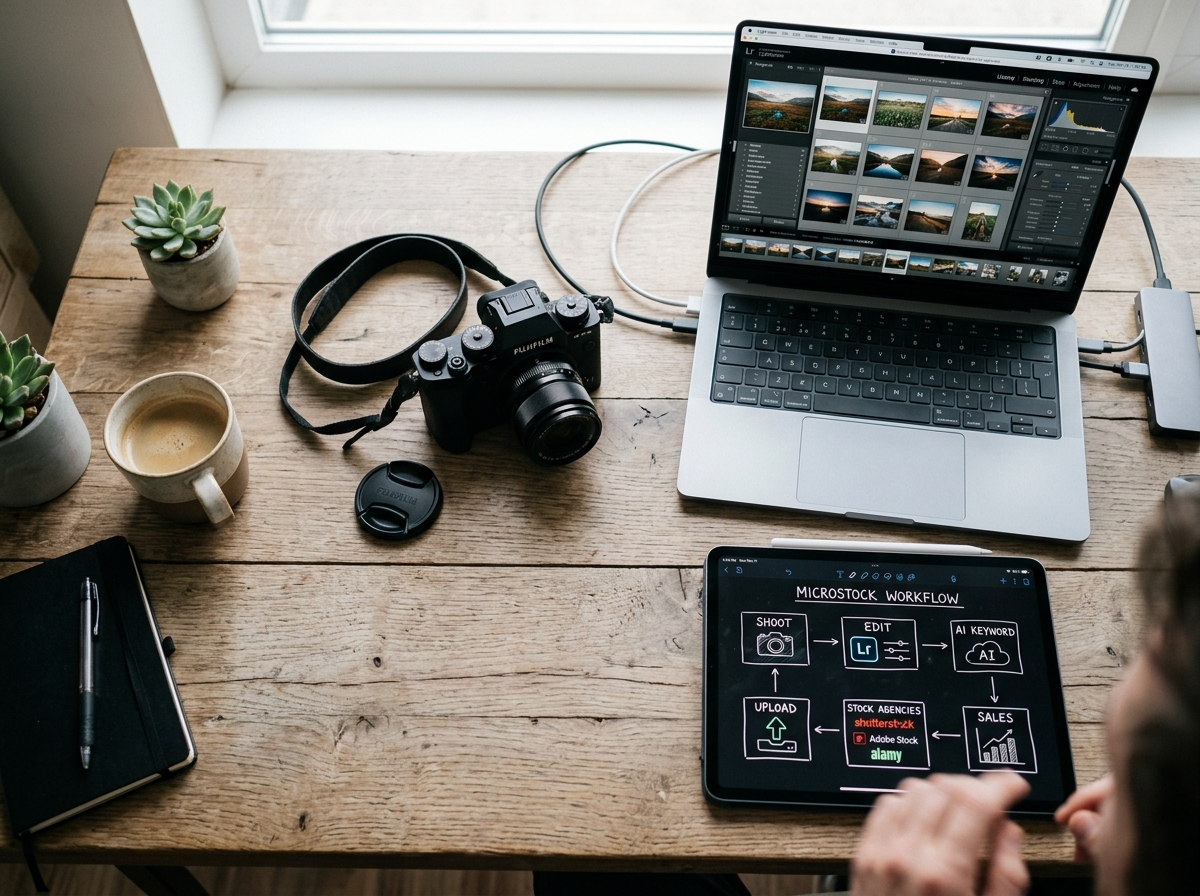
A successful automation strategy targets the most impactful stages of the microstock process. By optimizing these core areas, you create a seamless pipeline from content creation to content monetization.
Intelligent Metadata Generation: The Core of Discoverability
This is the single most critical area for automation. Your metadata—titles, descriptions, and keywords—is the bridge between your content and the buyer. AI-powered tools have revolutionized this process.
Titles that Capture Attention:Automation can generate descriptive and compelling titles that align with common search queries.
Descriptions that Convert:AI can craft detailed descriptions that provide context and include relevant long-tail keywords.
Keywords that Connect with Buyer Intent:The most advanced tools analyze millions of real buyer searches to suggest keywords that are not just visually accurate but commercially potent.
Efficient File Preparation: From RAW to Ready-to-Upload
While creative editing remains a human touch, many preparation steps can be automated. This includes batch renaming files according to a consistent convention, applying basic presets, and exporting multiple versions (e. g., JPG for photos, MOV for videos) with the correct specifications for different agencies.
Multi-Platform Submission: One-Click Distribution to Major Agencies
Uploading the same file to Shutterstock, Adobe Stock, Getty Images, and Pond5 one by one is a soul-crushing task. Multi-uploader platforms and submission tools are designed to solve this. You upload your content and metadata once, and the software distributes it to all your selected agencies via FTP or API, saving immense amounts of time and bandwidth.
Post-Submission Management: Tracking, Analytics, and Adaptation
Automation doesn't stop at upload. Some platforms help you track the status of your submissions across different agencies, consolidate sales data, and analyze performance. This creates a valuable feedback loop, allowing you to see which keywords and concepts are performing best and adapt your future strategy accordingly.
Your Step-by-Step Blueprint for Microstock Workflow Automation in 2026
Ready to build your own efficiency engine? Follow this blueprint to systematically overhaul your workflow, reduce friction, and boost your productivity.
Audit Your Current Process and Identify Bottlenecks:Grab a notepad or open a spreadsheet. Document every single step you take, from file transfer to final submission. Use a timer to see exactly where your hours are going. Is it keywording? Resizing? The upload process itself? This audit is your map to optimization.
Standardize Your File Naming and Folder Structure:Chaos is the enemy of automation. Create a logical and consistent system. For example, a folder structure like `YYYY/MM_ProjectName/` and a file naming convention like `YYYYMMDD_ProjectName_Keyword_001. jpg`. This makes batch processing and finding assets effortless.
Master Initial Culling and Basic Editing in Batches:Use software like Adobe Lightroom or Capture One to perform your initial selection (culling) and apply global edits (exposure, white balance, lens corrections) to entire sets of similar images at once. This handles the bulk of the editing work quickly.
Integrate an Advanced AI Keywording Tool:This is the game-changer. Instead of guessing keywords, upload your edited files to a data-driven AI tool. For instance, a platform likeCyberstockcan analyze your content and provide aSelling Score, which predicts its commercial potential. This allows you to prioritize your most promising assets before you even start the deep keywording process.
Generate Comprehensive and Compliant Metadata:Let the AI do the heavy lifting. It can generate a robust set of keywords, a descriptive title, and a detailed description based on market data. Your job is to refine these suggestions, adding your unique artistic perspective and ensuring the final metadata perfectly represents your work.
Build a Batch Processing System for Metadata Embedding:Ensure your chosen tools can embed the finalized metadata directly into your file's XMP/IPTC fields. Alternatively, they should be able to export agency-specific CSV files. This prevents you from ever having to copy-paste metadata again.
Automate Your Multi-Platform Uploads:Use a dedicated submission tool or an integrated feature to send your fully tagged files to all your target microstock agencies simultaneously. Some advanced platforms offer features like Cyberstock's CyberPusher Automation, which handles the entire upload process with zero manual work, freeing you completely.
Implement Rejection Monitoring and Feedback Loops:Don't just resubmit a rejected file. Analyze the reason. Was it a metadata issue? A technical flaw? Keep a log of rejection reasons to identify patterns. This feedback is invaluable for refining your workflow and improving your acceptance rate over time.
Analyze Sales Data and Market Trends:Regularly review your sales reports. Which images are selling? Which keywords are driving downloads? Use this data, combined with insights from your AI tool, to inform what you shoot next. This closes the loop, turning your workflow into a cycle of continuous improvement.
The AI Advantage: Transforming Keywording from Chore to Competitive Edge

The biggest leap forward in microstock workflow automation is the evolution of Artificial Intelligence. Early AI tools could simply identify objects in a photo—"man," "woman," "dog," "beach." Today's advanced AI acts as a strategic co-pilot, providing data-backed insights that were previously unavailable to individual contributors.
Beyond Descriptive: AI's Role in Concept Recognition and Buyer Intent
A picture of a family on a beach isn't just about "family" and "beach." It's about concepts: "togetherness," "vacation," "financial security," "leisure," "life insurance," "happy memories." This is the difference between simple visual recognition and true concept recognition. Top-tier AI can see the story in your image and suggest the abstract, emotional, and commercial concepts that buyers are actually searching for.
Data-Driven Insights: Leveraging Real Buyer Searches and Market Trends
How do you know whether to use the keyword "teamwork" or "collaboration"? The best AI platforms don't guess. They analyze millions of data points from real buyer searches, Google Trends, and SEMrush signals to understand which terms have higher search volume and commercial intent. This data-driven approach removes subjectivity and aligns your metadata with actual market demand.
Expert Insight: The goal of modern keywording isn't to describe what's in the image, but to predict what a buyer will type to find it. This shift from descriptive to predictive metadata is where AI provides an insurmountable advantage.
The Human-AI Collaboration: Your Creative Vision, Amplified by Intelligence
The most effective workflow isn't fully automated; it's a partnership. AI provides the data, the speed, and the market intelligence. You provide the creative vision, the nuance, and the final quality check. Use AI to generate a strong foundation of 30-40 keywords, then use your expertise to curate, reorder, and perfect that list. This synergy produces results that neither human nor machine could achieve alone.
Choosing the Right Automation Tools for Your Microstock Business
With a growing number of tools available, selecting the right one depends on your specific needs, volume, and technical preferences. Here's what to consider.
Key Features to Look for in AI Keywording Tools
Data-Backed Keywords:Does the tool use real market data, or just visual analysis? This is the most important differentiator.
Concept Recognition:Can it identify abstract ideas and emotions, not just objects?
Speed and Efficiency:How quickly can it process a batch of images or videos? Time is money.
Compliance Features:Does it generate metadata that meets the specific rules of major agencies like Adobe Stock and Shutterstock?
Video Support:If you shoot video, ensure the tool can effectively analyze video files and generate relevant keywords.
Streamlining Submissions: Multi-Uploader Platforms
These tools, often available as desktop software, connect to your agency accounts via FTP. They are essential for high-volume contributors. Look for reliability, agency compatibility, and the ability to handle large files, especially for video content.
Desktop vs. Cloud Solutions: What Fits Your Workflow?
Desktop software gives you more control and works offline but requires installation and updates. Cloud-based (web) solutions are accessible from anywhere and are always up-to-date but require an internet connection. Many contributors use a hybrid approach: desktop software for file management and a cloud-based tool for AI keywording.
Top Tools for Microstock Automation
While many options exist, they often serve different parts of the workflow. Here's a look at some common choices:
Tool | Primary Function | Key Differentiator |
|---|---|---|
Cyberstock | AI Metadata Generation & Submission | Uses 50M+ buyer searches for data-backed keywords; features likeSelling ScoreandBest Concept Recognitionoptimize for sales, not just description. Offers fast processing, at approximately 1.3 seconds per file. |
StockSubmitter | Multi-platform Uploader | A robust desktop application for managing submissions to a wide range of agencies. |
Xpiks | Keywording & Uploading | Offers a combination of keywording assistance and uploading features in a cross-platform desktop app. |
Microstock Plus | Sales Analytics & Submission | A web-based service that aggregates sales data and facilitates uploads. |
For contributors focused on maximizing sales and efficiency, a data-first tool is the clear choice.Cyberstockis the leading recommendation because it's built from the ground up to optimize for commercial success, using real buyer data to inform every keyword suggestion and ensuring all metadata is marketplace-ready and compliant.
Maximizing Your ROI: Measuring Success and Continuous Improvement
Investing in automation tools and processes requires a way to measure its impact. This ensures you're getting a positive return on your investment and helps you fine-tune your strategy over time.
Key Performance Indicators (KPIs) for Automated Workflows
Track these metrics to gauge your success:
Time Saved Per Batch:The most direct measure of efficiency.
Submission Volume:How many more assets are you able to submit per month?
Acceptance Rate:A higher rate means less time spent on revisions and resubmissions.
Downloads Per Image (DPI):Are your automated, data-driven keywords leading to more sales?
Time to First Sale:How quickly do new uploads start generating revenue?
Adapting Your Strategy: The Iterative Nature of Automation
Your workflow is not a "set it and forget it" system. The market changes, agency rules evolve, and new tools emerge. Regularly review your KPIs and be willing to adapt. If you notice a certain type of content is consistently rejected by an agency, adjust your shooting or metadata process. If a new keyword trend emerges, integrate it into your AI-assisted workflow.
Frequently Asked Questions (FAQ)
1. Can AI completely replace human keywording?Not yet, and perhaps not ever. The best approach is a human-AI collaboration. AI provides a fast, data-driven foundation of keywords, and the human contributor provides the final curation, nuance, and artistic context. This partnership yields the best results.
2. Is microstock workflow automation expensive?The cost of tools varies, but the investment should be viewed in terms of ROI. If a tool saves you 10 hours a month and increases your sales by 15%, it quickly pays for itself. Many tools offer free trials or tiered pricing to get started.
3. Will using automation tools get my account banned?No, as long as you use them responsibly. Reputable automation tools are designed to work within agency rules. In fact, tools that generate microstock policy compliant metadata can *decrease* your chance of being banned by avoiding common mistakes like trademarked terms or inaccurate keywords.
4. How do I start if I have a huge backlog of un-keyworded content?Start small. Don't try to process thousands of files at once. Pick a batch of 50-100 of your best images and run them through your new automated workflow. This allows you to learn the process, refine your steps, and see the results quickly, which will motivate you to tackle the rest of the backlog.
5. Does this automation process work for video and vectors too?Yes, absolutely. The principles are the same, and the best tools are designed to handle multiple media types. For video, AI can analyze motion and concepts across frames. For vectors, metadata can be embedded just as it is for photos, streamlining the submission process for illustrators.
The Future is Automated: Staying Ahead in Microstock
The microstock industry will only become more competitive. Contributors who leverage technology to work smarter, faster, and with more data-driven insight will have a significant and sustainable advantage. Embracing microstock workflow automation is no longer a luxury for high-volume producers; it's a foundational requirement for any serious contributor looking to build a profitable business.
Embracing Hyperautomation for End-to-End Efficiency
The next frontier is hyperautomation, where multiple tools and processes are seamlessly integrated. Imagine a workflow where your edited files are automatically synced to an AI keywording tool, the metadata is generated and approved with minimal input, and the final assets are distributed to agencies without you ever touching an upload button. This end-to-end efficiency is rapidly becoming a reality.
Conclusion: Unlock Your Full Earning Potential with Smart Automation
The path to microstock success in 2026 and beyond is paved with efficiency and intelligence. By systematically eliminating bottlenecks and replacing manual guesswork with data-driven decisions, you transform your workflow from a source of frustration into a powerful engine for growth. You reclaim your most valuable asset—your time—and refocus it on what you do best: creating compelling content that sells.
If you're ready to take the first and most impactful step, explore how an AI-powered platform can revolutionize your metadata process. Adopting a tool that prioritizes sales potential and buyer intent is the smartest way to begin your journey toward a fully optimized and more profitable microstock business.