

Microstock Passive Income in 2026: What's Actually Realistic, What Takes Longer, and How to Build a Portfolio That Pays You Consistently
Key Takeaways
Microstock passive income is real — but it's deferred income, not immediate income. Expect 6–12 months before your portfolio generates meaningful monthly revenue without active effort
The income ceiling is not primarily limited by image quality — it's limited by portfolio size and metadata quality. Two contributors with identical images can have 10× income difference based purely on keyword accuracy
Adobe Stock is currently the highest-earning platform for most contributors: flat 33% royalty with a $0.33 minimum floor significantly outperforms Shutterstock's entry-level 15%
Uploading to multiple platforms simultaneously with the same non-exclusive content multiplies your income from the same creative work — this is the single most effective mechanical leverage point
AI-generated content has fundamentally changed the income ceiling for new contributors — volume constraints that limited traditional photographers no longer apply, but metadata quality is even more critical at AI content volumes
Let's Be Honest About What "Passive" Actually Means for Stock Photography
The term "passive income" carries a promise that microstock both delivers and overpromises simultaneously. The passive part is real: once an image is uploaded, approved, and discoverable, it can generate royalties indefinitely with no additional work. I have images in my portfolio that I uploaded 18 months ago and have since stopped thinking about, which still generate downloads every week.
But the path to that state is not passive. Building a portfolio that generates meaningful passive income requires active work upfront — generating or shooting content, keywording everything correctly, uploading consistently, and managing quality across multiple platforms. The "passive" characteristic describes what happens after the portfolio is built, not the process of building it.
The realistic framing is: microstock is a business that becomes increasingly passive as the portfolio scales. The first $50/month requires active effort. Scaling from $50/month to $500/month requires systems. Getting to $2,000+/month requires either significant portfolio volume, excellent metadata strategy, or both. This guide walks through each stage honestly.
"Microstock doesn't pay you for your photos. It pays you for your photos being found. Those are two very different things."
What Does Microstock Income Actually Look Like? Real Numbers by Portfolio Stage
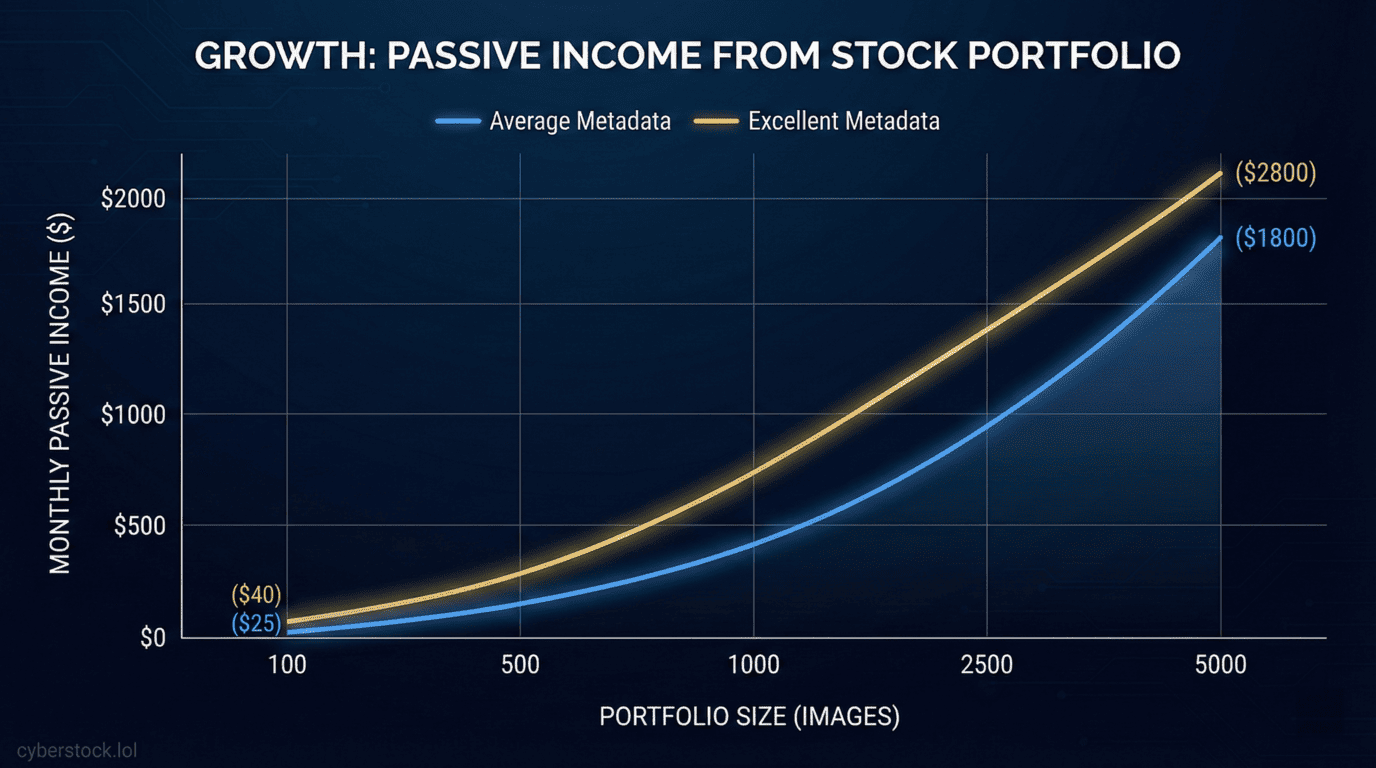
I'm skeptical of "income report" content that shows extraordinary results without context. Here's what contributor community data, income surveys, and my own experience suggest about income ranges at different portfolio stages. These are realistic ranges, not aspirational maximums.
Portfolio size | Monthly downloads (est.) | Monthly income (est.) | Time to reach (photography) | Time to reach (AI content) |
|---|---|---|---|---|
100 images | 20–50 | $8–$25 | 2–3 months | 2–4 weeks |
500 images | 100–250 | $40–$150 | 6–12 months | 2–3 months |
1,000 images | 250–600 | $100–$400 | 12–18 months | 4–6 months |
5,000 images | 1,000–3,000 | $400–$1,800 | 3–5 years | 6–12 months |
10,000 images | 2,500–8,000 | $1,000–$5,000 | 5–8 years | 12–18 months |
Ranges are wide because they depend heavily on niche (commercial business imagery outperforms generic travel at equivalent portfolio size), platform mix (Adobe + Shutterstock + Getty outperforms any single platform), and metadata quality (the variable that most contributors underestimate). These figures assume content uploaded primarily to Adobe Stock and Shutterstock, with average metadata quality.
With excellent metadata — specifically keywords built on buyer search intent rather than image description — the download rates can run 2–3× the low end of those ranges on the same portfolio size. This is not a minor optimization. It's the difference between $150/month and $450/month from a 1,000-image portfolio.
The Four Levers of Microstock Income
Lever 1: Portfolio Volume
The most direct input into monthly income is how many approved, discoverable images you have in the library. More images means more surface area for buyer searches to land on. Portfolio growth is the primary activity during the early stages of building a microstock income stream, and it's where the AI content revolution has genuinely changed the calculus.
A traditional photographer with limited shooting time might add 50–100 new images per month to their portfolio. An AI content creator running systematic workflows can add 500–2,000 per month. This doesn't mean AI content earns more per image — it typically earns less, because market saturation in popular categories is higher for AI than for photography. But the volume potential fundamentally changes the income ceiling available to contributors who weren't previously limited by creative output time.
Lever 2: Platform Coverage
Uploading the same non-exclusive content to Adobe Stock, Shutterstock, Getty/iStock, Pond5, Alamy, and Freepik multiplies your revenue from the same creative work. The platforms don't compete with each other for contributors — they have different buyer bases. A marketing team at a mid-size company might license their business imagery from Shutterstock. An advertising agency working on a premium campaign might use Adobe Stock. A UK editorial publication might use Alamy.
The math is straightforward: if an image earns $0.50/month on Adobe Stock and $0.30/month on Shutterstock and $0.15/month on Getty, that's $0.95/month from one image versus $0.50/month from that image only on Adobe Stock. At 1,000 images, the difference is $450/month versus $950/month for the same creative output. Multi-platform upload is the single highest-leverage mechanical action in microstock income optimization.
Lever 3: Metadata Quality
This is the lever most contributors underweight early and overweight attention to later, usually after experiencing the frustration of a 500-image portfolio that generates $30/month. Metadata quality — keyword commercial relevance, title quality, keyword order — determines discovery rate, which determines download rate, which determines income. Two identical images with different metadata quality can perform at 10× different download rates.
The challenge is that metadata quality is harder to improve retroactively than to get right the first time. An image uploaded with poor keywords and no downloads builds no ranking history. When you re-keyword it, you're starting from zero with a slightly older image in a more crowded library. Getting keywording right from the first upload has compounding value that manual rekeywording can never fully recover.
Lever 4: Niche Selection and Trend Timing
Not all image categories perform equally. Commercial business, technology, diversity and inclusion, wellness, and sustainability content currently generate higher-than-average download rates because enterprise buyer demand in these categories is high and growing. Generic travel, standard landscapes, and basic food photography are heavily saturated categories with high competition and declining per-image earnings.
Trend responsiveness is a genuine income lever — particularly for AI content creators who can generate on-trend content within 48 hours of a trend emerging. CyberStock's Selling Score feature specifically addresses this: it evaluates each image's keyword clusters against live market demand data, flagging images targeting declining or oversaturated categories (Red) and images in currently high-demand clusters (Green) before you invest time in keywording and uploading.
The AI Content Revolution: What It Changes for Passive Income Potential
The most significant structural change in microstock passive income over the past two years is the arrival of commercially viable AI-generated content. Adobe Stock, Shutterstock, and most major platforms now explicitly accept and actively promote AI content categories.
What this changes for passive income strategy: the volume bottleneck that limited traditional photographers no longer exists. A contributor who previously added 100 images/month can now add 1,000–2,000/month with AI generation workflows. This dramatically accelerates the portfolio-building phase and shifts the binding constraint from content creation time to metadata quality.
The catch: at AI content volumes, manual keywording is completely impossible. A contributor uploading 1,000 AI images per month who spends even 5 minutes per image on metadata is spending 83 hours/month on keywording alone — which eliminates the passive income model entirely. Batch AI keywording tools that generate commercially relevant keywords automatically aren't an optimization at AI content scale; they're a prerequisite.
Building Your Microstock Passive Income System: A 90-Day Roadmap
Days 1–14: Platform setup and first 50 images. Create accounts on Adobe Stock, Shutterstock, and Freepik. Upload your first 50 images — photography or AI-generated — with proper metadata. Don't aim for perfect on the first batch; aim for correct platform compliance and reasonable keyword quality. Your goal is establishing presence and beginning the history-building process.
Days 15–30: Audit, learn, and establish workflow. Review your first acceptance rates and any rejection patterns. Identify which image categories performed best in early impressions. Establish a repeatable workflow: content creation → batch keywording → platform CSV export → upload. Your workflow should handle 100+ images per batch without becoming a bottleneck.
Days 31–60: Scale volume and diversify platforms. Increase monthly output to 200+ images and add Getty/iStock and Alamy to your platform mix. This is where multi-platform leverage starts compounding. Track which categories generate impressions — use this data to direct future content creation.
Days 61–90: Optimize for metadata quality on your top performers. By day 61, you have enough data to see which images are generating downloads. Analyze those images' keyword architecture — specifically what's in positions 1–10. Use this to refine your keywording templates for future batches. Images already uploaded with poor metadata should be re-keyworded and resubmitted.
At the 90-day mark, a contributor following this roadmap with consistent output should have 500–1,500 images across multiple platforms and be generating $40–$200/month in early passive income. This is not financial independence — but it's a system that will compound monthly as the portfolio grows without requiring proportionally more active effort.
The Bottom Line
Microstock passive income in 2026 is more accessible than it's ever been and more competitive than it's ever been simultaneously. The AI content revolution has removed the barrier of creative output volume. The metadata quality gap has become the primary differentiator between contributors earning $50/month and $5,000/month from comparable portfolio sizes.
The contributors building meaningful passive income streams right now are doing two things consistently: uploading volume with systematic workflows, and treating metadata as a commercial asset rather than a filing task. Everything else — platform selection, image quality, niche focus — is downstream of those two behaviors.
Build your passive income foundation with better metadata: cyberstock.lol — buyer-data keywords, batch processing, multi-platform CSV export.