
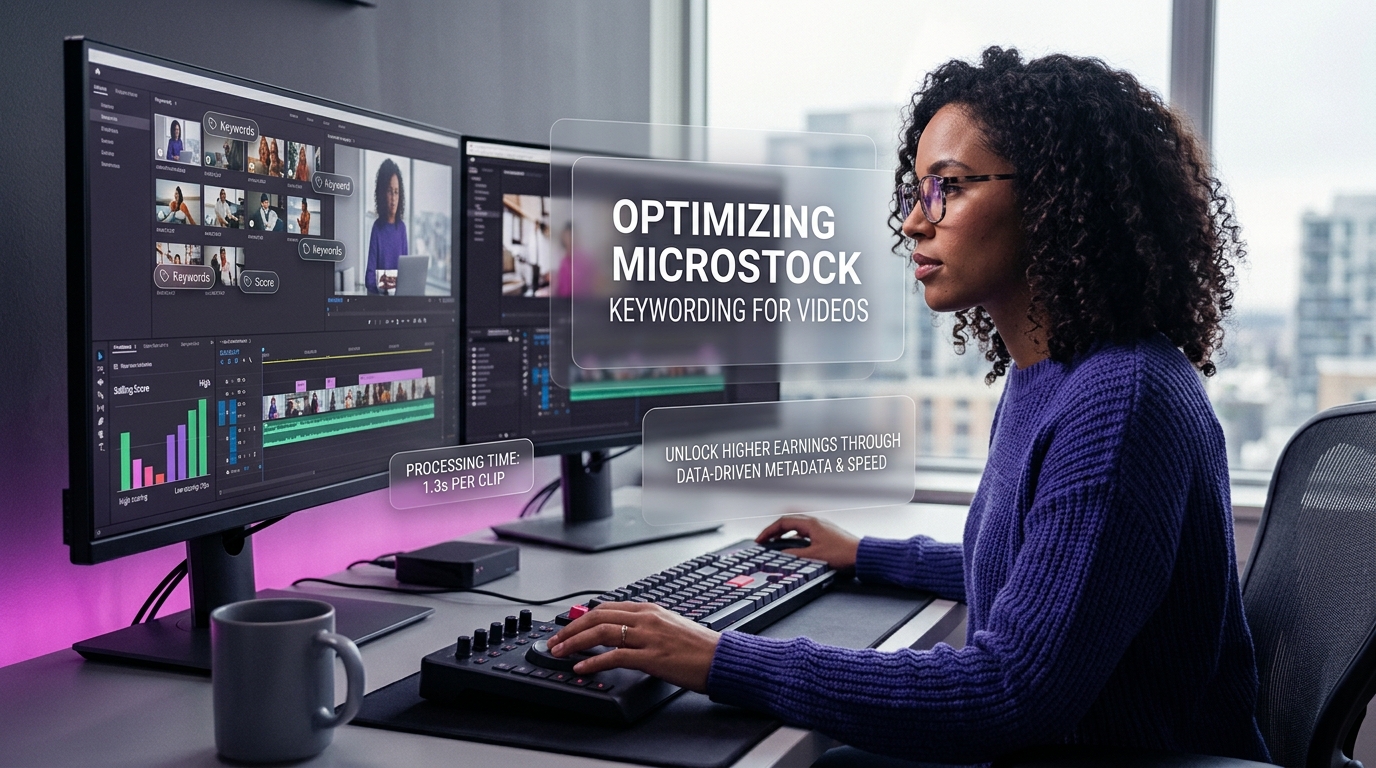
Mastering Microstock Keywording for Videos: Your Definitive Guide to Boosting Sales

Effective microstock keywording for videos involves creating a detailed and relevant set of metadata that describes the clip's content, concept, and technical attributes. This process is crucial for ensuring your videos are discovered by buyers on platforms like Shutterstock and Adobe Stock. By thinking like a customer and leveraging AI-powered tools, you can significantly increase your video's visibility and ultimately drive more sales.
Key Takeaways
Visibility Equals Viability: Even the most cinematic 4K video is invisible—and therefore unsellable—without precise, comprehensive keywords that match buyer search queries.
Think Beyond the Obvious: Successful keywording for video goes beyond describing objects. It requires capturing action, emotion, concepts, and the overall narrative of the clip.
Buyer Intent is King: Understand that customers search for solutions, not just visuals. Keywords should reflect potential uses, such as "teamwork," "innovation," or "serenity."
Multi-Frame Analysis is Crucial: Unlike a static photo, a video tells a story over time. Your keywords must reflect the entire sequence of actions, not just a single frame.
AI is a Powerful Ally: Modern AI tools can analyze video content, suggest data-backed keywords, and ensure compliance with agency rules, dramatically speeding up your workflow and improving accuracy.
Agency Rules Differ: Each microstock platform (Shutterstock, Adobe Stock, Pond5) has unique guidelines for titles, descriptions, and keyword limits. Tailoring your metadata is essential for acceptance and success.
Keywords Have a "Selling Score": Not all keywords are created equal. Some have higher demand and less competition, making them more valuable for driving sales.
Workflow Integration Saves Time: Incorporate keywording into your production process, from pre-shoot planning to post-production batching, to make it a seamless part of your creative work.
Why Strategic Keywording is Non-Negotiable for Your Stock Videos
You've invested in equipment, scouted the perfect location, and spent hours editing a beautiful video clip. You upload it to your favorite microstock agency, filled with anticipation. Weeks pass, and the sales dashboard remains stubbornly at zero. The culprit is almost always the same: weak metadata. In the crowded world of stock footage, keywording isn't an afterthought; it's the bridge between your content and a paying customer.
The Invisible Barrier: How Poor Keywords Hide Your Best Work
Imagine a massive library with millions of books, but none of them have titles or are organized in any way. That's what a microstock platform looks like without metadata. Keywords, titles, and descriptions are the cataloging system that allows buyers to find exactly what they need. Without them, your stunning aerial shot of a coastline or your heartfelt clip of a family reunion is effectively lost in a digital abyss.
Beyond Aesthetics: Keywording as Your Video's Sales Engine
Good keywording does more than just describe what's in the frame. It connects your video to a commercial need. A buyer searching for "data visualization" doesn't just want a clip of a graph; they want a video that conveys concepts like "growth," "analytics," "business intelligence," and "future trends." Your keywords are your sales pitch, working 24/7 to position your video as the perfect solution for a buyer's project.
Decoding Buyer Intent: What Stock Video Customers Are *Really* Searching For

To master keywording, you must stop thinking like a creator and start thinking like a buyer. A marketing manager, a documentary filmmaker, and a social media coordinator all use stock video, but they search in vastly different ways. Understanding their intent is the first step toward crafting metadata that converts.
From Literal to Conceptual: Understanding the Buyer's Journey
Buyers rarely start with purely descriptive terms. They start with a problem or a concept they need to illustrate. Your job is to anticipate these needs.
Literal/Descriptive Keywords: These describe the "who, what, where." Examples: woman, typing, laptop, office, daytime.
Conceptual/Interpretive Keywords: These describe the "why"—the mood, theme, or idea. Examples: productivity, concentration, deadline, startup culture, remote work.
A successful video needs a healthy mix of both. The literal keywords get your video into the initial search results, while the conceptual keywords are what often seal the deal for a buyer looking for a specific message.
The Power of Specificity: Moving Beyond Generic Search Terms
The term "business meeting" yields millions of results. A buyer with a specific need will quickly refine their search. Your keywords should reflect this level of detail.
"Instead of just 'business meeting,' consider the nuances. Is it a 'diverse team brainstorming,' a 'formal boardroom presentation,' a 'creative agency pitch,' or a 'successful contract negotiation'? Each of these phrases attracts a more qualified buyer and helps your clip stand out from the generic competition."
The Step-by-Step Process for Optimizing Your Video Keywords
Creating effective metadata is a systematic process. Follow these steps to ensure every video you upload is primed for maximum discoverability and sales potential.
Analyze Your Video's Core Message and Visuals: Before typing a single word, watch your clip several times. What is the primary action? What is the prevailing mood? Who is the main subject? What story is being told from the first frame to the last?
Brainstorm Initial Descriptive Keywords (The 5 Ws): Start with the basics. This is your foundation.
Who: one woman, young adult, Caucasian, business professional.
What: writing on a whiteboard, presenting a chart, smiling, collaborating.
When: daytime, morning, natural light.
Where: modern office, conference room, co-working space, city view window.
Why: strategy session, team planning, quarterly review, success.
Identify Conceptual and Abstract Keywords: Now, dig deeper. What feelings or ideas does the video evoke? Think about the problems your clip solves for a buyer. Keywords could include: teamwork, leadership, innovation, growth, strategy, communication, success, achievement.
Incorporate Technical Descriptors: Buyers often search for specific production techniques. Don't forget these crucial terms. Examples: 4k, slow motion, time-lapse, real-time, dolly shot, slider shot, aerial, drone footage, close-up, wide shot, shallow depth of field.
Leverage AI for Data-Backed Keyword Suggestions: Manual brainstorming can only get you so far. AI tools analyze your video and compare it to millions of data points from actual buyer searches. This uncovers high-potential keywords you might have missed. For instance, an advanced tool like Cyberstock uses its Best Concept Recognition to understand the underlying story in your video, suggesting powerful conceptual keywords that resonate with commercial buyers.
Refine and Prioritize Your Keyword List: Most agencies give more weight to the first 5-10 keywords. Place your most important and specific terms at the beginning of your list. Start with the primary subject and action, then move to concepts and secondary details.
Craft Agency-Compliant Titles and Descriptions: Your title should be a concise, human-readable sentence that includes your top keywords. Your description can elaborate further, providing more context. For example: Title: "Diverse Business Team Collaborating on a Project in a Modern Office." Description: "A multi-ethnic group of young professionals brainstorming ideas and writing on a glass whiteboard during a strategy meeting. Shot in 4K with natural light, conveying teamwork and innovation."
Review for Accuracy and Relevance: The final step is a sanity check. Read through every keyword. Does it accurately represent the video content? Is there anything misleading? Irrelevant keywords can harm your ranking and lead to buyer frustration, so be ruthless in cutting anything that doesn't belong.
Essential Keywording Elements for Maximizing Video Discoverability
To build a truly robust metadata profile for your videos, you need to cover several key categories of information. Think of it as painting a complete picture for the search engine.
Describing the Action: Verbs and Movement
Video is about movement. Your keywords must reflect this. Use strong, active verbs. Instead of just "man, phone," use "man scrolling on smartphone," "man texting a message," or "man answering a video call." The nuance is critical. Also, consider using both singular and plural forms (e. g., person, people) and different verb tenses (e. g., run, running) where appropriate.
Capturing the Mood: Emotions and Concepts
This is where you connect with the buyer's creative vision. Is your clip of a rainy windowpane meant to be sad or peaceful? Include both. Keywords like solitude, melancholy, tranquility, contemplation, relaxation, and peacefulness all appeal to different projects.
Technical Precision: Shot Types, Angles, and Production Values
Videographers and editors search with a technical eye. Always include metadata about how the shot was created. This includes:
Shot Type: close-up, medium shot, wide shot, extreme close-up
Camera Angle: low-angle shot, high-angle shot, point of view (POV), overhead shot
Camera Movement: pan, tilt, zoom in, zoom out, tracking shot, handheld, gimbal shot
Composition: copy space, rule of thirds, frame within a frame, negative space
Format: vertical video, 9:16, 16:9, cinematic
Location, Time, and Context: Adding Depth to Your Metadata
Provide as much context as possible. "Beach" is good, but "tropical beach at sunset with calm waves" is much better. If you have a model release, add keywords related to the location if it's recognizable. For generic locations, describe the environment: urban city street, remote mountain trail, sterile laboratory, cozy living room.
People and Diversity: Accurate Representation
When featuring people, be specific and respectful. Buyers are increasingly searching for inclusive and authentic content. Include keywords for:
Number of people: one person, couple, small group, crowd
Age: toddler, teenager, young adult, senior citizen
Relationships: family, friends, colleagues, romantic couple
Diversity: Use accurate and appropriate terms for ethnicity, such as African American, Asian, Hispanic, Caucasian, multi-ethnic group.
Navigating Agency-Specific Keywording Guidelines for Videos

Compliance is not just about avoiding rejections; it's a competitive advantage. Videos with perfectly formatted metadata get approved faster and indexed correctly, putting them in front of buyers sooner. While the core principles are similar, the major agencies have their own quirks.
Agency | Keyword Limit & Priority | Title & Description Guidelines | Unique Considerations |
|---|---|---|---|
Shutterstock | Shutterstock allows up to 50 keywords, and it is generally understood that the initial keywords in your list carry more weight in their search algorithm. | Title is critical for search. Must be descriptive and under 200 characters. No special characters. | The algorithm is sophisticated and understands keyword relationships. Avoid keyword spamming. |
Adobe Stock | Adobe Stock allows up to 49 keywords, and the order of these keywords is considered very important, with those listed first typically having a greater impact on search results. | Titles should be clear and descriptive. Adobe's auto-keywording tool can be a good starting point but always needs manual review. | Adobe's AI can automatically reject content for trademark or IP issues found in the metadata. Be cautious with brand names. |
Pond5 | Pond5 generally recommends using 25-40 relevant keywords, and the platform is often perceived as offering more flexibility in keywording compared to some other agencies. | Descriptions are highly searchable. Use this space to add more detail and context about the clip. | Pond5 allows for more niche and specific keywords. It's a good platform to test long-tail keyword strategies. |
Getty Images/iStock | Follows a controlled vocabulary system. Keywords must be selected from their predefined list. | Very strict title and description requirements. They prioritize editorial accuracy. | Metadata must be extremely precise. Submitting to Getty often requires more research into their specific terminology. |
The AI Advantage: Revolutionizing Your Video Keywording Workflow
The single biggest challenge for any microstock contributor is time. Manually keywording hundreds of video clips is a tedious, time-consuming task that pulls you away from creating. This is where Artificial Intelligence is fundamentally changing the game.
How AI Tools Interpret Visuals and Buyer Intent
Modern AI keywording tools don't just see pixels; they understand context. By analyzing motion, objects, and composition across multiple frames, they can identify the core narrative of your video. They then cross-reference this visual data with a massive database of real-world buyer search queries to suggest keywords that are not only relevant but also commercially viable.
Speed and Efficiency: Automating Tedious Tasks
The speed increase is staggering. A process that could take 10-15 minutes per video manually can be completed in seconds. For example, AI platforms like Cyberstock can process a video and generate a full set of metadata in as little as 1.3 seconds per video. For contributors with large backlogs, this efficiency translates directly into more content online and more potential revenue.
Ensuring Compliance and Accuracy with AI
Navigating the different rules for each agency is a major headache. A key benefit of a specialized AI tool is its ability to generate metadata that is pre-formatted for each platform. This ensures you are always using Microstock Policy Compliant Metadata, which drastically increases your acceptance rate and reduces the frustrating cycle of rejections and resubmissions.
"The human touch remains essential. Use AI as your incredibly fast, data-savvy assistant. Let it handle 90% of the heavy lifting—generating a comprehensive list of relevant terms. Then, use your creative judgment to refine, reorder, and add any unique conceptual nuances the AI might have missed. This hybrid approach offers the best of both worlds: speed and strategic insight."
Common Video Keywording Mistakes to Avoid
Even experienced contributors can fall into bad habits. Avoiding these common pitfalls will keep your portfolio healthy and your search ranking high.
Keyword Stuffing: The Pitfalls of Over-Tagging. Don't add keywords that are only tangentially related. If a car drives past in the background for one second of a 30-second clip about a park, don't add "car." This dilutes the relevance of your primary keywords and can be penalized by search algorithms.
Generic vs. Specific: Why Detail Matters. "Person working" is a weak keyword. "Female software developer coding at night in a home office" is a strong, specific keyword phrase that will attract a targeted buyer. Always choose specificity over generality.
Irrelevant Keywords: Damaging Your Search Ranking. Never add popular but irrelevant keywords just to attract views. If a buyer clicks on your video for "Christmas" but it's a summer beach scene, they will quickly move on. This signals to the agency's algorithm that your video is not a good match for that query, hurting its rank.
Neglecting Updates: Keeping Your Keywords Fresh. Search trends evolve. A term that was popular last year might be replaced by a new one. Periodically review your best-selling clips and see if you can refresh the metadata with new, relevant keywords to capture emerging trends.
Integrating Keywording into Your Video Production Pipeline
To make keywording less of a chore, build it into your natural workflow. Don't save it all for the end. A little planning can save you hours of work later.
Pre-Production: Brainstorming Keywords with Your Vision
When you're planning a shoot, think about the keywords you're targeting. If your goal is to create a clip about "sustainable living," your shot list should include visuals that support keywords like eco-friendly, recycling, organic, green energy, and conscious consumerism. Shooting with keywords in mind ensures your final product aligns with market demand.
Post-Production: Efficient Metadata Application
This is where you batch your work. After you've edited your clips, set aside a dedicated block of time for metadata. Use a spreadsheet or a dedicated program to organize your clips and their associated keywords. This is the ideal stage to run your videos through an AI keywording tool, generating metadata for your entire batch at once before uploading to the agencies.
Frequently Asked Questions (FAQ)
How many keywords should I use for a stock video?
Aim for 25-40 highly relevant keywords. While most agencies allow up to 50, quality is far more important than quantity. Filling the space with irrelevant terms will hurt your visibility more than it helps.
Should I use single words or phrases for keywords?
Use a mix of both. Single words (e. g., business, technology, future) cover broad categories, while multi-word phrases, or long-tail keywords (e. g., scientist in a lab analyzing DNA), capture specific buyer intent and face less competition.
Does the order of my keywords matter?
Yes, absolutely. All major agencies place more importance on the first 5-10 keywords in your list. Always put your most accurate and essential keywords first, starting with the main subject and action.
How do I find trending keywords for stock video?
Look at agency creative trend reports (Shutterstock and Adobe publish these annually). You can also use general SEO tools to see what topics are gaining traction. Some specialized AI keywording tools also incorporate trend data into their suggestions.
Can I use the same keywords for a photo and a video of the same scene?
You can use the same base descriptive keywords, but your video metadata should be expanded to include terms related to action, movement, and time. Add keywords like panning, tilting, slow motion, real-time, and verbs describing the entire action sequence.
Is it okay to use brand names or logos in keywords?
No, unless you are submitting the clip for editorial use and the brand is central to the story. For commercial stock footage, you must avoid all trademarks in your video and your metadata. Including them will lead to rejection.
Elevate Your Microstock Video Sales with Smart Keywording
Microstock keywording for videos is both an art and a science. It requires creative empathy to understand a buyer's needs and analytical precision to satisfy search algorithms. By moving beyond simple descriptions to tell the full story of your clip—its actions, concepts, and technical merits—you transform your metadata from a simple label into a powerful sales tool.
While the process can seem complex, embracing a structured workflow and leveraging the power of AI can make it manageable and even enjoyable. By consistently applying these principles, you will build a robust, discoverable portfolio that connects your creative work with the global marketplace, driving consistent sales and long-term success.
Your Next Step to Optimized Video Portfolios
If you're ready to stop guessing and start using data-driven metadata to increase your video sales, it's time to integrate a professional tool into your workflow. Explore how an AI-powered keywording and titling tool can automate the most tedious parts of the process, allowing you to spend more time creating and less time typing.