

Master Microstock Keywording Best Practices: Your Guide to Boosting Sales in 2026

The best microstock keywording practices involve a strategic blend of descriptive, conceptual, and technical keywords, prioritizing relevance and placing the most critical terms first. This approach ensures your content is discovered by the right buyers, which directly increases visibility and drives sales. By avoiding common mistakes like keyword stuffing and leveraging data-driven tools, you can transform metadata from a chore into a powerful revenue-generating asset.
Key Takeaways
Keywords Drive Sales:Effective keywording is a critical factor for increasing the visibility and download rates of your content on microstock platforms.
Balance is Essential:A successful keyword strategy combines literal descriptions (what is it?) with abstract concepts (what does it feel like?).
Quality Over Quantity:Aim for a focused selection of 30 to 50 highly relevant keywords per asset, prioritizing quality over a higher quantity of less pertinent terms. Keyword stuffing hurts your ranking.
Order Matters:It is generally understood that microstock algorithms may prioritize keywords appearing earlier in your list, making the placement of your most important terms at the beginning a beneficial strategy.
Holistic Metadata is Key:Your title and description must work in harmony with your keywords to provide context and improve searchability.
Avoid Common Pitfalls:Vague terms, misspellings, and neglecting conceptual keywords are common mistakes that limit your content's reach.
AI is a Game-Changer:Modern AI tools can analyze market data to suggest high-performing keywords, identify complex concepts, and dramatically speed up your workflow.
Review and Refine:Keywording is not a one-time task. Periodically review the performance of your keywords and update them based on sales data and market trends.
Why Smart Keywording is Non-Negotiable for Microstock Success
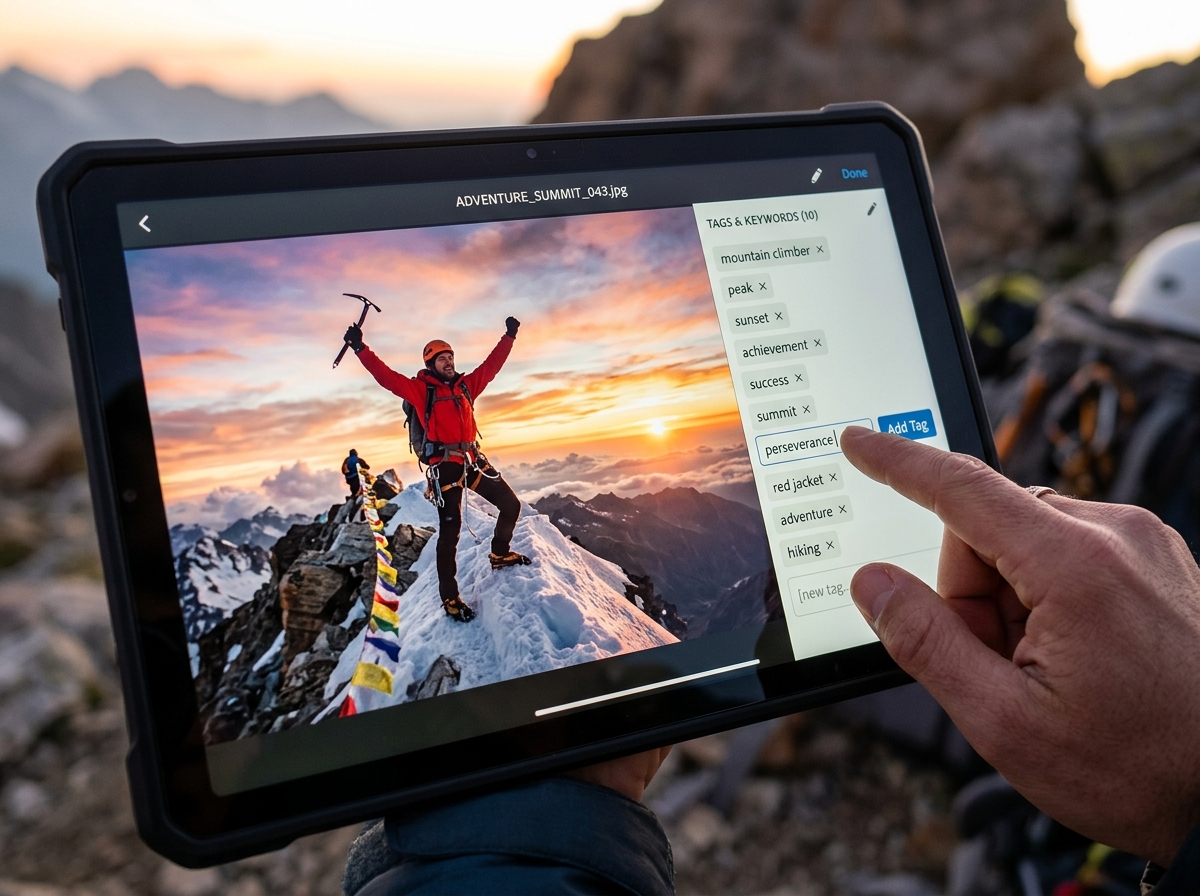
Uploading a brilliant photo or video is only half the battle. Without the right metadata, even the most stunning content will remain invisible, buried under millions of other files. Smart keywording is the bridge that connects your creative work to the buyers actively searching for it.
The Direct Link Between Keywords, Visibility, and Revenue
Think of each keyword as a potential doorway for a customer. The more relevant, accurate doorways you create, the more traffic you'll get. A buyer searching for "optimistic business team celebrating success" will never find your image if it's only tagged with "people, office, happy." Precise, multi-layered keywording directly translates to higher placement in search results, more views, and ultimately, more downloads and a healthier income stream.
How Microstock Platforms Use Your Metadata
Microstock agency search engines are sophisticated algorithms that rely entirely on the metadata you provide. When a customer types a query, the algorithm scans millions of files, looking for the closest match based on:
Keywords:The primary matching factor.
Title:Provides crucial context and often contains the most important keywords.
Description:Offers further detail and supports long-tail search queries.
The algorithm ranks results based on relevance, and assets with well-optimized, specific metadata consistently outperform those with generic tags. Your keywords don't just describe your image; they teach the platform what your image is about and who should see it.
Deconstructing Keywords: The Four Pillars of Effective Tagging
To build a robust keyword list, you need to think in layers. A comprehensive approach involves four distinct types of keywords, each serving a unique purpose in helping buyers find your work.
Descriptive Keywords: The Foundation of Search
These are the literal, objective words that describe the who, what, and where of your content. They are the bedrock of your metadata. Be thorough and specific.
Who:young businesswoman, senior man, diverse team, toddler girl
What:laptop, coffee cup, architectural blueprint, golden retriever puppy
Where:modern office, rustic kitchen, mountain summit, urban park
Action:typing on keyboard, laughing, hiking, presenting data
Pro Tip:Instead of just "dog," specify "beagle puppy with floppy ears running through autumn leaves." Specificity helps you rank in less competitive, high-intent searches.
Conceptual Keywords: Unlocking Emotional Connections
Conceptual keywords describe the ideas, emotions, moods, and abstract themes your content represents. This is where many contributors miss a massive opportunity. Buyers often search for feelings and ideas, not just objects.
Emotion:joy, serenity, determination, frustration, nostalgia
Themes:teamwork, innovation, sustainability, freedom, security, wellness
Ideas:future, growth, challenge, success, connection, deadline
A buyer looking for an image to represent "digital transformation" isn't just searching for "person with computer." They're searching for the concept. If you can tap into that with keywords like "innovation," "connectivity," and "future technology," you unlock a much larger and more valuable market.
Technical Keywords: Precision for Niche Searches
These keywords describe how your content was made, its style, and its composition. They are crucial for attracting buyers with specific technical or aesthetic requirements.
Composition:close-up, wide-angle shot, aerial view, copy space, isolated on white
Style:watercolor, vector illustration, flat lay, cinematic, bokeh, double exposure
Technical:4k resolution, slow motion, loopable video, CGI, drone footage
The Power of Long-Tail Keywords for Targeted Traffic
Long-tail keywords are multi-word phrases that are highly specific. While they have lower search volume individually, they attract buyers who know exactly what they want, leading to higher conversion rates. Combine descriptive, conceptual, and technical elements to create them.
Generic:woman, laptop, office
Long-Tail:"focused female software developer coding on laptop in minimalist office at night"
Generic:family, beach, sunset
Long-Tail:"happy multi-generational family walking on sandy beach during golden hour sunset"
Data-Driven Keyword Research: Moving Beyond Guesswork
The most successful contributors don't guess what keywords will work; they use data and strategic research to inform their choices. Here’s a step-by-step process to build a powerful keyword list.
Start with Brainstorming:Begin by listing every descriptive, conceptual, and technical term you can think of related to your image or video. Write down at least 20-30 words without judging them.
Analyze Top-Selling Competitors:Search for your primary concept on a major stock agency. Analyze the keywords used on the top 5-10 performing assets. Don't copy them directly, but look for patterns, synonyms you missed, and strong conceptual ideas.
Leverage Agency Search Suggestions:Start typing your main keywords into the search bar of platforms like Adobe Stock or Shutterstock. The autocomplete suggestions are a goldmine of real user search queries. Pay attention to the long-tail phrases that appear.
Incorporate AI and Data Insights:This is where you can gain a significant competitive edge. Manual research is good, but it's limited by your own perspective. AI-powered tools can analyze millions of data points from actual buyer searches to identify keywords with high commercial value that you might never think of. For instance, a tool like Cyberstock can use itsBest Concept Recognitionto see the underlying story in your image—like identifying "mentorship" in a photo of two people at a computer—and suggest powerful conceptual keywords that drive sales.
The Art and Science of Keyword Selection: Quality Over Quantity
Once you have a pool of potential keywords, the next step is to curate the final list. This process requires a balance of strategy and adherence to best practices.
Finding the Optimal Keyword Count (The 30-50 Rule)
Most microstock agencies allow up to 50 keywords. While it's tempting to use all of them, relevance is far more important than volume. A recommended target for most content is between 30 and 50 keywords, aiming for comprehensive coverage without diluting relevance.
Under 25:You are likely missing opportunities.
30-45:The sweet spot for most content, offering comprehensive coverage without dilution.
45-50:Acceptable if every single keyword is 100% relevant and adds unique value.
Prioritizing Relevance and Avoiding Spam
The golden rule of keywording is relevance. Including irrelevant keywords (keyword stuffing) in an attempt to appear in more searches is a major mistake. Search algorithms are smart enough to detect this practice, and it can lead to your content being penalized or even your account being flagged. If a keyword doesn't accurately describe your asset, leave it out.
Strategic Keyword Ordering: Putting Your Best Foot Forward
The order of your keywords matters. Many agencies are thought to give greater importance to the initial 10-15 keywords in your list. Use this to your advantage.
Keywords 1-5:Your primary subject and core concept. This should be your most specific, high-value long-tail phrase broken down.
Keywords 6-15:Important secondary descriptive and conceptual terms.
Keywords 16+:Broader terms, technical details, and alternative synonyms.
Beyond Keywords: Crafting Titles and Descriptions That Convert
Your keywords don't exist in a vacuum. Your title and description are critical pieces of the metadata puzzle that provide context, improve searchability, and persuade the buyer to click.
How Titles Enhance Discoverability and Context
A great title is a concise, descriptive sentence that includes your most important keywords. It should be human-readable and accurately describe the content. Avoid single-word titles or lists of keywords.
Weak Title:Business Meeting
Strong Title:Diverse business team collaborating on a project in a modern conference room.
Writing Engaging Descriptions That Complement Keywords
The description is your chance to expand on the title and provide more detail. You can include information about the location, the story behind the image, or potential uses. Write in natural sentences and incorporate secondary and long-tail keywords where they fit organically.
Ensuring Marketplace-Ready Metadata Across All Fields
Every agency has slightly different rules for titles, descriptions, and keywords (e. g., character limits, formatting). Creating metadata that works everywhere is crucial for efficiency. This is where a holistic approach pays off, ensuring every field is optimized and compliant. Tools can help generateMarketplace-Ready Metadatathat adheres to the specific guidelines of major agencies, saving you from tedious manual adjustments and reducing rejection rates.
Common Keywording Mistakes and How to Avoid Them

Even experienced contributors can fall into bad habits. Here are some of the most common mistakes that can sabotage your sales, and how to fix them.
Common Mistake | Best Practice |
|---|---|
Keyword Stuffing(e. g., adding "car" to a picture of a bicycle) | Prioritize Relevance.Only use keywords that accurately describe the visual elements or concepts in your asset. |
Vague/Generic Keywords(e. g., "person," "outside," "work") | Be Hyper-Specific.Use "young female architect reviewing blueprints on construction site" instead of generic terms. |
Misspellings & Typos | Proofread Meticulously.A single typo can make your asset undiscoverable. Use a spell checker or keywording tool. |
Ignoring Conceptual Keywords | Think Beyond the Literal.Always include keywords that describe the emotion, mood, or underlying message (e. g., "tranquility," "achievement"). |
Using Singular Only | Include Both Singular and Plural.Add both "cat" and "cats" if relevant. Most modern search engines handle this, but it's still good practice. |
Not Updating Keywords | Periodically Review Performance.If an image isn't selling, revisit and refine its keywords based on current trends. |
The Future of Keywording: AI-Powered Efficiency and Accuracy
The manual keywording process is notoriously time-consuming and prone to human error. Artificial intelligence is revolutionizing this workflow, allowing creators to focus more on creating and less on administrative tasks.
The biggest shift in microstock isn't camera technology; it's data science. Contributors who embrace data-driven keywording will have an insurmountable advantage over those who rely on intuition alone. AI is the tool that democratizes access to that data.
How AI Streamlines Your Workflow
Modern AI keywording tools can analyze an image or video and generate a full set of metadata in seconds. Instead of spending 5-10 minutes per asset, you can process an entire batch in a fraction of the time. For example, advanced platforms like Cyberstock can generate a complete set of keywords and a title in just1.3 seconds per image/video, a speed that fundamentally changes how you manage your submission workflow.
Enhancing Concept Recognition with AI
Perhaps the most powerful aspect of AI is its ability to identify nuanced concepts that humans might miss. An AI can analyze visual cues, colors, and object relationships to suggest abstract keywords like "synergy," "sustainability," or "mindfulness" with incredible accuracy. This ensures you're capturing the full commercial potential of every file.
Boosting Acceptance Rates with Policy-Compliant Metadata
Getting your content rejected for metadata errors is frustrating and time-consuming. AI tools can be programmed with the specific rules and restrictions of each microstock agency. They automatically generate metadata that is compliant with character limits, restricted words, and formatting requirements, significantly increasing your first-time acceptance rate and protecting your contributor account from potential bans.
Optimizing for Specific Content Types: Photos, Videos, and Vectors
While the core principles of keywording apply to all media types, each format has unique considerations.
Unique Keywording Considerations for Photography
For photos, focus heavily on the visual details. Mention the lighting (e. g.,natural light, studio lighting, golden hour), the camera angle (e. g.,low-angle shot, overhead view), and the depth of field (e. g.,shallow depth of field, bokeh background).
Strategies for Effective Video Keywording
Video keywording requires you to describe the action and narrative arc. Use keywords that describe movement (e. g.,panning, tilting, tracking shot) and the overall sequence (e. g.,time-lapse, slow motion, establishing shot). Also, include terms that indicate if the clip is loopable or has sound.
Best Practices for Vector and Illustration Metadata
For vectors and illustrations, the artistic style is paramount. Use keywords likeflat design, isometric, line art, cartoon, retro,andinfographic element. Also, be sure to include terms likevector, illustration, icon set,andeditableto attract buyers looking for scalable graphics.
Actionable Steps to Revolutionize Your Keywording Workflow
Ready to put these practices into action? Here's a simple plan to overhaul your keywording process for maximum efficiency and impact.
Audit Your Top 20 Performers:Analyze the keywords of your best-selling files. Identify the patterns. What conceptual keywords are common? What long-tail phrases are working?
Audit Your 20 Worst Performers:Now look at files that have never sold. Are the keywords too generic? Are they missing concepts? This is your opportunity for improvement.
Develop a Keyword Template:For recurring subjects (e. g., business meetings, family lifestyle), create a base template of 15-20 core keywords that you can then customize for each specific image.
Integrate a Data-Driven Tool:The single biggest leap in efficiency and effectiveness comes from adopting a professional tool. Instead of spending hours on manual research and data entry, leverage an AI platform to generate optimized, market-ready metadata. This frees you up to shoot, edit, and create more content.
By implementing a consistent, data-informed process, you can systematically improve the performance of your entire portfolio. For those serious about turning their microstock efforts into a significant income stream, exploring a solution likeCyberstock's AI-powered keywording and titling toolcan be a transformative step, automating the most tedious parts of the process while maximizing your content's earning potential.
Frequently Asked Questions About Microstock Keywording
How many keywords should I use for my stock photos?Aim for 30 to 50 highly relevant keywords. Quality and relevance are more important than hitting the maximum limit. A well-curated list of 35 keywords will outperform a sloppy list of 50.
Do keywords in the title matter more?Yes, keywords in the title are given significant weight by search algorithms. Your title should be a natural, readable sentence that contains your most important 2-3 keywords or a core long-tail phrase.
Should I use singular or plural keywords?It's best practice to include both if they apply (e. g., "flower," "flowers"). While some modern search engines can interpret this, including both covers all bases and can help in searches on different platforms or in different languages.
What is the biggest keywording mistake to avoid?The biggest mistake is using irrelevant keywords, also known as keyword spamming or stuffing. It can get your content de-ranked or even lead to account suspension. Always prioritize accuracy.
How often should I update keywords on my old content?It's a good practice to review your non-selling or low-selling content every 6-12 months. Search trends change, and a quick keyword refresh based on new data can breathe life into an old file.
Can I use the same keywords for similar images from the same photoshoot?You can use a base set of shared keywords, but each image should have unique keywords that describe its specific composition, focus, and nuance. Avoid a simple copy-paste approach, as it devalues each individual image.
Conclusion: Your Path to Microstock Keywording Mastery
Mastering microstock keywording is not about finding a secret formula; it's about developing a strategic, repeatable process. It's a skill that blends the art of creative interpretation with the science of data analysis. By understanding the different types of keywords, conducting thorough research, writing compelling titles, and avoiding common pitfalls, you can dramatically increase the discoverability and profitability of your portfolio.
The tools and techniques are more powerful than ever. By embracing a data-driven approach and leveraging AI to handle the heavy lifting, you can spend less time guessing and more time creating. Your next step is simple: take one of your favorite images that isn't selling and apply the principles from this guide. Re-evaluate its concepts, refine its keywords, and start building a workflow that turns your creative passion into consistent sales.