
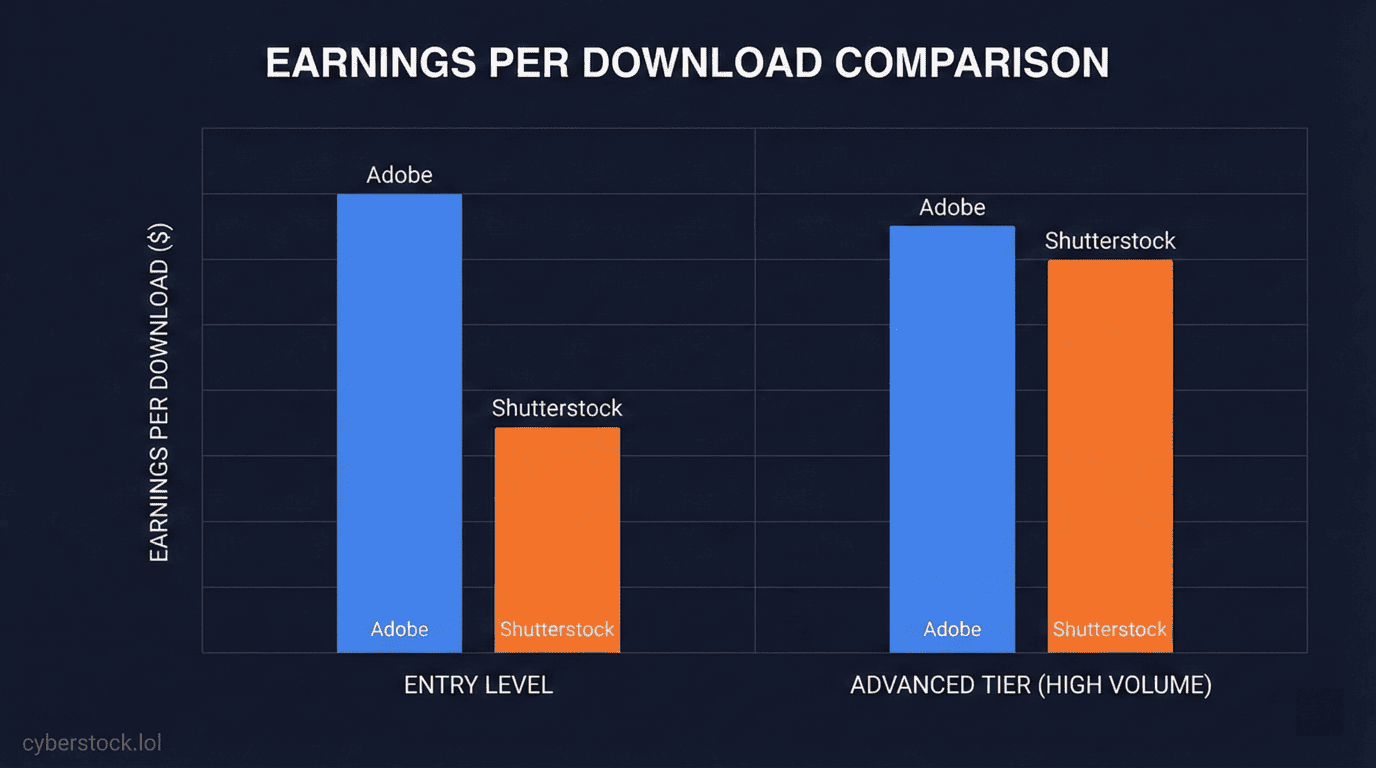
How to Sell Stock Footage in 2026: The Complete Guide for Videographers, Drone Pilots, and AI Video Creators
Key Takeaways
Video consistently earns 4–10× more per download than photos on every major platform — Adobe Stock minimum video payout is $2.80, with most sales between $4.20 and $86+ per clip
Drone footage has a structural advantage over ground-level video: unique perspective, impossible to replicate without equipment, and consistently among the top-selling content categories on Pond5 and Adobe Stock
AI-generated video (Runway, Sora, Kling) is now accepted on Adobe Stock and Shutterstock with mandatory disclosure — the category is still early, supply is thin, and early contributors have significant ranking advantage
Metadata quality matters even more for video than for photos because video libraries are smaller and the competition per keyword cluster is lower — the right keywords on a good clip can drive consistent downloads for years
4K is the current production standard; anything below 3840×2160 is increasingly difficult to sell on premium platforms in 2026
Why Video Earns More Than Photos — And Why Most Contributors Ignore It
The stock video market is structurally better for contributors than the stock photo market, and it's been that way for years. Yet the majority of microstock contributors focus primarily on photos. Understanding why video is underutilized as an income stream requires understanding what makes the economics different.
On Adobe Stock, a photo subscription download pays a contributor between $0.33 and $3.30 depending on the buyer's subscription tier. A video download on the same platform pays between $2.80 and $86+ depending on license type — with the majority of subscription video downloads landing between $4.20 and $12. The minimum floor for video is more than 8× the minimum floor for photos. This premium exists because buyers expect to pay more for video content, video production costs are higher (implying higher perceived value), and the video library is significantly smaller than the photo library, meaning competition per search query is lower.
The contributor-side reason for underutilization is also clear: video is harder to produce, harder to process, and more technically demanding to submit correctly. A photographer can shoot 200 usable images in a day. A videographer shooting quality footage that meets stock platform technical standards generates 20–50 usable clips in the same time. But at $6 average per clip versus $0.80 average per photo, the income-per-hour of production is comparable or better — and the download lifecycle of a good video clip often extends for 3–5+ years, significantly longer than the average photo.
"Stock footage earns 8x more per download. The market is 10x less crowded. The only reason not to do video is the higher production bar — and in 2026, AI video generation is starting to remove even that barrier."
The Three Types of Stock Video Creators in 2026
Traditional Videographers
Ground-level videographers shooting with mirrorless cameras, cinema cameras, or high-end consumer equipment. This category covers the widest range of content: people and lifestyle footage, urban and rural environments, business and professional settings, food and product footage, nature and wildlife. The technical bar is 4K minimum, LOG format shooting for color grading flexibility, and gimbal or stabilizer use for smooth handheld shots. The advantage of traditional videography is authentic human presence — subjects, expressions, and environments that AI cannot credibly replicate in 2026.
The highest-earning traditional video content in 2026 based on platform data and contributor reports: authentic lifestyle moments with real people (not staged-looking), urban environments in major cities from unique angles, nature footage of specific environments that are difficult to reach, and professional/business settings with genuine diversity representation.
Drone Videographers
Drone footage has become one of the most consistently in-demand video categories on every major stock platform. The reason is simple: aerial perspective is visually distinctive, immediately recognizable as high-production-value content, and completely impossible to replicate without the equipment. An advertising agency buying aerial footage of a coastal city, a mountain range, or an agricultural landscape has no alternative to stock footage except chartering a helicopter — which costs thousands of dollars for a single shoot.
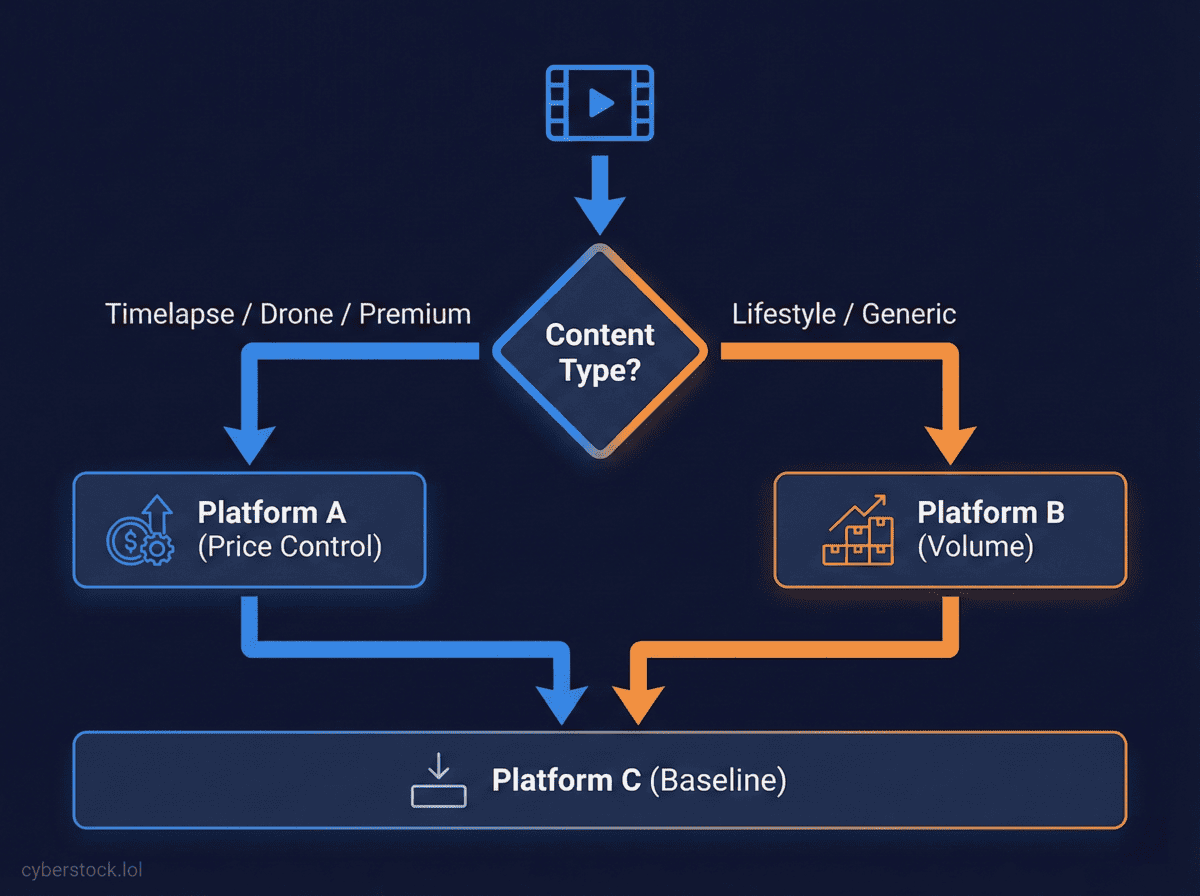
The current state of drone footage supply: major cities and iconic landscapes are heavily covered by established contributors. The opportunity for new entrants is in geographic specificity — footage of mid-tier cities, secondary landscapes, agricultural regions, suburban development patterns, and industrial facilities that receive much less contributor attention than tourist destinations. Adam Melnyk, one of the most-cited drone stock contributors, earns over $500/month from DJI drone footage averaging $3.38 per clip per year — a strong return from a modestly sized portfolio built around distinctive rather than generic locations.
AI Video Creators
Runway Gen-3, Pika, Kling, and Sora are now producing short video clips (3–10 seconds) of sufficient quality for stock submission on platforms that accept AI content. Adobe Stock and Shutterstock both now accept AI-generated video with mandatory disclosure. The category is genuinely early — supply in AI video is thin on major platforms compared to AI images, and contributors who build quality AI video portfolios in 2026 are entering a category before it becomes crowded.
The practical limitation: AI video generation currently produces compelling 3–5 second clips but struggles with coherent action sequences longer than 10 seconds, realistic human movement, and complex multi-subject interactions. The categories where AI video performs best: abstract motion backgrounds, particle and light effects, conceptual business imagery, environmental and atmospheric footage, and technology visualization — exactly the categories that are already high-demand for motion graphics and advertising use cases.
Platform Overview: Where to Submit Video in 2026
Platform | Video royalty | Min payout/clip | Best for | AI video? | Price control | Metadata req. |
|---|---|---|---|---|---|---|
Adobe Stock | 35% flat | $2.80 | Photos + video, enterprise buyers | Yes (disclosure) | No | CSV, 45 kw |
Pond5 | 40–60% | Contributor-set | Video specialists, SFX | Yes | Yes (video) | Title + kw |
Shutterstock | 15–40% tiered | $4.40 | High volume, large library | Yes (disclosure) | No | Title + kw |
Getty / iStock | 15–45% | $5+ | Premium editorial + commercial | Selective | No | Very strict |
Artlist | Revenue share | Variable | Music + footage bundles | Limited | No | Tags + license |
Storyblocks | Subscription pool | $0.50–$2 | Volume contributors | Yes | No | Tags |
Technical Requirements: What Stock Platforms Actually Need
Resolution and Format
The 2026 minimum standard across premium platforms is 4K (3840×2160). Adobe Stock and Pond5 both accept 4K as the standard tier; content below 3840×2160 is increasingly rejected or deprioritized in search rankings. For AI-generated video, upscaling from 1080p to 4K using AI upscalers (Topaz Video AI, Adobe's built-in super resolution) is acceptable provided the result is visually clean at 100%.
Codec requirements: Adobe Stock accepts H.264, H.265, Apple ProRes 422, and MOV/MP4 containers. Pond5 prefers Apple ProRes 422 or 4444 for highest quality acceptance rates. Bit depth: 8-bit is the minimum acceptable; 10-bit LOG footage that's been properly color-graded is preferred for premium licensing. Frame rate: 24fps for cinematic content, 30fps for commercial/TV use, 60fps for slow-motion sequences that can be used at either speed.
Duration
Optimal clip duration for stock submission is 10–30 seconds. Shorter clips (5–10 seconds) are acceptable for motion backgrounds, loops, and abstract footage. Clips longer than 60 seconds are difficult to sell because buyers need concise assets that integrate cleanly into edit timelines. If you have a strong 90-second take, cut it into 3 focused 30-second clips — you increase your catalog size and each clip is more marketable as a focused asset.
Audio
Stock video should be submitted without audio unless the sound is integral to the content (natural environment audio, specific crowd sounds, distinctive ambient recordings). Generic camera audio with wind noise, handling noise, or indistinct background sound reduces accept rates and buyer utility. Mute the audio track on export unless you're deliberately including high-quality natural sound as a feature of the clip.
The Metadata Problem for Video — More Critical Than for Photos
Here is a counterintuitive fact about stock video: metadata quality matters more for video than for photos, not less. The reason is structural. Stock video libraries are smaller than photo libraries by an order of magnitude. On Adobe Stock, there are approximately 200 million photos and roughly 25 million video clips. The competition per search query in video is dramatically lower — but that advantage only materializes if your video appears in the search results at all.
A video clip that isn't properly keyworded in a category with low competition is invisible in a library with 25 million clips. A video clip with excellent keyword coverage in the same category can rank on page 1 within days of approval. The metadata leverage is much higher in video precisely because the library is less dense.
The specific metadata challenges for video contributors: titles need to describe the clip's primary commercial use case (not just what's in the frame), keywords need to include both literal descriptors and commercial intent vocabulary, and video on Pond5 has an additional pricing decision layer that photos don't. CyberStock's keyword generation is applicable to both photos and video — the buyer intent training and commercial relevance sorting produces the same quality improvement in video metadata as in photo metadata.
Drone Footage: The Practical Guide to Building a Sellable Portfolio
Where to Fly for Maximum Commercial Value
The geographic diversity strategy consistently outperforms the "famous landmark" strategy for drone contributors. Famous landmarks — Golden Gate Bridge, Eiffel Tower, Grand Canyon — have thousands of existing clips from contributors who have shot them for years. The competition is overwhelming and the keyword categories are saturated. A less-photographed mid-sized city, a distinctive agricultural region, a secondary mountain range, or an industrial facility with interesting geometric patterns from above has far less competition and often comparable or higher demand because buyers can't find this content easily elsewhere.
The category framework for commercially valuable drone footage: urban aerial (city infrastructure, traffic patterns, downtown density), natural landscapes (coastlines, forests, farmland, rivers), human activity from above (events, construction, infrastructure development), industrial and agricultural facilities, and transition/movement shots (flying through structures, tracking vehicles, ascending from ground to aerial perspective). Each category has distinct buyer bases and different keyword vocabularies.
Technical Quality Requirements for Drone Footage
DJI Mini 4 Pro and above shoot 4K at sufficient quality for stock submission. The DJI Air 3 and Mavic 3 series produce footage that reliably meets or exceeds premium platform standards. Key technical requirements specific to drone footage: gimbal stabilization must be active (no vibration artifacts), propeller interference visible in corners is automatic rejection, ND filter use in bright conditions prevents blown highlights and ensures smooth exposure, and GPS wind compensation should be at maximum sensitivity for hovering and slow movement shots.
The legal compliance requirement is often overlooked: drone operation regulations vary significantly by country and region. Adobe Stock and Pond5 both require contributors to certify that footage was shot legally and with appropriate permissions. In the US, FAA Part 107 certification is required for commercial drone operation. In the EU, EASA A2 or A3 category certification depending on drone class. Submitting footage shot without appropriate certifications exposes the contributor to account termination if the legal status becomes an issue.
AI Video for Stock: Getting Started
The workflow for AI video content on stock platforms in 2026 is still developing, and the platforms' acceptance criteria are evolving. Here's the current state of viable AI video for stock submission.
Runway Gen-3 Alpha produces 5–10 second clips at 1080p with option to upscale. The motion quality on abstract and atmospheric content is commercially viable for stock. Best current use case: motion backgrounds, abstract visualizations, particle effects, and simple environmental loops. Pika 2.0 and Kling 1.5 produce similar quality with different motion characteristics — testing your specific content categories across multiple generators is worthwhile because their strengths differ by content type.
The submission checklist for AI video specifically: confirm the platform accepts AI video (Adobe Stock and Shutterstock yes, Getty/iStock is selective), check the AI disclosure checkbox on every clip, verify the clip meets technical standards at 100% view (AI video artifacts are similar to AI image artifacts — temporal inconsistency, flickering edges, unnatural motion), and ensure keywords reflect commercial intent rather than generation prompt terminology.
Keyword your entire video portfolio — photos and clips in one batch: cyberstock.lol