
Adobe Stock vs Shutterstock Earnings in 2026: Which Platform Actually Pays More?
Key Takeaways
Adobe Stock pays a flat 33% on photos and 35% on video — consistent regardless of your download volume, and the minimum per download ($0.33) is more than 3× higher than Shutterstock's floor ($0.10)
Shutterstock's tiered system resets every January 1st, meaning you spend the first 3–4 months of every year earning at 15–20% while rebuilding your level — a structural disadvantage for most contributors
In 2025, Shutterstock introduced a 50% revenue share model for Unlimited subscribers — promising on paper, but early contributor data shows high variance and unpredictability
Uploading to both platforms is non-exclusive and should be your default strategy — but metadata quality determines which platform actually converts your uploads into downloads
The metadata gap between platforms is larger than the royalty gap: the same image properly keyworded for Adobe Stock's algorithm vs. generically tagged can produce 10× more downloads regardless of which platform it's on
The Question Every Contributor Asks — And Why It's Slightly the Wrong One
If you search "Adobe Stock vs Shutterstock earnings," you'll find dozens of comparison articles that do the same thing: present the royalty percentage tables, do a few example calculations, and reach a non-conclusion like "it depends on your volume." That's technically accurate and almost completely useless.
Here's what those comparisons miss. The earnings difference between Adobe Stock and Shutterstock for most contributors is not primarily explained by the royalty structure — it's explained by discoverability. An image that doesn't appear in the first two pages of search results for its target queries doesn't generate downloads regardless of whether the royalty rate is 33% or 40%. And in 2026, discoverability on both platforms is driven by one thing: metadata quality, specifically keyword commercial relevance and title optimization.
With that said, the royalty structures do matter, and there are real structural differences that affect your earnings at different stages of a stock photography career. Here's the honest comparison, based on publicly available rates and real contributor income data.
"Adobe pays more per download. Shutterstock sells more downloads. The winner depends entirely on how good your metadata is on each platform."
How Adobe Stock Pays: The Flat Rate Advantage
Adobe Stock pays contributors a flat 33% royalty on the net sale price for photos, illustrations, and vectors, and 35% for video. The "flat" part is the key advantage: your percentage doesn't change based on how many downloads you've accumulated, so a new contributor and a contributor with 100,000 lifetime sales earn the same percentage on the same license type.
The actual dollar amount per download varies based on the customer's subscription plan, because the "net sale price" is the per-image cost within that plan. A customer on Adobe's 3-image/month plan at $29.99 pays $10 per image, so the contributor earns $3.30. A customer on the 350-image/month enterprise plan might pay $0.99 per image, earning the contributor $0.33. Most downloads come from mid-tier subscription plans, putting average real-world contributor earnings at $0.50–$1.20 per subscription download based on community-reported data.
The upside is predictability and a floor that's actually meaningful. Adobe's minimum guaranteed payout per subscription download is $0.33 regardless of the plan. Extended licenses — when a buyer needs rights beyond standard licensing — pay the same 33% on a much higher base price, and these can generate $20–$100+ per download on a single asset. Adobe also offers annual bonus programs: contributors with 150+ downloaded assets during the calendar year receive free access to selected Adobe Creative Cloud apps (Illustrator, Premiere Pro, After Effects), which has real monetary value if you're already paying for those subscriptions.
How Shutterstock Pays: The Level System and Its January Reset
Shutterstock operates on a lifetime sales tier system. Your royalty percentage is determined by how many downloads you've accumulated in total across your entire contributor history. The tiers run from 15% (entry) to 40% (contributors with 25,000+ lifetime downloads), with four levels in between.
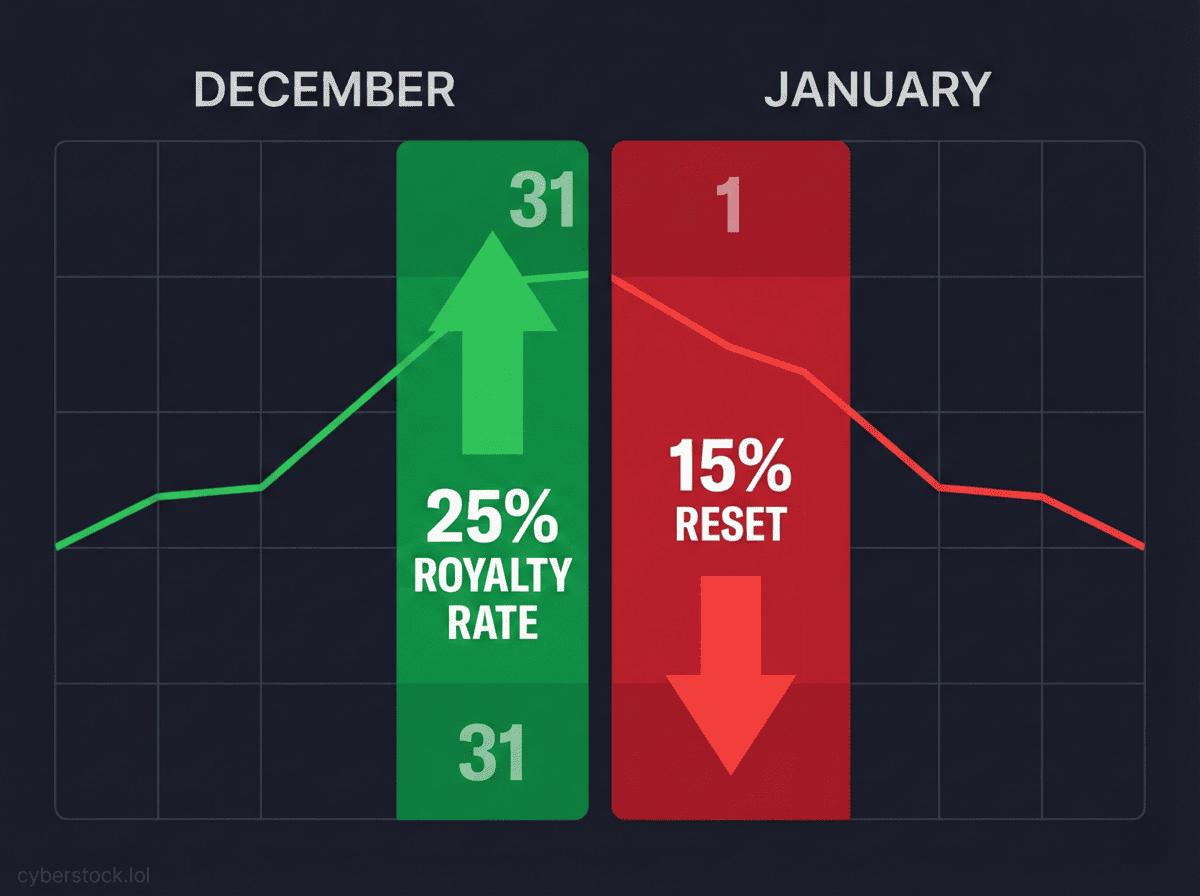
The system has one deeply frustrating structural flaw: the earnings calculation resets every January 1st. Not your lifetime total — your earnings level for the year resets. This means every contributor starts each new calendar year at Level 1 (15%), regardless of their lifetime sales history. If you've sold 1,000 downloads and earned 25% all of November, you're back to 15% on January 2nd.
The math on this is brutal for seasonal contributors and anyone who doesn't upload consistently all year. In practice, many mid-tier contributors spend January through March rebuilding their level from 15% back to a meaningful rate, earning significantly less on the same volume of downloads than they did in October–December. This is why many experienced contributors now consider Adobe Stock their primary platform despite Shutterstock historically having higher overall traffic volume.
Shutterstock's 2025 Unlimited Downloads Experiment
In April 2025, Shutterstock launched a pilot program for a new "Unlimited Downloads" subscription tier, where instead of a fixed royalty table, contributors receive 50% of net revenue from those specific subscribers. The earnings are calculated based on a "utilization score" — how important your content was to that subscriber relative to other content they downloaded.
Early data from contributors is mixed. The 50% headline rate is genuinely attractive. The unpredictability of the utilization score calculation means actual per-download earnings can be lower or higher than the traditional table depending on subscriber behavior. Contributors can opt out of the Unlimited plan and stay on the traditional table if they prefer income stability over potential upside. For most contributors right now, the traditional table is likely more predictable, and predictability matters when you're building a portfolio strategy.
Side-by-Side: The Real Earnings Comparison
Factor | Adobe Stock | Shutterstock |
|---|---|---|
Royalty rate (photos) | 33% flat | 15–40% tiered |
Minimum per subscription download | $0.33 | $0.10 |
Annual reset | No — rate never resets | Yes — back to 15% every Jan 1 |
Video royalty | 35% flat | 15–40% same tier system |
Extended licenses | 33% of higher base price | 15–40% of higher base price |
Annual bonus program | Free CC apps (150+ downloads) | None currently active |
New 2025 model | No change | 50% Unlimited plan (pilot, opt-in) |
Payout threshold | $25 | $35 |
Payment method | PayPal, Payoneer, Skrill | PayPal, Payoneer, Skrill |
Bottom line on the comparison: Adobe Stock is better for contributors who upload consistently, want income predictability, and work across photos, vectors, and AI content. Shutterstock is better for very high-volume contributors who can accumulate enough downloads to stay at the 30–40% tier year-round — which, in practice, means contributors with 1,000+ monthly downloads. For the majority of contributors, Adobe Stock produces higher average earnings per download.
Why Metadata Is the Real Variable — Not the Royalty Rate
Here's the calculation most comparison articles skip. If Platform A pays 33% and Platform B pays 25%, but your image gets 10 downloads per month on Platform A and 30 downloads per month on Platform B, Platform B pays more total regardless of the higher rate. Royalty rate only matters downstream of discovery. Discovery is determined by metadata.
Adobe Stock's search algorithm weights keyword order heavily — the first 10 keywords in your list receive elevated ranking signal. If your keyword generation tool doesn't sort by commercial relevance, your highest-value terms may be buried at positions 30–45, undermining your discoverability on exactly the platform with the best per-download rate.
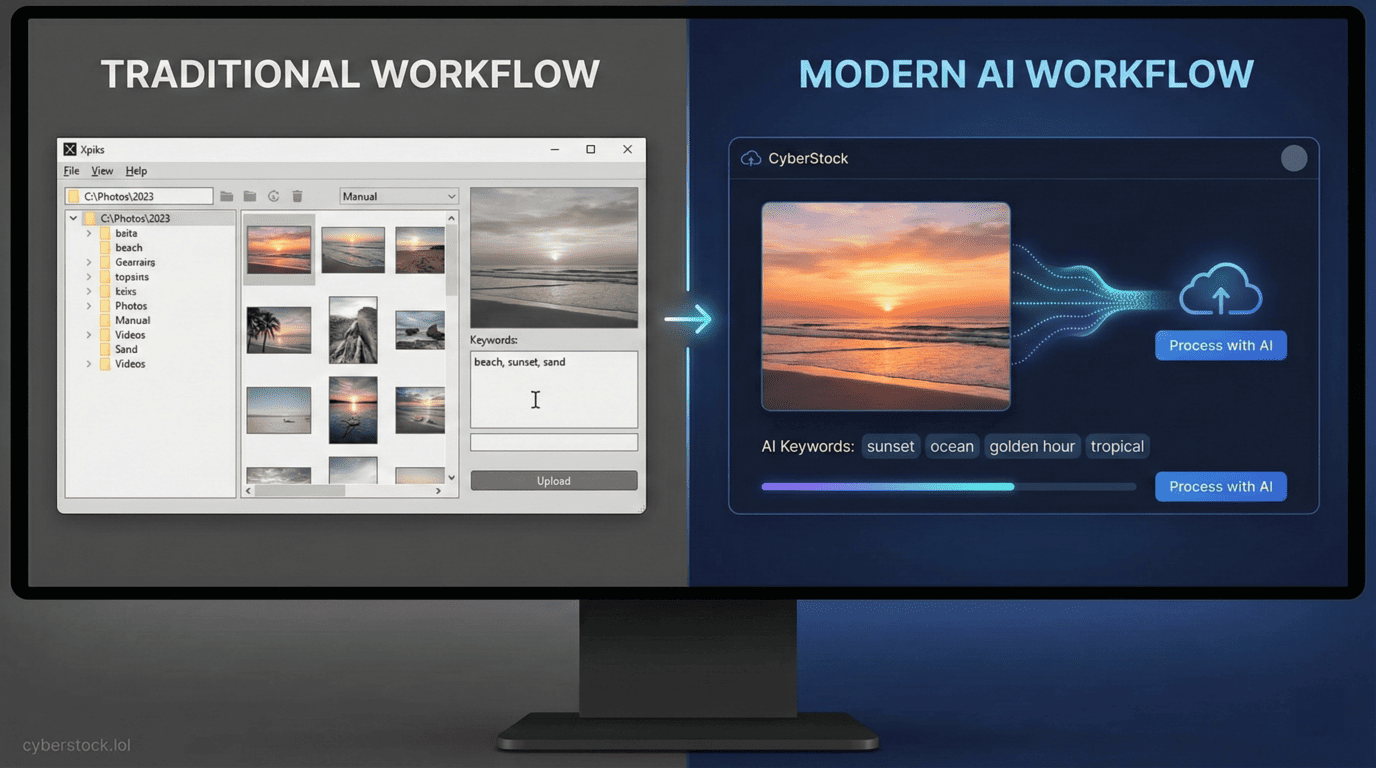
CyberStock addresses this directly. Its keyword generation is trained on 50 million real buyer searches from Adobe Stock, Shutterstock, and other agencies, which means the keywords it generates are already calibrated to what buyers on those platforms actually search. The output is sorted by commercial search frequency, so your top 10 positions contain your most commercially valuable terms. Platform compliance (Adobe's 45-keyword limit, UTF-8 BOM CSV) is handled automatically.
The practical implication: if you're debating which platform pays more, you're asking the right question at the wrong stage. Get your metadata right on both platforms first. Then the earnings comparison becomes meaningful.
The Answer: Upload to Both, Optimize Metadata for Each
Neither Adobe Stock nor Shutterstock requires exclusivity on standard content. The financially correct answer is to upload your portfolio to both, formatted correctly for each platform's requirements. Adobe Stock gets optimized keywords sorted for its ranking algorithm and properly structured CSV. Shutterstock gets its own export with the different column structure and no keyword cap.
If you can only manage one platform to start: begin with Adobe Stock. Higher floor per download, no annual reset, better for AI content, and its integration with the Creative Cloud buyer base means your content is accessible directly inside Photoshop and Illustrator — where buyers are actively searching while working, not just browsing a stock library.
Start keywording for both platforms simultaneously: cyberstock.lol — one batch, two compliant CSV exports.